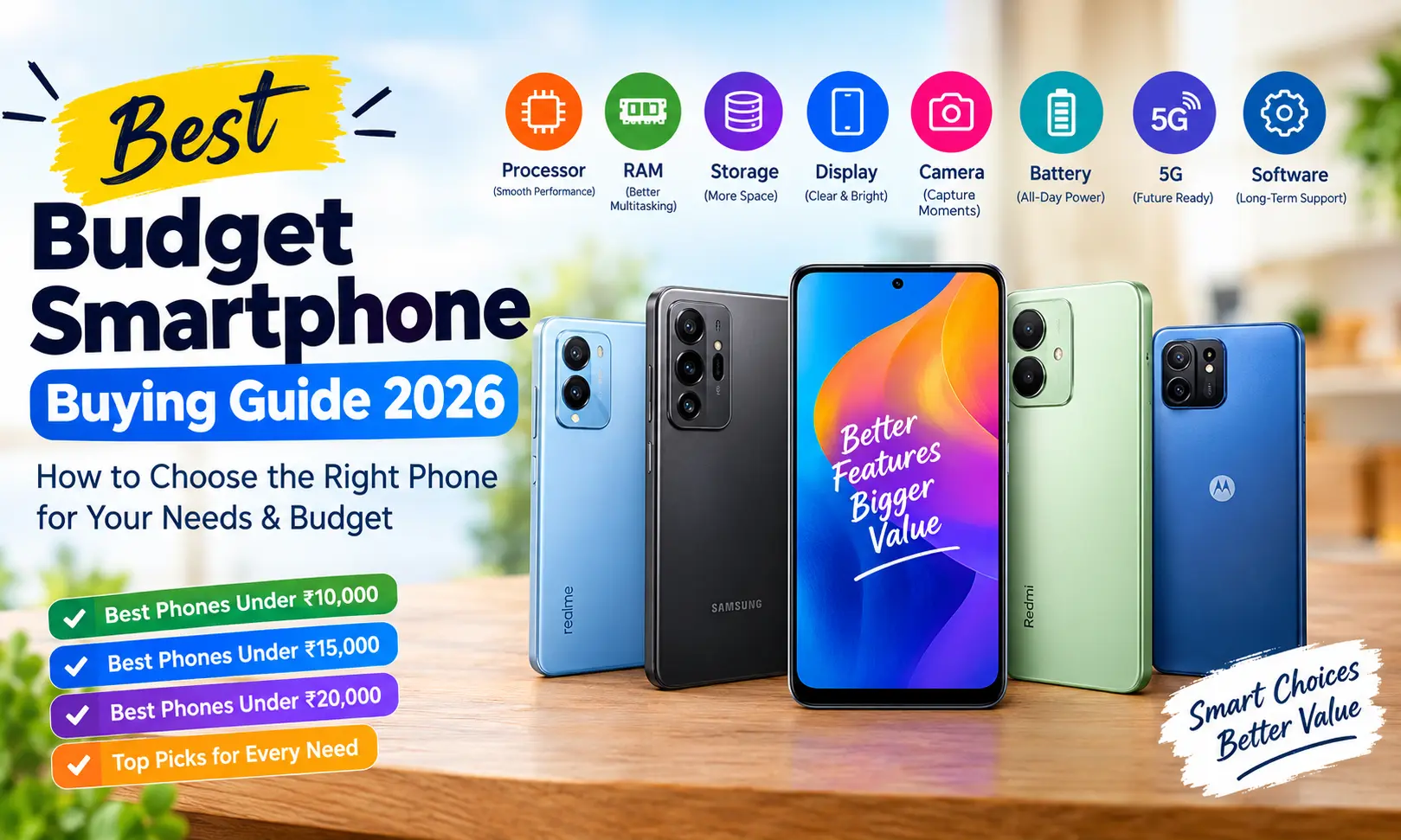
Buying a smartphone has become more complicated than ever. Every month, smartphone brands introduce new models with bigger batteries, faster processors, high-refresh-rate displays, multiple cameras, artificial intelligence features, 5G connectivity, and attractive designs. The good news is that you no longer need to spend a huge amount of money to get a capable smartphone.
Today, a budget smartphone can handle everyday tasks such as calling, WhatsApp, social media, online classes, YouTube, video streaming, photography, navigation, digital payments, and even casual gaming. However, not every affordable phone offers the same experience.
The biggest mistake buyers make is choosing a phone based only on one specification. A smartphone may advertise a 200MP camera, 12GB RAM, a 120Hz display, or a massive battery, but those numbers alone do not guarantee a great phone. Real-world performance depends on how the processor, software, display, camera sensors, battery, storage, and thermal management work together.
This detailed budget smartphone buying guide explains everything you should know before purchasing an affordable phone in 2026. Whether you are looking for a smartphone under ₹10,000, ₹15,000, ₹20,000, or another budget range, this guide will help you understand which features matter and where you can save money.
What Is a Budget Smartphone?
A budget smartphone is generally designed to deliver essential smartphone features at a lower price than premium and flagship devices. The exact definition of “budget” changes depending on the market and time, but in India, buyers commonly consider phones in the lower price segments to be budget devices.
Budget smartphones usually focus on value. Manufacturers try to provide a combination of:
- Good battery life
- Decent processor performance
- Large and responsive display
- Adequate RAM
- Sufficient storage
- 4G or 5G connectivity
- Useful cameras
- Modern Android software
- Fast charging
- Durable construction
- Competitive pricing
The important point is that a budget smartphone does not have to be a low-quality smartphone.
Technology has improved significantly, and features that were once reserved for expensive phones have gradually moved into affordable segments. High-refresh-rate screens, large batteries, 5G connectivity, fast charging, AI-powered software features, and capable camera systems can now be found in much more affordable devices.
At the same time, increasing component costs can affect smartphone pricing. Recent 2026 market reporting indicates that smartphone prices in India have risen significantly, particularly in lower price segments, making careful comparison even more important.
Why Choosing the Right Budget Smartphone Matters
A smartphone is no longer just a device for making calls. For many people, it is a camera, entertainment system, banking tool, navigation device, study device, work computer, gaming machine, and communication platform all in one.
That means a poor buying decision can become frustrating very quickly.
For example, a phone with a weak processor may feel acceptable on the first day but become frustrating when multiple applications are installed. A phone with insufficient storage can become difficult to use after a year. A low-quality display can make video consumption less enjoyable. Poor software support can reduce the useful life of the device.
Therefore, the best budget smartphone is not necessarily the phone with the lowest price.
The best budget smartphone is the phone that provides the best overall experience for your specific needs and budget.
How Much Should You Spend on a Budget Smartphone?
Before comparing phones, determine your maximum budget.
Instead of saying, “I want the cheapest smartphone,” decide what you actually need.
For example:
Entry-Level Budget
If you mainly need:
- Calling
- YouTube
- UPI payments
- Browsing
- Social media
- Basic photography
You may not need a powerful processor or expensive camera system.
Mid-Budget Smartphone
If you want:
- Better multitasking
- Better cameras
- Gaming
- 5G
- AMOLED display
- Faster charging
- More storage
You should consider moving toward the higher end of the budget segment.
Long-Term Smartphone
If you plan to keep your phone for three or four years, spending slightly more on the processor, storage, software support, display, and build quality can make sense.
The important principle is simple:
Do not spend more just for specifications. Spend more when the extra money improves your actual daily experience.
1. Processor: The Most Important Specification
The processor, also known as the chipset or SoC, is one of the most important components in a smartphone.
It affects:
- App loading
- Multitasking
- Gaming
- Camera processing
- Video recording
- AI features
- Battery efficiency
- System animations
- Overall responsiveness
A smartphone with a good processor can remain smooth for years, while a weak processor may struggle as applications become more demanding.
When comparing budget smartphones, don’t simply look at the processor’s brand. Check the actual chipset and compare its performance with competing models.
Modern budget and mid-range phones can use processors from companies such as Qualcomm Snapdragon, MediaTek Dimensity, Samsung Exynos, and other chipset manufacturers.
The generation of a processor matters too.
A newer processor can offer improvements in:
- Efficiency
- Graphics performance
- AI processing
- Connectivity
- Thermal management
- Camera processing
Therefore, don’t assume that a processor is better simply because it has a familiar brand name.
 Tips & Tricks
AD admin| Apr 07, 2026| 2 min read
ATM Card / Debit Card के लिए आवेदन कैसे करें?
2. RAM: How Much RAM Do You Need?
RAM helps the smartphone keep applications available in memory.
More RAM can be useful when you:
- Switch between multiple apps
- Use social media frequently
- Play games
- Edit photos or videos
- Keep many browser tabs open
- Use productivity applications
For a modern budget smartphone, a practical configuration should generally provide enough physical RAM for your expected usage.
However, don’t be fooled by virtual RAM marketing.
Some manufacturers advertise additional “virtual RAM” by using a portion of internal storage as temporary memory. This is not equivalent to having the same amount of physical RAM.
For example, a phone advertised as “8GB RAM + 8GB virtual RAM” does not provide the same experience as a phone with 16GB of physical RAM.
For most budget buyers, it is better to prioritize:
Good processor + sufficient physical RAM + fast storage
rather than choosing a phone simply because it has the biggest advertised RAM number.
3. Storage: 128GB Is a Better Starting Point
Storage is another feature that becomes increasingly important over time.
Modern applications are larger than they used to be. Photos and videos also consume considerable storage space.
If you frequently record:
- 4K video
- High-resolution photos
- Social media videos
- WhatsApp media
- Downloaded movies
- Games
your storage can fill up quickly.
For many buyers, 128GB should be considered a practical starting point, while 256GB can be preferable for users who store lots of media.
A current buying guide from Reliance Digital similarly recommends at least 128GB storage for many modern smartphone buyers.
Before purchasing, also check whether the phone supports a microSD card.
Expandable storage can be particularly useful in affordable smartphones.
4. Display: AMOLED vs LCD
You look at your smartphone display every day, so display quality should not be ignored.
Budget smartphones can use LCD, IPS LCD, AMOLED, or other display technologies.
AMOLED Display
AMOLED displays generally provide:
- Deep blacks
- Strong contrast
- Vibrant colors
- Excellent viewing experience
- Potential battery advantages in dark interfaces
LCD Display
LCD screens can still be perfectly suitable for budget users and can offer:
- Good brightness
- Natural colors
- Reliable performance
- Lower device cost
If you can get a good-quality AMOLED display within your budget without sacrificing processor or software quality, it can be a worthwhile upgrade.
But don’t automatically buy an AMOLED phone if the rest of the hardware is significantly weaker.
5. Refresh Rate: Is 90Hz or 120Hz Important?
Refresh rate determines how many times per second the screen can refresh.
Traditional displays often use 60Hz.
Higher-refresh-rate displays such as:
- 90Hz
- 120Hz
- 144Hz
can make scrolling and animations appear smoother.
For everyday smartphone usage, a 90Hz or 120Hz display can make the phone feel more responsive.
However, refresh rate should not be considered independently.
A 120Hz display paired with a weak processor may not deliver a consistently smooth experience.
A balanced combination of:
Good processor + optimized software + high-refresh-rate display
is much more important.
 Earning
AD admin| Apr 07, 2026| 1 min read
घर बैठकर ऑनलाइन जॉब कैसे करते हैं?
6. Display Brightness Matters More Than You Think
If you frequently use your phone outdoors, especially under strong sunlight, display brightness becomes extremely important.
A screen that looks beautiful indoors may become difficult to read outdoors if it cannot reach sufficient brightness.
Before buying a budget smartphone, check:
- Peak brightness
- Outdoor visibility
- Automatic brightness
- Viewing angles
- Color accuracy
- Screen protection
This is particularly important for people who use Google Maps, navigation, banking apps, messaging, or social media outside the home.
7. Camera: Don’t Choose a Phone Only by Megapixels
Camera marketing is one of the biggest traps in smartphone shopping.
A phone with a 200MP camera is not automatically better than a phone with a 50MP camera.
Image quality depends on several factors:
- Sensor size
- Sensor quality
- Lens quality
- Image processing
- Optical image stabilization
- Autofocus
- HDR processing
- Low-light performance
- Camera software
A well-optimized 50MP camera can produce better photos than a poorly implemented high-megapixel camera.
Therefore, don’t choose a smartphone simply because it has the highest megapixel number.
8. OIS Can Be More Useful Than Extra Megapixels
Optical Image Stabilization, commonly called OIS, can help reduce camera shake.
It can be especially useful for:
- Night photography
- Indoor photography
- Video recording
- Moving subjects
- Low-light situations
If photography is important to you, check whether the primary camera includes OIS.
This can be more meaningful than choosing a phone solely because another model has a higher megapixel count.
9. Don’t Ignore the Front Camera
Selfie cameras are important for:
- Video calls
- Online meetings
- Social media
- Selfies
- Content creation
Look beyond megapixels.
Check:
- Skin tone reproduction
- Dynamic range
- Video quality
- Stabilization
- Low-light performance
- Portrait mode
A lower-megapixel selfie camera can still produce excellent results if the sensor and processing are good.
 Tips & Tricks
AD admin| Apr 07, 2026| 1 min read
बाइक इंश्योरेंस क्या है? (Bike Insurance in Hindi) – संपूर्ण जानकारी
10. Battery Life: One of the Biggest Budget Smartphone Advantages
Battery life is one area where budget smartphones can perform extremely well.
Many affordable phones offer large batteries designed to provide all-day usage.
When comparing battery specifications, look beyond capacity.
A larger battery is useful, but efficiency also depends on:
- Processor efficiency
- Display technology
- Refresh rate
- Software optimization
- Network conditions
- User behavior
For example, a very large battery paired with an inefficient processor and bright display may not always outperform a slightly smaller battery paired with efficient hardware.
A well-balanced smartphone can provide excellent battery life without being extremely heavy.
11. Fast Charging Saves Time
Fast charging can be particularly useful for busy users.
Instead of keeping your phone connected to a charger for hours, fast charging can provide a significant amount of battery in a relatively short period.
When evaluating fast charging, check:
- Charging wattage
- Charger included in the box
- Supported charging standard
- Charging speed in real-world testing
- Battery health features
Do not choose a phone based solely on a large wattage number.
Thermal management and charging optimization also matter.
12. 5G Connectivity: Do You Really Need It?
5G has become increasingly common in budget and mid-range smartphones.
If your network provider offers 5G service in your area, buying a 5G smartphone can make sense if you intend to keep the device for several years.
However, don’t purchase a phone merely because the box says “5G.”
Check:
- Supported 5G bands
- Carrier compatibility
- Network coverage
- Dual-SIM functionality
- VoLTE/VoNR support where relevant
A smartphone needs appropriate network support to make practical use of 5G.
For Indian buyers, network compatibility should be checked against the bands used by their carrier.
13. Software Updates Are Extremely Important
One of the most overlooked smartphone features is software support.
A phone may have an excellent camera and processor, but if the manufacturer provides poor software support, the device may not remain attractive for long.
Software updates can provide:
- Security patches
- Android version upgrades
- Bug fixes
- New features
- Performance improvements
- Privacy improvements
Before buying, check the manufacturer’s official update policy.
If you plan to keep the smartphone for three or four years, update support becomes even more important.
A current India-focused buying guide emphasizes software support as one of the factors buyers should check alongside performance, battery, cameras, display, and storage.
 SEO – Search Engine Optimization
AD admin| Apr 07, 2026| 4 min read
Search Engine क्या है? (Complete Guide in Hindi)
14. Android Version and User Interface
The Android version matters, but the user interface is equally important.
Different manufacturers customize Android differently.
Some interfaces are:
- Clean
- Lightweight
- Simple
- Fast
Others include:
- Additional applications
- Extra features
- Custom tools
- Advertising
- Duplicate applications
Before purchasing, consider whether you like the manufacturer’s interface.
A clean and well-optimized interface can make a budget phone feel faster.
15. Bloatware: A Common Budget Smartphone Problem
Bloatware refers to unnecessary applications that come pre-installed on a phone.
Some pre-installed applications may be useful, but others may:
- Consume storage
- Send unnecessary notifications
- Use background resources
- Display promotional content
When reviewing a budget smartphone, check whether the software experience is clean.
A slightly less powerful phone with better software optimization can sometimes feel better in everyday use than a phone with impressive hardware but poorly optimized software.
16. Build Quality and Durability
A budget smartphone does not need a premium metal body to be durable.
What matters is how well the phone is constructed.
Check:
- Frame quality
- Back panel durability
- Screen protection
- Water and dust resistance
- Button quality
- Port quality
- Overall weight
If the phone has an IP rating, understand what that rating actually means.
Water resistance is not an excuse to intentionally expose your phone to water.
17. Protection and Repairability
Before buying a budget smartphone, check the availability and cost of:
- Replacement displays
- Batteries
- Back panels
- Charging ports
- Official accessories
A cheap phone can become expensive if a replacement display costs a large percentage of the original purchase price.
Also consider the manufacturer’s service network.
For buyers outside major cities, local service availability can be particularly important.
18. Speaker and Audio Quality
Speakers are often ignored during smartphone comparisons.
But many users use their phones for:
- YouTube
- Music
- Video calls
- Movies
- Reels
- Podcasts
- Gaming
A stereo speaker setup can provide a noticeably better experience than a single speaker.
Also check whether the smartphone includes:
- 3.5mm headphone jack
- Bluetooth audio support
- High-quality codecs
- Stereo speakers
If you use wired headphones regularly, the absence of a headphone jack may matter to you.
19. Gaming on a Budget Smartphone
Budget phones can handle casual gaming, but not every budget smartphone is designed for heavy gaming.
If gaming is important, prioritize:
- Processor
- GPU performance
- Cooling system
- Display refresh rate
- Touch sampling
- Battery capacity
- Charging speed
- Storage
Don’t buy a gaming phone simply because it has a 120Hz display.
The processor and thermal management are more important.
For casual games, an affordable chipset may be enough.
For demanding titles, you should consider a stronger mid-range processor.
Also remember that sustained performance matters more than short benchmark scores.
A phone that performs extremely well for ten minutes but becomes hot and throttles afterward may not provide a good gaming experience.
20. AI Features in Budget Smartphones
Artificial intelligence has become an important smartphone marketing feature.
Modern phones may offer AI tools for:
- Photo editing
- Object removal
- Text summarization
- Translation
- Voice transcription
- Search
- Writing assistance
- Image enhancement
However, AI features should not be the only reason to buy a smartphone.
Ask:
Will I actually use these features?
If the answer is no, prioritize processor performance, battery, display, camera quality, storage, and software support instead.
AI can be useful, but practical hardware still matters.
21. Best Budget Smartphone for Students
Students usually need a phone for:
- Online classes
- YouTube
- Google Meet
- Notes
- PDFs
- Browsing
- Social media
- Photography
- Music
For students, prioritize:
- Good battery life
- Comfortable display
- Reliable processor
- At least adequate storage
- Good speakers
- Stable software
- Strong connectivity
A huge camera system is usually less important than battery and performance.
22. Best Budget Smartphone for Office Workers
For work, look for:
- Reliable network connectivity
- Good microphone
- Good speakers
- Battery endurance
- Smooth multitasking
- Email support
- Office applications
- Video calling quality
- Secure software updates
If you regularly attend video meetings, don’t ignore the front camera and microphone quality.
23. Best Budget Smartphone for Photography
If photography is your top priority, look for:
- Good primary sensor
- OIS
- Reliable HDR
- Strong night mode
- Good autofocus
- Natural skin tones
- Consistent processing
Do not assume that more cameras mean a better camera system.
Sometimes a phone with two good cameras is better than a phone with four weak cameras.
24. Best Budget Smartphone for Battery Life
Battery-focused buyers should look at:
- Battery capacity
- Processor efficiency
- Display efficiency
- Charging speed
- Screen-on time
- Network efficiency
A phone with a large battery and efficient processor can be an excellent choice for people who spend long hours away from chargers.
25. Best Budget Smartphone for Social Media
Social-media users should prioritize:
- Display quality
- Camera quality
- Front camera
- Video recording
- Battery
- Storage
- Smooth performance
Instagram, YouTube, Snapchat, Facebook, and other applications can consume significant battery and storage over time.
Therefore, don’t buy a phone with very limited storage if social media is a major part of your daily usage.
26. What Specifications Should You Look For?
A simple budget smartphone checklist can make shopping much easier.
Processor
Choose the strongest reliable processor available within your budget.
RAM
Prioritize sufficient physical RAM rather than virtual RAM marketing.
Storage
128GB is a practical starting point for many buyers.
Display
Look for a good-quality panel with a high refresh rate if available.
Battery
Look for a battery that can comfortably last through your typical day.
Charging
Faster charging is useful, especially for heavy users.
Camera
Prioritize sensor quality, OIS, processing, and real-world image quality.
Software
Check the Android version and update policy.
Connectivity
Check 4G/5G bands, Wi-Fi, Bluetooth, GPS, and NFC if required.
Durability
Check build quality and water/dust resistance.
27. Common Mistakes to Avoid When Buying a Budget Smartphone
Mistake 1: Buying Based Only on Megapixels
A higher megapixel number does not automatically mean better photos.
Mistake 2: Buying Based Only on RAM
More RAM does not compensate for a weak processor or slow storage.
Mistake 3: Ignoring Software Updates
A phone should receive security updates for a reasonable period.
Mistake 4: Buying the Cheapest Phone Available
Saving money today can create frustration later.
Mistake 5: Ignoring Storage
Low storage can become a major problem within a year or two.
Mistake 6: Ignoring Display Brightness
A beautiful screen is less useful if it is difficult to see outdoors.
Mistake 7: Ignoring Network Compatibility
5G support is useful only if the device supports appropriate network bands.
Mistake 8: Choosing Too Many Cameras
Three or four cameras don’t necessarily mean better photography.
Mistake 9: Ignoring Service Availability
A phone should be easy to repair when something goes wrong.
Mistake 10: Buying Without Comparing Variants
The same phone may be available with different RAM and storage configurations.
Always compare the exact variant and its price.
28. How to Compare Two Budget Smartphones
Suppose you are comparing two phones.
Instead of asking:
“Which phone has better specifications?”
ask:
Which has the better processor?
Which has better software support?
Which has better battery life?
Which has the better display?
Which has better primary-camera quality?
Which offers more storage?
Which has better charging?
Which has better build quality?
Which has better service availability?
Which gives better value at the actual purchase price?
This approach provides a much more realistic comparison.
29. Don’t Forget the Actual Selling Price
Smartphone prices can change frequently because of:
- Bank offers
- Exchange discounts
- Festival sales
- Coupons
- Cashback
- Trade-in offers
- New product launches
Therefore, the launch price is not always the price you should consider.
A smartphone launched at ₹18,000 might later become more attractive if it regularly sells for ₹14,000.
On the other hand, a phone advertised at a low price may require paying extra for the charger, storage upgrade, or accessories.
Always calculate the total cost of ownership.
30. Should You Buy an Older Premium Phone Instead?
Sometimes an older premium smartphone can be tempting because it offers:
- Better cameras
- Better build quality
- Better processors
- Premium displays
However, there are risks.
An older phone may have:
- Shorter remaining software support
- Older battery
- Expensive replacement parts
- No current warranty
- Less efficient hardware
- Limited 5G support
A new budget smartphone can therefore be a better choice for buyers who value warranty, battery health, software support, and long-term reliability.
31. Online vs Offline Smartphone Buying
Both options have advantages.
Buying Online
Advantages include:
- More models
- Easy price comparison
- Online-exclusive discounts
- Bank offers
- Customer reviews
- Home delivery
Buying Offline
Advantages include:
- Hands-on testing
- Immediate purchase
- Physical inspection
- Local retailer support
- Easier comparison of display and size
If buying online, verify the seller, return policy, warranty, exact model number, and storage/RAM configuration.
If buying offline, compare the retailer’s price with current online pricing.
32. A Simple Budget Smartphone Buying Formula
If you don’t know what to prioritize, use this formula:
Processor + Software Support + Battery + Display + Storage + Camera + Build Quality
For most buyers, this is more useful than:
Megapixels + RAM + Refresh Rate + Marketing Features
The first formula focuses on the complete experience.
The second focuses mostly on headline specifications.
33. Future-Proofing Your Budget Smartphone
You cannot completely future-proof a smartphone, but you can make a smarter purchase.
Choose:
- A relatively modern processor
- Adequate RAM
- At least practical storage
- 5G if you need it
- Long software support
- Good battery
- Durable build
- Quality display
This can help the phone remain useful for longer.
If you plan to keep the phone for three or more years, avoid buying hardware that is already close to its minimum requirements.
34. Is a Budget Smartphone Good Enough in 2026?
Absolutely.
The affordable smartphone category has become much more competitive.
Today’s budget devices can provide:
- Large displays
- High refresh rates
- 5G
- Large batteries
- Fast charging
- Capable cameras
- Modern Android software
- Good processors
- AI features
Current 2026 listings show that even phones below ₹15,000 can offer features such as high-refresh-rate displays, large batteries, and useful durability features.
However, the key is selecting the right combination of specifications rather than buying based on one impressive number.
35. Budget Smartphone Buying Checklist
Before paying for your new smartphone, check the following:
Performance
- Processor
- GPU
- Physical RAM
- Storage type
Display
- Screen technology
- Refresh rate
- Brightness
- Resolution
- Screen protection
Camera
- Main sensor
- OIS
- Ultrawide camera
- Selfie camera
- Video recording
- Night mode
Battery
- Battery capacity
- Charging speed
- Charger included
- Battery optimization
Connectivity
- 4G/5G bands
- Wi-Fi
- Bluetooth
- GPS
- NFC if needed
- Dual-SIM support
Software
- Android version
- Security updates
- Major Android updates
- Bloatware
- User interface
Durability
- Build quality
- IP rating
- Screen protection
- Service availability
Value
- Current price
- Bank offers
- Exchange value
- Warranty
- Accessories
- Repair cost
36. Frequently Asked Questions About Budget Smartphones
Instead of looking for one universally “best” phone, choose the model that offers the strongest combination of performance, battery, display, camera, storage, software support, and price for your needs.
For many users, a sensible amount of physical RAM is enough for everyday applications and multitasking. Rather than chasing the largest number, prioritize the combination of RAM, processor, and storage speed.
5G is not mandatory for everyone. If your current network and location provide good 5G service and you plan to keep the phone for several years, 5G can be a useful feature.
AMOLED generally provides deeper blacks and stronger contrast, but a good LCD can still offer a very good experience. Don’t sacrifice processor, battery, or software support simply to get AMOLED.
A 120Hz display can make scrolling and animations feel smoother. It is a valuable feature, but the processor and software optimization must also be good.
Not necessarily. Image quality depends on the sensor, lens, processing, stabilization, and software. Megapixel count alone does not determine camera quality.
For many buyers, 128GB is a practical starting point. Heavy users who store lots of photos, videos, applications, and games may prefer 256GB.
Fast charging is useful because it reduces the amount of time you need to keep the phone connected to a charger. However, charging quality, battery health management, and thermal control also matter.
It depends. An older flagship may offer better hardware, but a new budget phone can provide a newer battery, warranty, current connectivity, and longer remaining software support.
With appropriate hardware and software support, a budget smartphone can remain useful for several years. Actual longevity depends on battery health, updates, storage, performance, and how heavily the device is used.
37. Final Verdict: How to Choose the Best Budget Smartphone
Choosing a budget smartphone does not have to be difficult.
The secret is to stop chasing individual specifications and start evaluating the complete smartphone experience.
Before buying, identify your most important needs.
If you are a student, battery life and display quality may matter most.
If you are a gamer, processor performance and cooling should be priorities.
If you love photography, focus on the camera sensor, OIS, image processing, and video capabilities.
If you are a professional, prioritize reliability, software support, battery life, connectivity, and multitasking.
If you want to keep the phone for several years, look for a capable processor, sufficient storage, strong battery life, durable construction, and a clear software-update policy.
A good budget smartphone should not simply be cheap. It should provide strong value for every rupee you spend.
The best approach is to compare smartphones based on real-world needs:
Performance + Display + Battery + Camera + Storage + Software + Durability + Price
rather than being distracted by marketing numbers.
In 2026, affordable smartphones are more capable than ever, but rising component costs and a crowded market make smart comparison increasingly important.
Ultimately, the perfect budget smartphone is different for every person. The right phone is the one that fits your budget, handles your everyday workload smoothly, gives you the features you actually use, and remains reliable long after the excitement of the purchase has disappeared.
Before you buy, compare the complete package—not just the specification sheet.
That is the real key to finding the best budget smartphone.
Quick Budget Smartphone Buying Summary
If you want the shortest possible checklist, remember these ten points:
- Choose the processor carefully.
- Don’t buy based only on megapixels.
- Prefer sufficient physical RAM over virtual RAM marketing.
- Consider 128GB or more storage for long-term use.
- Choose a good display with a high refresh rate when possible.
- Check outdoor brightness.
- Look for a large battery and reliable fast charging.
- Check 5G bands and network compatibility.
- Verify software-update support.
- Compare the actual selling price, warranty, and service network.
A smartphone that balances all ten factors will usually provide a better long-term experience than a phone that wins in only one specification.
Smart buying is not about buying the most expensive phone. It is about buying the right phone.
Leave a Reply