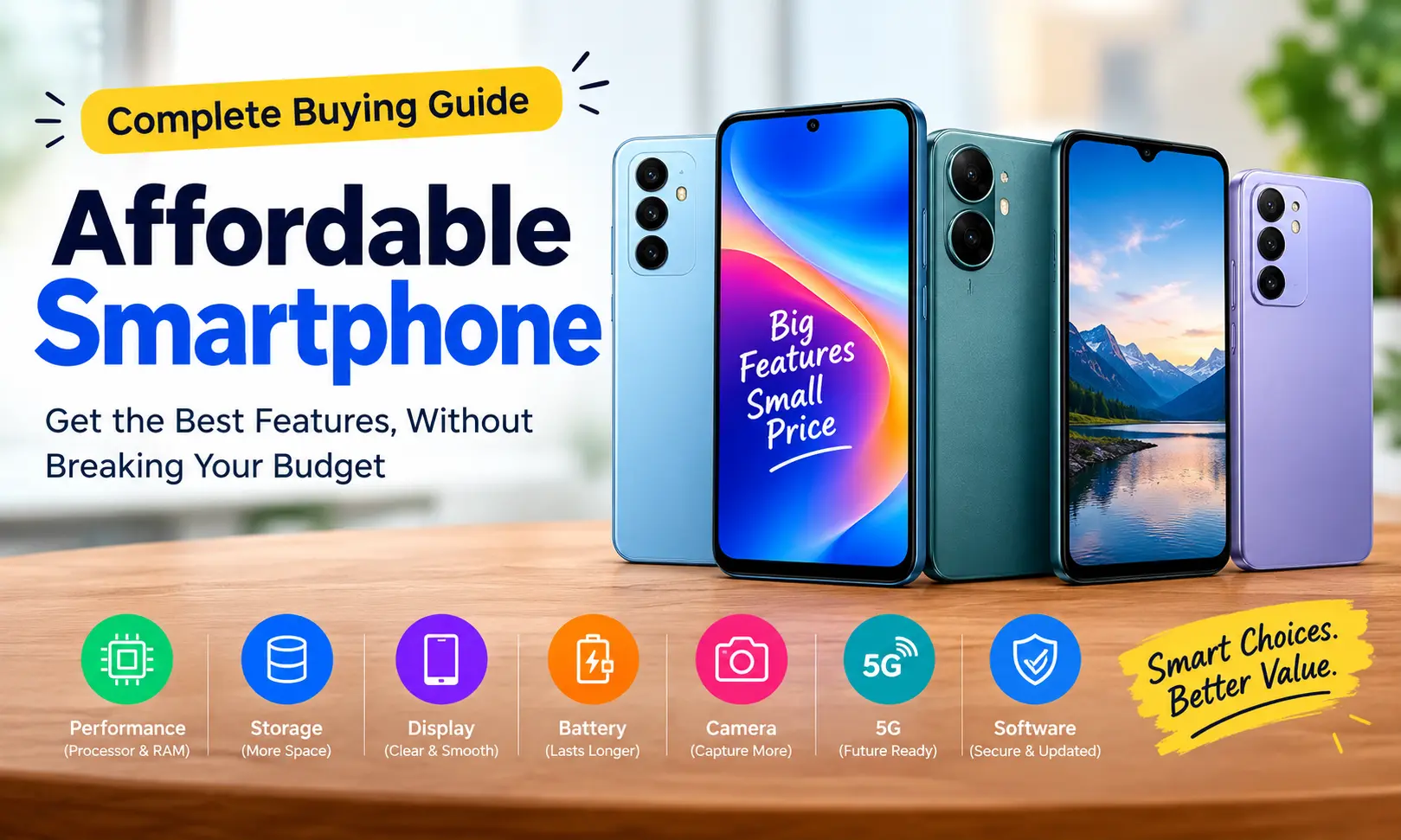
Finding the right affordable smartphone has become easier than ever, but choosing the best one can still be confusing. With hundreds of smartphones available across different price ranges, buyers have to compare processors, RAM, storage, cameras, displays, battery capacity, charging speed, software updates, 5G connectivity, and overall build quality.
The good news is that you do not always need to spend a huge amount of money to get a capable smartphone. Modern budget and affordable smartphones can handle everyday activities such as calling, messaging, social media, online classes, video streaming, photography, navigation, mobile payments, and even casual gaming.
The challenge is understanding which specifications actually matter and which specifications are mostly marketing numbers.
An affordable smartphone should not simply be the cheapest phone available. It should provide the right balance between price, performance, battery life, camera quality, display, software experience, durability, and long-term usability.
This comprehensive guide explains everything you need to know before buying an affordable smartphone. Whether you are a student, professional, senior citizen, traveler, content consumer, casual gamer, or someone purchasing a first smartphone, this guide can help you make a smarter decision.
What Is an Affordable Smartphone?
An affordable smartphone is a mobile device designed to provide useful modern smartphone features without the premium price associated with flagship devices.
The exact meaning of “affordable” depends on the buyer’s budget and location. In India, for example, many buyers consider smartphones below ₹10,000, ₹15,000, or ₹20,000 to be affordable depending on their requirements.
The important thing is not the exact price category. The important thing is the value you receive for your money.
A good affordable smartphone should ideally provide:
- Reliable everyday performance
- Good battery life
- A comfortable display
- Enough RAM and storage
- A capable processor
- A useful camera system
- Modern connectivity
- A dependable software experience
- Good build quality
- Security and software updates
- Reasonable long-term durability
Budget smartphones have improved dramatically over the years. Features that were once restricted to expensive phones, such as high-refresh-rate displays, large batteries, multi-camera systems, 5G connectivity, fast charging, and advanced software features, are now available in many affordable devices.
However, every phone involves compromises. One model may prioritize battery life, another may offer better cameras, while another may focus on performance.
Therefore, the best affordable smartphone is not necessarily the phone with the most specifications. It is the phone that best matches your personal needs.
Why Choose an Affordable Smartphone?
There are several reasons why an affordable smartphone can be a smart purchase.
1. Save Money
The most obvious advantage is cost.
If you mainly use your phone for calls, WhatsApp, browsing, YouTube, social media, online payments, navigation, and photography, spending a very large amount on a flagship device may not be necessary.
A well-selected affordable smartphone can perform these tasks comfortably while leaving more money available for other priorities.
2. Better Value for Everyday Users
Most people do not use every premium feature offered by expensive smartphones.
For example, you may not need an advanced telephoto camera, extremely powerful gaming hardware, or a premium glass-and-metal construction.
If your smartphone usage is primarily focused on communication, entertainment, productivity, and basic photography, an affordable phone may offer excellent value.
3. Modern Features at Lower Prices
The affordable smartphone market has become highly competitive.
Many modern budget phones can offer features such as:
- Large displays
- High refresh rates
- 5G connectivity
- Large batteries
- Fast charging
- Multiple cameras
- Fingerprint sensors
- Face unlock
- USB connectivity
- Dual SIM support
- Expandable storage on selected models
This means buyers can often get a surprisingly capable smartphone without paying flagship prices.
4. Excellent Choice for Students
Students frequently need smartphones for:
- Online classes
- Research
- Messaging
- Video calls
- Educational applications
- Social media
- Entertainment
- Digital payments
An affordable smartphone can handle these requirements without putting unnecessary pressure on a student’s budget.
5. Ideal as a Secondary Phone
Some users need a second phone for work, travel, business, testing applications, or separating personal and professional communication.
An affordable smartphone can be an excellent secondary device.
 Meditation
AD admin| Apr 07, 2026| 1 min read
भारत में प्रमुख विपश्यना केंद्र | Vipassana Meditation Centres in India (Complete Guide)
How Much Should You Spend on an Affordable Smartphone?
There is no universal answer.
Instead of deciding your budget based only on what other people are buying, start with your requirements.
Ask yourself:
What do I use my smartphone for every day?
If your requirements are limited to calls, messaging, browsing, and social media, you may not need a powerful processor or expensive camera system.
If you regularly edit videos, play demanding games, use multiple applications simultaneously, or capture high-quality photos, you may benefit from moving into a higher price segment.
A simple approach is:
Entry-Level Affordable Smartphone
Best for:
- Calling
- Messaging
- Basic browsing
- YouTube
- Social media
- Online payments
- Light applications
Mid-Range Affordable Smartphone
Best for:
- Multitasking
- Better photography
- Gaming
- Streaming
- Productivity
- Long-term use
- 5G connectivity
Upper Mid-Range Smartphone
Best for:
- Heavy gaming
- Advanced photography
- Video recording
- Content creation
- Intensive multitasking
- Premium display experiences
The key principle is simple:
Buy according to your usage, not according to specifications alone.
Processor: One of the Most Important Smartphone Features
The processor is one of the most important components in a smartphone.
It affects how quickly applications open, how smoothly the interface operates, how well games perform, and how efficiently the phone manages power.
When choosing an affordable smartphone, do not look only at the number of processor cores.
Instead, consider:
- Processor generation
- Manufacturing process
- CPU performance
- GPU performance
- Power efficiency
- Real-world reviews
- Software optimization
A newer, efficient processor can sometimes provide a better overall experience than an older processor with impressive-looking specifications.
Why Processor Efficiency Matters
Performance and battery life are closely connected.
A power-efficient processor can help a smartphone perform everyday tasks while consuming less energy.
This is particularly important if you want a phone that can comfortably last through a full day.
For users who play games, processor and GPU performance become even more important.
Casual games can run on relatively affordable hardware, but demanding 3D games require stronger graphics performance.
Therefore, gamers should prioritize the processor over features that they may rarely use.
How Much RAM Does an Affordable Smartphone Need?
RAM helps a smartphone manage applications and multitasking.
If you frequently switch between applications, having sufficient RAM can contribute to a smoother experience.
For basic smartphone usage, a modest amount of RAM can be sufficient.
Users who regularly multitask may prefer higher memory configurations.
However, more RAM does not automatically mean a better smartphone.
Software optimization, processor performance, storage technology, and memory management also matter.
Instead of buying a phone simply because it advertises a large RAM number, look at the entire hardware and software package.
 Loan
Loan
AD admin| Apr 07, 2026| 1 min read
मोबाइल से लोन कैसे ले?
Storage: Choose Enough for Your Lifestyle
Storage determines how many applications, photographs, videos, documents, games, and other files your smartphone can hold.
If you frequently take photographs and record videos, storage can fill surprisingly quickly.
Before purchasing an affordable smartphone, consider:
- Internal storage capacity
- Expandable storage availability
- Cloud storage options
- Video recording habits
- Number of applications you use
A phone with insufficient storage can become frustrating over time.
You may constantly receive warnings that storage is almost full, forcing you to delete photographs, videos, or applications.
Therefore, if you plan to keep your phone for several years, choosing sufficient storage from the beginning is often worthwhile.
Display Quality Matters More Than You Think
The display is the part of the smartphone you interact with constantly.
You use it for:
- Reading
- Watching videos
- Browsing websites
- Playing games
- Viewing photographs
- Messaging
- Working
- Social media
Therefore, display quality should be an important part of your purchasing decision.
Display Size
A larger screen is useful for:
- Movies
- YouTube
- Gaming
- Reading
- Multitasking
However, larger phones can also be harder to use with one hand.
A compact smartphone may be preferable for people who value portability.
Refresh Rate
The refresh rate determines how frequently the display updates the image.
Higher refresh rates can make scrolling and animations feel smoother.
For everyday users, a smooth display can make the phone feel more responsive.
However, refresh rate should not be considered in isolation.
A good display should also provide:
- Adequate brightness
- Good viewing angles
- Natural colors
- Comfortable readability
- Suitable resolution
AMOLED vs LCD on an Affordable Smartphone
Display technology can make a noticeable difference.
AMOLED displays generally provide deeper blacks and strong contrast because individual pixels can be controlled differently from traditional LCD panels.
LCD displays can still provide a good experience, particularly when the panel is bright and well calibrated.
If you frequently watch movies or use dark-mode applications, an AMOLED display can be particularly attractive.
However, do not automatically reject an LCD smartphone. Consider the entire device and its price.
Battery Life: A Major Priority for Budget Buyers
Battery life is one of the most important factors when purchasing an affordable smartphone.
Nobody wants to constantly search for a charger.
Many affordable phones now use large-capacity batteries, with 5,000mAh being common in many segments. Large battery capacity can provide strong endurance, although actual battery life also depends on the processor, display, software optimization, network conditions, brightness, and usage patterns.
A good battery smartphone should ideally handle your typical day without requiring repeated charging.
What Affects Battery Life?
Several factors influence battery consumption:
- Screen brightness
- Display refresh rate
- Processor efficiency
- 5G usage
- Gaming
- Video streaming
- GPS
- Background applications
- Mobile network strength
- Camera usage
Two smartphones with identical battery capacities may therefore provide different real-world battery life.
Fast Charging on an Affordable Smartphone
Fast charging is another useful feature.
If you frequently forget to charge your phone overnight, fast charging can provide extra convenience.
For example, being able to quickly add a meaningful amount of battery before leaving home can reduce charging anxiety.
However, charging speed should not be the only deciding factor.
A smartphone with excellent charging speed but poor battery endurance may not be as useful as a phone with efficient power management and slightly slower charging.
Meditation
AD admin| Apr 07, 2026| 1 min read
भारत में प्रमुख विपश्यना केंद्र | Vipassana Meditation Centres in India (Complete Guide)
Camera Quality: Don’t Be Fooled by Megapixels
Camera specifications can be confusing.
You may see smartphones advertising 50MP, 64MP, 108MP, or even higher-resolution cameras.
But megapixels are only one part of camera quality.
A good smartphone camera depends on:
- Sensor quality
- Image processing
- Lens quality
- Software
- HDR performance
- Low-light processing
- Stabilization
- Autofocus
- Video capabilities
A well-optimized lower-resolution camera can sometimes produce better photographs than a high-megapixel camera with poor processing.
Therefore, never choose a smartphone solely because it has the largest megapixel number.
What Camera Should You Look For?
For most users, a good primary camera is more important than having many additional cameras.
A useful camera system might include:
Main Camera
This is generally the most important camera for everyday photography.
Ultra-Wide Camera
Useful for:
- Landscapes
- Group photographs
- Architecture
- Travel photography
Macro Camera
Macro cameras can be useful for close-up subjects, although their usefulness varies considerably between devices.
Front Camera
The selfie camera is important for:
- Video calls
- Selfies
- Social media
- Online meetings
When comparing phones, look at actual camera samples and reviews instead of relying only on specifications.
Affordable Smartphone for Photography
If photography is your main priority, consider image quality rather than camera quantity.
A good affordable camera phone should ideally provide:
- Natural colors
- Good dynamic range
- Reliable autofocus
- Good daylight performance
- Acceptable low-light results
- Stable video
- Good selfie quality
Software processing is particularly important.
Modern smartphone photography relies heavily on computational photography, where software improves exposure, color, HDR, noise reduction, and detail.
5G Connectivity: Is It Necessary?
5G has become an important consideration for smartphone buyers.
If 5G networks are available in your area and you plan to keep your phone for several years, choosing a 5G-compatible smartphone can provide additional future flexibility.
However, do not buy a phone solely because it has “5G” written on the box.
Check:
- Supported 5G bands
- Network compatibility
- Carrier support
- Regional availability
- Actual performance
Network availability and real-world speeds can vary depending on location, network provider, signal conditions, and other factors.
Software Experience Is Extremely Important
Hardware gets most of the attention, but software determines how your phone feels every day.
A smartphone with excellent hardware can still be frustrating if its software is poorly optimized.
Look for:
- Smooth interface
- Useful features
- Minimal unnecessary applications
- Regular security updates
- Operating system updates
- Reliable app compatibility
- Good privacy controls
Software updates can also help extend the useful life of a smartphone.
If you plan to keep your affordable smartphone for several years, software support should be one of your buying criteria.
 Meditation
AD admin| Apr 07, 2026| 1 min read
आंतरिक शांति और आनंद का अनुभव कैसे करें?
Security Updates and Long-Term Support
Smartphone security is not something to ignore.
Your phone may contain:
- Personal photographs
- Banking applications
- Payment information
- Emails
- Private messages
- Documents
- Password managers
- Social media accounts
Security updates help protect devices against newly discovered vulnerabilities.
Therefore, when buying a smartphone, investigate how long the manufacturer intends to provide software and security updates.
Longer support can make a slightly more expensive smartphone a better long-term investment.
Affordable Smartphone for Gaming
Budget phones have become much better for gaming.
However, gaming performance depends heavily on the processor and GPU.
If you primarily play casual games, almost any modern smartphone with reasonable hardware should provide a satisfactory experience.
For demanding games, look for:
- Strong processor
- Capable GPU
- Adequate RAM
- Good thermal management
- High refresh-rate display
- Large battery
- Fast charging
Gaming also generates heat and consumes significant battery power.
Therefore, a phone designed for gaming should have more than just a powerful processor.
Affordable Smartphone for Students
Students often need a phone that can handle multiple responsibilities.
A student-friendly affordable smartphone should offer:
- Good battery life
- Reliable performance
- Clear display
- Good speakers
- Decent camera
- Stable Wi-Fi and mobile connectivity
- Enough storage
- Long software support
Battery life is particularly important because students may spend hours attending online classes, watching educational videos, researching topics, and communicating with classmates.
A large display can also make reading documents and watching lectures more comfortable.
Affordable Smartphone for Business Users
Business users often prioritize reliability over flashy specifications.
Important features include:
- Strong battery life
- Reliable connectivity
- Good microphone quality
- Clear display
- Smooth multitasking
- Secure software
- Good call quality
- Sufficient storage
If you use your phone for email, video conferencing, messaging applications, document editing, navigation, and payments, a balanced mid-range smartphone may be more useful than a gaming-focused device.
Affordable Smartphone for Seniors
Older users may prioritize simplicity and reliability.
A suitable phone should ideally offer:
- Bright display
- Clear text
- Loud speakers
- Easy interface
- Good battery life
- Reliable calling
- Simple settings
- Strong durability
The most expensive smartphone is not necessarily the easiest smartphone to use.
A straightforward user interface can be more valuable than advanced features that are rarely used.
Build Quality and Durability
Affordable does not have to mean fragile.
Before purchasing a phone, consider its:
- Frame construction
- Screen protection
- Water resistance
- Dust resistance
- Back panel durability
- Case availability
A protective case and screen protector can significantly reduce the risk of damage from everyday accidents.
If you frequently travel or work outdoors, durability should receive greater priority.
Audio and Speaker Quality
Speakers are often overlooked.
However, your smartphone may be your primary entertainment device.
Good speakers are useful for:
- YouTube
- Music
- Podcasts
- Video calls
- Movies
- Notifications
If audio quality matters to you, listen to the phone in person or check reliable reviews before purchasing.
Connectivity and Ports
Before buying an affordable smartphone, check the connectivity options.
Depending on your needs, you may want:
- 5G
- 4G LTE
- Wi-Fi
- Bluetooth
- NFC
- USB-C
- Dual SIM
- GPS
NFC can be particularly useful for supported contactless payments and accessories.
USB-C is also increasingly common and convenient because many modern devices use the same connector.
Should You Buy a Cheap Smartphone or a Slightly More Expensive One?
This is an important question.
The cheapest phone may save money initially, but it may not always provide the best long-term value.
Suppose one smartphone is significantly cheaper but has:
- Less storage
- A weaker processor
- Poorer cameras
- Shorter software support
- Lower-quality display
A slightly more expensive model could potentially remain useful for longer.
Therefore, instead of asking:
“What is the cheapest smartphone?”
ask:
“What is the best smartphone I can afford?”
That change in thinking can help you make a much better purchase.
Common Mistakes When Buying an Affordable Smartphone
Mistake 1: Buying Based Only on Price
Cheap does not automatically mean good value.
Always compare specifications, reviews, software support, and durability.
Mistake 2: Choosing the Highest Megapixel Camera
More megapixels do not guarantee better photographs.
Look at sensor quality and image processing.
Mistake 3: Ignoring Software Updates
A phone that receives reliable updates may provide better long-term value.
Mistake 4: Buying Too Little Storage
Applications, photographs, videos, and system files can consume storage quickly.
Mistake 5: Ignoring Processor Performance
A phone may look attractive but feel slow if its processor is inadequate.
Mistake 6: Focusing Only on 5G
5G is useful, but the complete smartphone experience matters more.
Mistake 7: Ignoring Battery Efficiency
A large battery is helpful, but processor and software efficiency are also important.
Mistake 8: Buying Without Checking Reviews
Specifications cannot tell you everything.
Real-world reviews can reveal:
- Heating
- Battery performance
- Camera quality
- Software problems
- Speaker quality
- Network performance
- Gaming performance
How to Compare Two Affordable Smartphones
When comparing two phones, create a simple checklist.
| Feature | Phone A | Phone B |
|---|---|---|
| Price | Check | Check |
| Processor | Compare | Compare |
| RAM | Compare | Compare |
| Storage | Compare | Compare |
| Display | Compare | Compare |
| Battery | Compare | Compare |
| Charging | Compare | Compare |
| Main Camera | Compare | Compare |
| Selfie Camera | Compare | Compare |
| 5G | Check | Check |
| Software Support | Check | Check |
| Build Quality | Check | Check |
| Warranty | Check | Check |
Do not simply count which phone has more features.
Instead, identify which phone performs better in the categories that matter most to you.
Best Affordable Smartphone Buying Strategy
Here is a simple process you can follow.
Step 1: Set Your Maximum Budget
Decide how much you can comfortably spend.
Step 2: Identify Your Main Usage
Are you buying the phone for:
- Gaming?
- Photography?
- Business?
- Study?
- Social media?
- Entertainment?
- General use?
Step 3: Choose Your Priorities
Select your top three requirements.
For example:
Battery + Camera + Display
or
Performance + Gaming + Cooling
Step 4: Shortlist Several Phones
Do not immediately buy the first phone you find.
Compare several alternatives.
Step 5: Check Reviews
Look for real-world testing rather than relying exclusively on advertisements.
Step 6: Check Software Support
Find out how long the manufacturer provides updates.
Step 7: Compare Final Prices
Consider discounts, bank offers, exchange programs, and seasonal sales where applicable.
Step 8: Consider Long-Term Value
Ask yourself whether the phone will still meet your needs two or three years from now.
How to Make Your Affordable Smartphone Last Longer
Buying a good phone is only half the process.
Taking care of it can extend its useful life.
Use a Protective Case
A good case can protect the device from drops and scratches.
Use Screen Protection
A quality screen protector can help reduce damage from everyday accidents.
Keep Software Updated
Install official operating system and security updates when available.
Avoid Untrusted Applications
Download applications from trusted sources and avoid suspicious software.
Manage Storage
Keep sufficient free storage to maintain a comfortable experience.
Protect the Battery
Avoid exposing the phone to extreme temperatures.
Clean the Device
Keep charging ports, speakers, and other openings clean and free from dust.
Is an Affordable Smartphone Good for Long-Term Use?
Yes, provided you choose carefully.
Long-term usability depends on several factors.
A smartphone is more likely to remain useful if it has:
- Efficient processor
- Enough RAM
- Adequate storage
- Good battery
- Reliable software
- Regular security updates
- Durable construction
A phone that is slightly more expensive but significantly better balanced can sometimes offer better long-term value.
Current smartphone buying guides increasingly emphasize not just specifications but software support, battery efficiency, display quality, connectivity, and overall reliability when evaluating affordable devices.
Affordable Smartphone vs Flagship Smartphone
Flagship smartphones generally offer:
- More powerful processors
- Advanced camera systems
- Premium materials
- Better displays
- More advanced features
- Faster performance
Affordable smartphones generally focus on:
- Value
- Essential features
- Battery life
- Practical performance
- Lower purchase price
The question is not whether a flagship phone is better.
Of course, premium devices often offer more advanced hardware.
The better question is:
Do you need those premium features?
If you do not, an affordable smartphone can provide a much better value-to-price ratio.
What Makes an Affordable Smartphone “Best”?
There is no single best smartphone for everyone.
The best affordable smartphone is the one that matches your needs.
For example:
Best for Battery Life
Prioritize battery capacity, processor efficiency, display efficiency, and charging.
Best for Gaming
Prioritize processor, GPU, RAM, cooling, display refresh rate, and battery.
Best for Photography
Prioritize camera sensors, image processing, stabilization, and video quality.
Best for Students
Prioritize battery, display, storage, software reliability, and affordability.
Best for Business
Prioritize reliability, security, multitasking, connectivity, and battery life.
Best for Entertainment
Prioritize display quality, speakers, battery, and storage.
Frequently Asked Questions About Affordable Smartphones
The best affordable smartphone depends on your budget and requirements. Instead of selecting a phone solely based on price, compare processor performance, battery life, display, cameras, storage, software support, and connectivity.
Yes. Modern affordable smartphones can provide excellent everyday performance without the cost of flagship devices.
The appropriate amount depends on your usage. Basic users can work comfortably with less memory, while multitaskers and gamers may benefit from higher RAM configurations.
5G can be useful if compatible networks are available in your area and you want a phone that remains relevant for several years. However, network support and band compatibility should be checked before purchasing.
A 5,000mAh battery can provide strong battery capacity, but actual battery life depends on the processor, display, software, network, and usage pattern.
Some affordable smartphones can handle casual gaming very well. For demanding games, choose a phone with a stronger processor, capable GPU, sufficient RAM, good thermal management, and a suitable display.
Megapixels matter, but they are not the only measure of camera quality. Sensor size, image processing, stabilization, lenses, and software are also important.
Choose enough storage for your applications, photographs, videos, games, and documents. If you frequently record videos or take many photos, more storage can be especially useful.
Online shopping can provide access to a large selection and discounts, but always purchase from reputable sellers and verify warranty and return policies.
A well-selected smartphone can remain useful for several years. Its lifespan depends on hardware, battery health, software support, usage patterns, and physical care.
Final Thoughts: Choosing the Right Affordable Smartphone
Buying an affordable smartphone does not mean accepting a poor smartphone experience.
The smartphone market has become highly competitive, and buyers can now find devices with strong batteries, capable processors, attractive displays, good cameras, modern connectivity, and useful software features at considerably lower prices than flagship phones.
The key is to avoid getting distracted by individual specifications.
A smartphone with a huge megapixel number is not automatically the best camera phone. A phone with more RAM is not automatically faster. A larger battery does not automatically guarantee longer battery life. And a phone with 5G is not automatically better than every 4G alternative.
The best buying decision comes from evaluating the complete package.
Before purchasing your next affordable smartphone, consider these priorities:
- Set a realistic budget.
- Identify how you use your phone.
- Choose a suitable processor.
- Select enough RAM and storage.
- Look for a quality display.
- Prioritize reliable battery life.
- Evaluate camera quality beyond megapixels.
- Consider 5G and network compatibility.
- Check software and security support.
- Consider durability and long-term value.
Most importantly, remember that the perfect smartphone is different for every person.
A student may need excellent battery life and a large display. A gamer may prioritize processor performance and cooling. A photographer may care more about image processing and stabilization. A business user may value security and multitasking. A casual user may simply want a reliable phone that lasts all day.
That is why the smartest way to choose an affordable smartphone is not to ask, “Which phone has the most features?”
Instead, ask:
“Which smartphone gives me the features I actually need at a price I can comfortably afford?”
Once you answer that question, finding the right affordable smartphone becomes much easier.
Quick Affordable Smartphone Checklist
Before completing your purchase, make sure you have checked:
- Price
- Processor
- RAM
- Storage
- Display
- Battery
- Charging speed
- Main camera
- Selfie camera
- 5G support
- Software updates
- Security updates
- Build quality
- Warranty
- Reviews
- Long-term value
A carefully selected affordable smartphone can deliver years of communication, entertainment, productivity, photography, learning, and connectivity without requiring you to spend a fortune. The goal is not simply to buy a cheaper phone—it is to find a smartphone that delivers the best possible value for your individual needs.
Leave a Reply