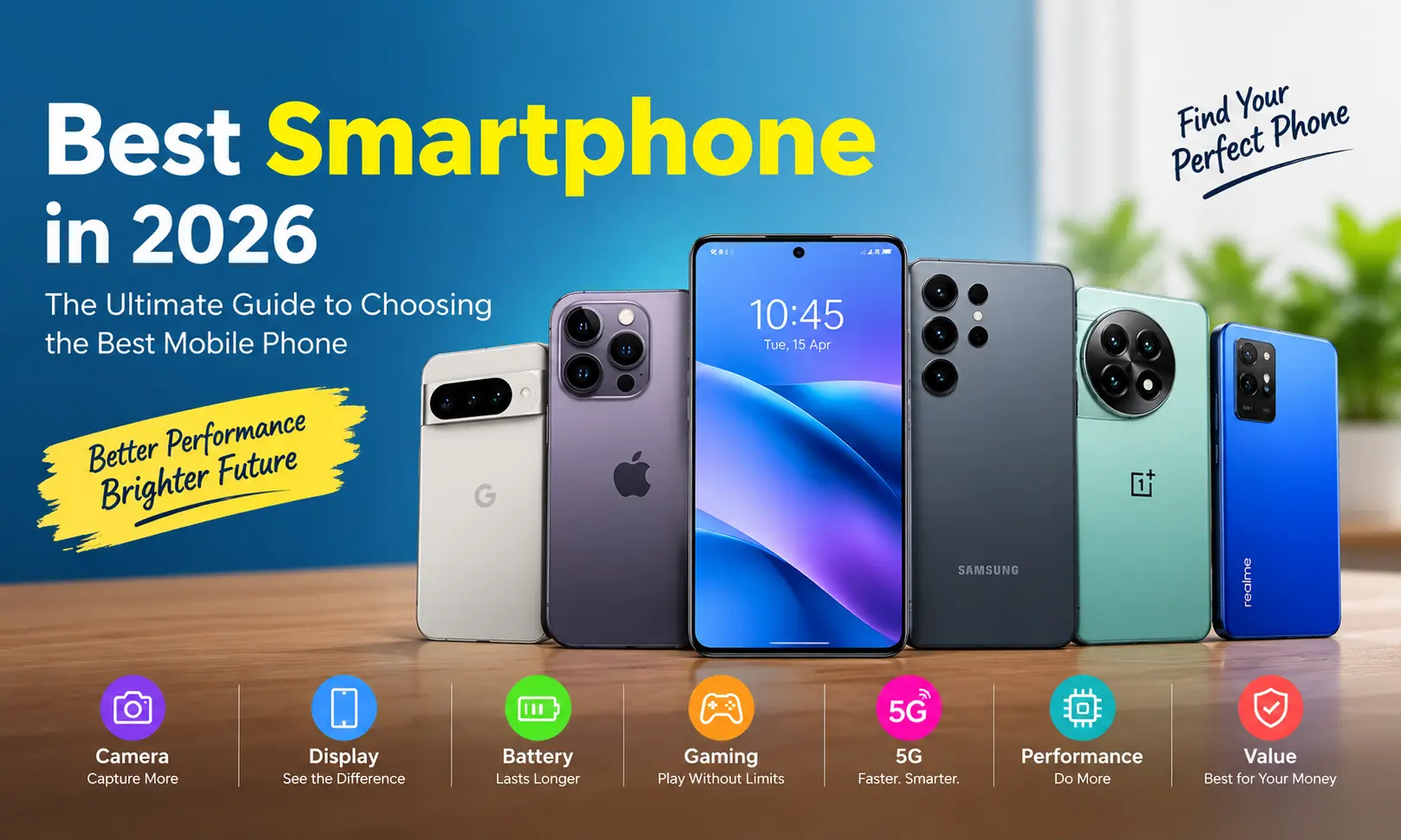
Buying the best smartphone is no longer as simple as choosing the phone with the highest megapixel camera, the biggest battery, or the fastest processor. The smartphone market has become highly competitive, with hundreds of models available across budget, mid-range, premium, flagship, gaming, camera, and foldable categories.
A modern smartphone can be a camera, gaming console, entertainment center, office workstation, navigation device, payment tool, communication hub, and personal assistant all in one. Because of this, the best smartphone for one person may not be the best choice for another.
For example, a mobile gamer may care most about processor performance, cooling, display refresh rate, and battery capacity. A photography enthusiast may prioritize camera sensors, optical image stabilization, telephoto capability, and image processing. A business user may care more about software support, security, productivity features, battery life, and reliability.
This comprehensive guide explains how to choose the best smartphone in 2026, what specifications actually matter, which features you should prioritize, what mistakes to avoid, and how to select a phone according to your budget and lifestyle.
What Is the Best Smartphone?
The best smartphone is not necessarily the most expensive phone available. Instead, it is the device that provides the right combination of performance, camera quality, display, battery life, software, durability, connectivity, and long-term value for your particular needs.
In 2026, flagship smartphones can offer extremely powerful processors, advanced AI capabilities, high-quality OLED displays, sophisticated multi-camera systems, fast charging, and extended software support. However, mid-range smartphones have also become increasingly capable.
Current smartphone guides show strong options across multiple price segments, with premium phones competing on cameras and performance while mid-range models increasingly focus on battery life, displays, and value.
Therefore, before searching for the best smartphone, you should first answer a simple question:
What do you actually need your smartphone to do?
Best Smartphone at a Glance
Here is a simple way to think about the major smartphone categories:
| Category | What to Prioritize |
|---|---|
| Best Overall Smartphone | Balanced performance, camera, display, battery and software |
| Best Android Smartphone | Performance, cameras, display, software support |
| Best iPhone | Performance, video, ecosystem and long-term support |
| Best Camera Phone | Main sensor, telephoto, OIS, image processing |
| Best Gaming Phone | Processor, GPU, cooling, display and battery |
| Best Battery Phone | Battery capacity, efficiency and charging |
| Best Budget Smartphone | Value, battery, performance and software |
| Best Mid-Range Phone | Balanced specifications and long-term value |
| Best Premium Phone | Cameras, display, performance, materials and software |
| Best Foldable Phone | Hinge, displays, durability, multitasking and software |
There is no single winner for every category. The right choice depends on your priorities.
1. Best Smartphone for Overall Performance
Performance is one of the most important factors when buying a smartphone.
A fast phone should open applications quickly, switch between apps smoothly, handle demanding games, process photos efficiently, record high-resolution video, and remain responsive after years of use.
The processor, or SoC, controls much of this experience. Modern smartphone processors also handle artificial intelligence, image processing, graphics, connectivity, security, and power management.
When comparing processors, do not focus only on benchmark numbers.
A processor that scores highly in a short benchmark may not maintain the same performance during long gaming sessions if the phone has poor thermal management.
What makes a smartphone fast?
Important factors include:
- Processor generation
- CPU performance
- GPU performance
- RAM
- Storage speed
- Thermal management
- Software optimization
- Display refresh rate
- Battery management
For most everyday users, a modern mid-range processor is already fast enough for social media, streaming, photography, browsing, office applications, video calls, navigation, and casual gaming.
For heavy gaming, professional video editing, demanding multitasking, and long-term flagship use, a higher-end processor makes more sense.
 Mobile Phones
AB Abhishek Gupta| Apr 26, 2026| 13 min read
Best Phones Under 25k in India (2026) – Ultimate Buying Guide
2. Best Smartphone for Camera Quality
Camera performance has become one of the biggest reasons people upgrade their smartphones.
However, the number printed on the camera specification sheet does not tell the whole story.
A 200MP camera is not automatically better than a 50MP camera.
The actual image quality depends on:
- Sensor size
- Lens quality
- Optical image stabilization
- Image processing
- Dynamic range
- Autofocus
- Low-light performance
- HDR processing
- Telephoto capabilities
- Ultrawide camera quality
- Video stabilization
In 2026, premium smartphones increasingly use sophisticated multi-camera systems and computational photography. Camera-focused models can provide excellent results across daylight, portraits, zoom, and low-light conditions.
Recent Indian smartphone recommendations, for example, highlight models with high-resolution sensors, telephoto cameras, strong image processing, and large batteries across different price categories.
Main Camera
The primary camera is normally the most important camera on a smartphone.
A good main camera should provide:
- Natural colors
- Strong dynamic range
- Good detail
- Fast autofocus
- Good skin tones
- Reliable exposure
- Good night photography
Ultrawide Camera
An ultrawide camera is useful for:
- Landscapes
- Architecture
- Group photographs
- Travel
- Interior photography
However, cheaper phones often use a lower-quality ultrawide camera.
Telephoto Camera
A telephoto lens is especially useful for portraits and distant subjects.
Optical zoom generally provides a more useful experience than simply cropping an image digitally.
If photography is your priority, pay close attention to the actual camera system rather than just the megapixel count.
3. Best Smartphone for Video Recording
If you create YouTube videos, Instagram Reels, TikTok-style short videos, travel content, or professional social media content, video performance can be more important than still photography.
Look for:
- 4K recording
- High frame-rate recording
- Optical stabilization
- Electronic stabilization
- Good autofocus
- Strong microphones
- Good dynamic range
- Reliable exposure
- Good front-camera video
- Storage options suitable for large video files
Video files can consume storage quickly. Therefore, if you record frequently, choosing 256GB or more storage can be a much better long-term decision than buying a cheaper 128GB model.
4. Best Smartphone Display
The display is something you interact with every day.
Whether you are browsing websites, watching YouTube, playing games, reading documents, editing photos, or using social media, display quality has a direct impact on the experience.
AMOLED vs LCD
AMOLED and OLED displays generally offer:
- Deep blacks
- Strong contrast
- Vibrant colors
- Excellent viewing experience
- Potentially better power efficiency for dark interfaces
LCD displays can still be perfectly usable, particularly on affordable smartphones.
For a premium smartphone, however, an excellent OLED or AMOLED display is usually expected.
Refresh Rate
A higher refresh rate makes scrolling and animations feel smoother.
Common refresh rates include:
- 60Hz
- 90Hz
- 120Hz
- Higher refresh rates on some specialized gaming phones
For a modern smartphone, a 90Hz or 120Hz display can provide a noticeably smoother experience than a traditional 60Hz screen.
Current buying guidance also recommends paying attention to OLED/AMOLED quality and refresh rate rather than focusing exclusively on headline specifications.
 Mobile Phones
AB Abhishek Gupta| Apr 25, 2026| 14 min read
Best Phone Under 15k (2026) – Complete Buying Guide, Top Picks & Expert Comparison
5. Best Smartphone for Battery Life
Battery life is one of the most practical smartphone features.
A phone with an amazing camera and processor is frustrating if it needs to be charged repeatedly throughout the day.
Battery performance depends on more than capacity.
Important factors include:
- Battery capacity
- Processor efficiency
- Display efficiency
- Software optimization
- Screen brightness
- Refresh rate
- 5G usage
- Gaming workload
- Background applications
Modern smartphone batteries have also evolved, with some manufacturers using silicon-carbon technology to increase capacity without proportionally increasing phone size.
What Battery Capacity Should You Look For?
For many Android users, a battery around 5,000mAh or higher provides a strong starting point.
Some modern phones now offer significantly larger batteries, especially performance and battery-focused models.
But remember:
A 7,000mAh battery does not automatically guarantee better battery life than a well-optimized 5,500mAh phone.
Efficiency matters.
6. Fast Charging Matters Too
Battery capacity tells you how much energy the phone stores.
Charging speed tells you how quickly you can refill it.
Fast charging is particularly useful for people who have busy schedules.
For example, if your phone supports fast charging, a short charging session while you get ready for work can provide enough battery for several hours.
However, charging speed should not be the only deciding factor.
You should also consider:
- Charger availability
- Charger included in the box
- Charging protocol
- Heat management
- Battery health
- Wireless charging
- Reverse charging
Very high charging speeds can be convenient, but good thermal and battery management are important for long-term ownership.
7. Best Smartphone for Gaming
Mobile gaming has become a major smartphone use case.
Games such as competitive shooters, racing games, open-world titles, and multiplayer games can place significant demands on the processor and GPU.
A good gaming smartphone should offer:
- Powerful chipset
- Strong GPU
- High-refresh-rate display
- Good touch response
- Effective cooling
- Large battery
- Fast charging
- Stable sustained performance
- Good speakers
- Sufficient storage
Processor vs RAM for Gaming
The processor is generally more important than simply having an enormous RAM number.
For example, adding virtual RAM does not magically transform a weak processor into a flagship gaming chip.
Physical RAM still matters for multitasking, but you should not choose a phone solely because its advertisement says it has an extremely large RAM figure.
A balanced combination of processor, physical RAM, storage, cooling, and software optimization is more important.
 Earning
AB Abhishek Gupta| Apr 15, 2026| 14 min read
How to Earn Money Online: Complete Guide to Making Money from Home Without Investment
8. How Much RAM Does a Smartphone Need?
RAM helps a smartphone keep applications available in memory.
The ideal amount depends on how you use your phone.
4GB RAM
Suitable mainly for basic smartphone usage and entry-level devices.
6GB RAM
Can be sufficient for basic everyday use.
8GB RAM
A strong choice for most mainstream users.
12GB RAM
Useful for heavy multitasking, gaming, productivity, and long-term performance.
16GB or More
Usually aimed at high-end users, gaming phones, premium smartphones, or people who want maximum multitasking capability.
However, more RAM does not automatically mean a better smartphone.
Software optimization and processor performance are equally important.
9. Smartphone Storage: 128GB vs 256GB vs 512GB
Storage is often underestimated when buying a new smartphone.
Modern applications are larger than they used to be. High-resolution photographs and 4K videos also consume significant storage.
128GB
Good for:
- Social media
- Messaging
- Streaming
- Basic photography
- Everyday applications
256GB
Better for:
- Frequent photography
- Gaming
- Video recording
- Offline movies
- Large application collections
512GB
Useful for:
- Content creators
- Professional photography
- Frequent 4K video recording
- Large game libraries
- Heavy users
If you plan to keep your phone for several years, paying extra for 256GB can often be more sensible than constantly managing storage.
10. Software Updates Are Extremely Important
One of the most overlooked factors when choosing the best smartphone is software support.
A smartphone is not only hardware.
It is also an operating system and an ecosystem of applications and security features.
A strong software-update policy can make a phone useful for significantly longer.
Before purchasing, check:
- Android/iOS version
- Number of major OS updates
- Security update period
- Update frequency
- Manufacturer reputation
- Availability of replacement parts
- Warranty support
Some manufacturers now promise many years of software and security updates. For example, Samsung’s current affordable Galaxy A08 announcement emphasizes up to six generations of operating-system updates and six years of security updates.
This demonstrates why update support should be treated as a real feature rather than an afterthought.
11. Android vs iPhone: Which Is Better?
One of the biggest smartphone decisions is choosing between Android and iOS.
Both platforms have advantages.
Android Advantages
Android smartphones generally offer:
- More device choices
- More price ranges
- Greater hardware variety
- More customization
- More charging options
- Foldable phones
- Gaming-focused models
- Different camera approaches
Android is particularly attractive if you want flexibility.
iPhone Advantages
iPhones are known for:
- Strong processor performance
- Long software support
- Excellent video recording
- Consistent app optimization
- Strong ecosystem integration
- High-quality accessories
- Strong resale value in many markets
For people already using Macs, iPads, Apple Watches, or AirPods, the Apple ecosystem can be a major advantage.
Ultimately, the better operating system is the one that fits your existing devices and personal preferences.
12. Best Smartphone for Students
Students usually need a phone that balances affordability with reliability.
Important features include:
- Long battery life
- Good display
- Reliable performance
- Good camera
- 5G connectivity
- Enough storage
- Durable build
- Long software support
Students may use their phones for:
- Online classes
- Notes
- Research
- Video calls
- Social media
- Photography
- Music
- Streaming
- Gaming
- Mobile payments
You do not necessarily need a flagship phone for these tasks.
A strong mid-range smartphone can often provide an excellent experience while costing considerably less.
13. Best Smartphone for Professionals
Professionals often have different priorities.
A business-oriented smartphone should provide:
- Reliable performance
- Excellent battery life
- Secure software
- Long update support
- Strong connectivity
- High-quality microphones
- Good video calling
- Comfortable display
- Reliable biometric security
- Enough storage
If your phone is part of your workday, reliability can be more valuable than having the highest benchmark score.
A premium smartphone may be worthwhile if your phone replaces some laptop functions, handles documents, video calls, photography, navigation, and communication throughout the day.
14. Best Smartphone for Content Creators
Content creators need a different type of smartphone.
The ideal device should have:
- Excellent main camera
- Good ultrawide camera
- Telephoto camera
- High-quality front camera
- Strong video stabilization
- 4K video recording
- High-quality microphones
- Powerful processor
- Large storage
- Fast charging
- Bright display
Creators should pay particular attention to storage.
Recording high-quality video can consume many gigabytes very quickly.
A phone with excellent cameras but inadequate storage may become frustrating after several months.
15. Best Smartphone for Photography
If photography is your primary priority, don’t simply search for the highest megapixel count.
Instead, compare:
Sensor quality
Larger sensors can capture more light and can provide stronger low-light performance.
OIS
Optical image stabilization helps reduce camera shake.
Telephoto
A dedicated telephoto lens is useful for portraits and distant subjects.
Computational photography
Modern phones use sophisticated software to process images.
Night photography
Test whether the phone produces natural-looking night photographs rather than artificially bright images.
Portrait mode
Check edge detection, skin tones, background blur, and consistency.
The best camera phone is the one that produces consistently good photographs in the conditions where you actually shoot.
16. Best Smartphone for Battery Life
If battery life is your number-one priority, look beyond the battery capacity.
The processor and software efficiency can make a huge difference.
Current battery-focused smartphone testing shows that phones with large batteries and efficient hardware can deliver extremely strong endurance, while some premium devices also compete strongly despite different battery capacities.
For heavy users, consider:
- 5,500mAh or larger battery
- Efficient processor
- LTPO or efficient OLED display
- Adaptive refresh rate
- Fast charging
- Good thermal management
17. Best Smartphone Under ₹15,000
The entry-level and affordable smartphone market is designed primarily for practical everyday use.
At this price level, prioritize:
- Reliable processor
- Good battery
- 5G where required
- Decent display
- 6GB or more RAM if possible
- 128GB storage
- Good software experience
Do not expect every premium feature.
Instead, focus on the fundamentals.
A phone with an average camera but excellent battery and reliable software may be a better purchase than a phone advertising an enormous megapixel number but providing poor overall performance.
18. Best Smartphone Under ₹25,000
The ₹15,000–₹25,000 range can be one of the most attractive segments for value-conscious buyers.
You can often find:
- AMOLED displays
- High refresh rates
- Strong mid-range processors
- Good cameras
- Fast charging
- Large batteries
- 5G
- Better build quality
Current 2026 buying guides identify the mid-range segment as a particularly strong value area, with improvements in display, performance, battery, and software support.
If you do not need the absolute fastest processor or most advanced camera system, this price range can offer excellent value.
19. Best Smartphone Under ₹40,000
This category is often called the premium mid-range or flagship-killer segment.
Phones in this range can offer:
- Flagship-class performance
- Excellent AMOLED displays
- High-quality cameras
- Fast charging
- Premium designs
- Strong gaming performance
- Good battery life
The key is to identify your priority.
For gaming, select the fastest processor.
For photography, choose the strongest camera system.
For everyday use, prioritize software support, battery, display, and balanced performance.
20. Best Premium Smartphone
Premium smartphones compete on more than specifications.
They typically offer:
- Advanced processors
- Excellent displays
- Premium materials
- Advanced cameras
- High-quality speakers
- Strong haptics
- Wireless charging
- Water resistance
- Extended software support
- Advanced AI features
In the flagship segment, current 2026 comparisons include devices such as the Samsung Galaxy S26 Ultra and Apple’s iPhone 18 Pro Max, with both targeting buyers who want top-tier displays, performance, cameras, and premium features.
At this level, the best phone depends heavily on ecosystem preference.
21. Foldable Smartphones
Foldable smartphones have become a major premium category.
There are two major designs:
Book-style Foldables
These open like a small tablet.
They are useful for:
- Multitasking
- Documents
- Large-screen browsing
- Video
- Productivity
Flip Foldables
These fold vertically and become smaller.
They are useful for:
- Compact portability
- Style
- Quick notifications
- Selfies
- Cover-screen features
The biggest considerations with foldables are:
- Hinge durability
- Screen durability
- Water resistance
- Software optimization
- Camera quality
- Battery
- Repair costs
Foldables can be excellent devices, but they are not automatically better than conventional smartphones.
22. Smartphone Design and Build Quality
A smartphone should feel comfortable in your hand.
Important design factors include:
- Weight
- Thickness
- Frame material
- Back material
- Camera bump
- Button placement
- Grip
- Water resistance
Premium smartphones may use materials such as aluminum, titanium, glass, or other advanced composites.
But expensive materials do not automatically make a phone more comfortable.
If you use your phone for several hours every day, ergonomics matter.
23. 5G and Connectivity
5G is now an important consideration for smartphone buyers.
Before purchasing a phone, check whether it supports the 5G bands required by your network and region.
Also consider:
- Wi-Fi generation
- Bluetooth
- NFC
- GPS
- Dual SIM support
- eSIM
- USB standard
- Mobile network compatibility
Do not assume that every 5G phone provides exactly the same network experience.
For Indian buyers, checking carrier compatibility and supported bands is especially important.
24. AI Features in Modern Smartphones
Artificial intelligence has become a major smartphone marketing feature.
AI-powered smartphone features can include:
- Photo editing
- Object removal
- Text summarization
- Translation
- Voice transcription
- Writing assistance
- Call assistance
- Search
- Personalization
- On-device image processing
However, you should ask whether the AI features are genuinely useful to you.
Do not pay hundreds or thousands of rupees extra simply because a phone has an AI label.
The most important question is:
Will you actually use the feature?
25. Smartphone Security
Your smartphone contains highly sensitive information.
This can include:
- Banking applications
- Passwords
- Personal photographs
- Messages
- Work documents
- Payment information
- Contacts
Security should therefore be a major consideration.
Look for:
- Regular security updates
- Secure biometric authentication
- Strong app permissions
- Device encryption
- Reliable software support
- Secure payment features
A phone with excellent hardware but poor long-term security support is not necessarily a good long-term purchase.
26. Common Smartphone Buying Mistakes
Many buyers make decisions based on marketing rather than actual requirements.
Here are some of the most common mistakes.
Mistake 1: Buying the Highest Megapixel Camera
More megapixels do not automatically equal better photography.
Mistake 2: Buying Based Only on RAM
More RAM does not compensate for a weak processor or poor software.
Mistake 3: Ignoring Software Updates
A phone should ideally receive security updates for years.
Mistake 4: Choosing the Largest Battery Without Considering Weight
Huge batteries can make smartphones heavier and thicker.
Mistake 5: Buying Too Much Storage
If you rarely take photos or videos, you may not need 512GB.
Mistake 6: Buying Too Little Storage
On the other hand, content creators may quickly outgrow 128GB.
Mistake 7: Ignoring the Display
You look at your smartphone screen every day.
Mistake 8: Buying Based on Benchmark Scores Alone
Real-world performance and sustained performance matter.
Mistake 9: Ignoring After-Sales Service
A smartphone is a physical product that may eventually require repairs.
Mistake 10: Buying an Old Flagship Without Checking Software Support
A discounted older flagship can be excellent, but check how many years of updates remain.
27. How to Choose the Best Smartphone for You
Use this simple process.
Step 1: Set Your Budget
Decide your maximum spending limit.
Step 2: Identify Your Main Use
Choose your most important activity:
- Gaming
- Photography
- Video
- Work
- Social media
- Battery life
- General use
Step 3: Shortlist Three Phones
Do not compare twenty devices at once.
Step 4: Compare the Important Specifications
Check:
- Processor
- Display
- Battery
- Charging
- Cameras
- Storage
- RAM
- Software support
Step 5: Check Reviews
Look for long-term reviews, camera samples, battery tests, and real-world performance.
Step 6: Check Warranty and Service
Make sure support is available where you live.
Step 7: Compare the Final Price
Consider bank offers, exchange discounts, bundled accessories, and warranty.
Step 8: Buy the Phone That Matches Your Priorities
Do not automatically choose the phone with the longest specification list.
28. What Specifications Matter Most?
If you want a simple priority list, use this:
For General Users
- Battery
- Display
- Software
- Processor
- Camera
- Storage
For Gamers
- Processor/GPU
- Cooling
- Display
- Battery
- Charging
- Storage
For Photographers
- Camera sensor
- Image processing
- Telephoto
- OIS
- Display
- Storage
For Content Creators
- Camera
- Video
- Storage
- Processor
- Battery
- Microphones
For Business Users
- Software support
- Battery
- Security
- Performance
- Display
- Connectivity
29. Best Smartphone: Flagship vs Mid-Range
One of the most important decisions is whether you actually need a flagship.
Flagship Smartphone
Choose a flagship if you want:
- Maximum performance
- Best camera technology
- Premium materials
- Advanced display
- Long software support
- Best video capabilities
- Premium ecosystem features
Mid-Range Smartphone
Choose a mid-range phone if you want:
- Strong everyday performance
- Good battery
- Excellent value
- Good display
- Good cameras
- Lower purchase cost
For many consumers, the mid-range category provides the best balance.
Current smartphone market analysis also indicates strong demand for premium devices while manufacturers continue to compete aggressively in mid-range categories.
30. How Long Should a Smartphone Last?
A good smartphone can remain useful for several years if it has:
- Good processor
- Enough RAM
- Adequate storage
- Long software support
- Healthy battery
- Durable construction
The practical lifespan depends heavily on how demanding your usage is.
A light user may be happy with the same phone for years.
A heavy gamer or content creator may upgrade sooner because of performance, battery, or camera requirements.
Software support is particularly important for long-term ownership.
31. Should You Buy a New Smartphone or an Older Flagship?
Sometimes an older flagship can be better than a brand-new budget smartphone.
An older premium model may offer:
- Better camera hardware
- Better display
- Stronger processor
- Better materials
- Better speakers
- More premium design
However, always check:
- Remaining software support
- Battery condition
- Warranty
- Repair availability
- Current price
If the older flagship is only slightly cheaper than a new model, the newer device may offer better long-term value.
32. How to Get the Best Smartphone Deal
You do not always need to buy a phone on launch day.
Consider:
- Festival sales
- Bank discounts
- Exchange offers
- No-cost EMI
- Bundle offers
- Price drops after launch
- Previous-generation flagship discounts
However, do not let a discount convince you to buy a phone that does not meet your needs.
A ₹10,000 discount is not a saving if you bought the wrong phone.
33. Best Smartphone Buying Checklist
Before purchasing your next smartphone, check this list:
☐ Budget
☐ Processor
☐ RAM
☐ Storage
☐ Display
☐ Refresh rate
☐ Main camera
☐ Ultrawide camera
☐ Telephoto camera
☐ Front camera
☐ Video recording
☐ Battery capacity
☐ Charging speed
☐ Wireless charging
☐ 5G compatibility
☐ Wi-Fi
☐ Bluetooth
☐ NFC
☐ Software updates
☐ Security updates
☐ Water resistance
☐ Build quality
☐ Warranty
☐ Service availability
☐ Accessories
☐ Current price
☐ Long-term value
34. Frequently Asked Questions About the Best Smartphone
There is no single smartphone that is best for everyone. The best device depends on budget and priorities. Current flagship rankings frequently place premium Samsung and Apple models among the strongest overall choices, while other phones can be better for battery, gaming, cameras, or value.
Camera rankings depend on whether you prioritize portraits, zoom, night photography, video, or overall consistency. A phone with a sophisticated camera system and strong image processing can outperform a phone with a higher megapixel count.
Yes. For most users, 12GB of RAM is more than sufficient. Heavy gamers and power users may benefit from more, but processor performance and software optimization remain important.
For most users, 256GB provides an excellent balance. It is particularly useful if you take lots of photographs, download games, or record video.
For many users, yes. Actual battery life depends on processor efficiency, display, software optimization, network use, brightness, and workload.
AMOLED generally offers stronger contrast and deeper blacks and is common in mid-range and premium phones. However, a high-quality LCD can still provide an excellent experience.
If you plan to keep your phone for several years and 5G is available through your network, choosing a 5G-compatible smartphone can be sensible.
A flagship can be worth it if you value premium cameras, maximum performance, advanced displays, long support, and premium construction. If you mainly use social media, messaging, browsing, and streaming, a mid-range phone may provide better value.
Spend according to your usage rather than buying the most expensive phone you can afford. The ideal budget is the amount that lets you get the features you genuinely need without paying for features you will never use.
For general use, both matter. For gaming, processor performance matters more. For photography, camera hardware and image processing matter more.
Replace it when it no longer meets your requirements, becomes unreliable, loses battery capacity significantly, or stops receiving important software/security updates. You do not need to upgrade every year.
35. Final Verdict: How to Find the Best Smartphone
The best smartphone is not simply the device with the biggest number on its specification sheet.
It is the phone that delivers the right combination of:
- Performance
- Camera quality
- Display
- Battery life
- Charging
- Storage
- Software
- Security
- Connectivity
- Durability
- After-sales support
- Price
If you are a gamer, focus on the processor, GPU, cooling, display, and battery.
If you are a photographer, prioritize camera sensors, OIS, telephoto capability, image processing, and storage.
If you create videos, look for excellent cameras, stabilization, microphones, processing power, and large storage.
If you are a student, focus on battery life, performance, display, reliability, and value.
If you are a professional, prioritize software support, security, battery life, connectivity, and dependable performance.
And if you simply want an excellent everyday smartphone, look for a balanced device rather than chasing a single specification.
The smartphone market in 2026 offers more choices than ever. That is good news for buyers, but it also makes comparison more important. Current market guides emphasize that different phones lead different categories, from overall flagship performance and camera quality to battery life, gaming, and value.
Ultimately, the smartest smartphone purchase is not the phone that looks most impressive on paper. It is the phone that continues to feel fast, reliable, useful, and enjoyable months and years after you buy it.
Choose your priorities first, compare the right specifications second, and choose the smartphone that provides the best overall value for your personal needs.
Quick Final Checklist
Before clicking the Buy button, ask yourself:
Does it have enough performance?
Is the camera good enough for my photography needs?
Will the battery last through my normal day?
Is the display comfortable and smooth?
Does it have enough storage?
How long will it receive software and security updates?
Does it support my network?
Is after-sales service available near me?
Am I paying for features I will actually use?
If the answer to all of these questions is yes, you have probably found the best smartphone for you.
Leave a Reply