Introduction
The smartphone has become one of the most important devices in modern life. People use mobile phones for communication, entertainment, photography, online shopping, banking, education, business, gaming, social media, navigation, content creation, and much more. As smartphone technology continues to advance, choosing the right device can become increasingly difficult.
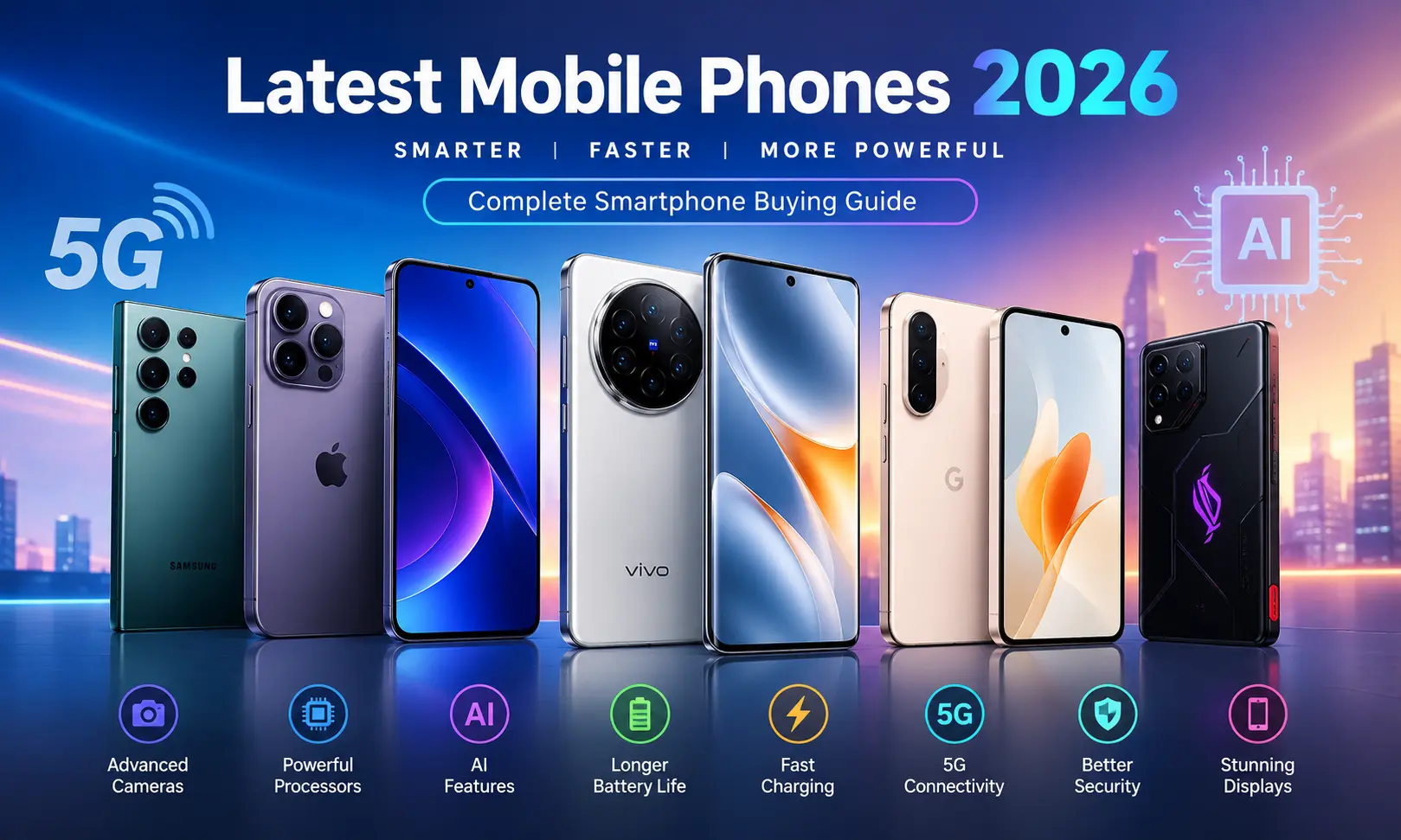
The latest mobile phones in 2026 offer impressive improvements in artificial intelligence, camera technology, processing power, display quality, battery capacity, charging speeds, connectivity, security, and software support. At the same time, consumers have more choices than ever, ranging from affordable 5G smartphones to premium flagship devices and advanced foldable phones.
Artificial intelligence has become an increasingly important part of the smartphone experience. Research in India shows that AI is influencing purchasing decisions, but traditional features remain extremely important. An Amazon India survey reported that performance and speed were the top consideration for respondents, followed by battery life and camera quality, while AI features were also becoming a significant factor. This shows that buyers still want a balanced smartphone rather than a phone that focuses on only one technology.
Whether you are looking for the best camera phone, a powerful gaming smartphone, a long-lasting battery phone, an affordable 5G device, or a premium flagship, understanding the most important smartphone features can help you make a better decision.
This complete guide explains the latest mobile phone technology in 2026 and provides practical advice for choosing the right smartphone for your needs.
Table of Contents
- What Are the Latest Mobile Phones?
- Smartphone Technology in 2026
- Artificial Intelligence in Smartphones
- Smartphone Processors and Performance
- RAM and Storage
- Smartphone Display Technology
- Mobile Phone Camera Technology
- Battery Life and Fast Charging
- 5G and Connectivity
- Smartphone Software and Updates
- Security and Privacy
- Build Quality and Durability
- Best Mobile Phones for Photography
- Best Smartphones for Gaming
- Best Phones for Business and Productivity
- Best Smartphones for Students
- Budget Smartphones
- Mid-Range Smartphones
- Premium Flagship Smartphones
- Foldable Mobile Phones
- Android vs iPhone
- How to Choose the Best Mobile Phone
- Common Smartphone Buying Mistakes
- Smartphone Price and Value
- Latest Smartphone Trends in 2026
- Future of Mobile Phone Technology
- Frequently Asked Questions
- Final Verdict
1. What Are the Latest Mobile Phones?
The term “latest mobile phones” usually refers to recently released smartphones that feature newer processors, improved cameras, updated operating systems, better displays, faster connectivity, advanced artificial intelligence, and other modern technologies.
However, the newest smartphone is not automatically the best smartphone for every person.
Someone who primarily uses WhatsApp, YouTube, Instagram, Google Maps, calls, and online banking may not need an expensive flagship. A professional photographer, gamer, business user, or content creator may have completely different requirements.
This is why smartphone shopping should begin with your personal needs rather than simply searching for the newest model.
The latest smartphone market includes several categories:
- Budget smartphones
- Entry-level 5G phones
- Mid-range smartphones
- Premium smartphones
- Flagship phones
- Gaming phones
- Camera phones
- Foldable phones
- Business-focused smartphones
- Compact smartphones
Each category has different strengths.
The best mobile phone for you should offer the right combination of performance, camera quality, battery life, software, display, storage, durability, and price.
2. Smartphone Technology in 2026
Smartphone technology has developed significantly, and 2026 devices demonstrate how quickly the industry is changing.
Some of the most important smartphone technologies include:
- Artificial intelligence
- Powerful mobile processors
- High-refresh-rate AMOLED displays
- Advanced camera sensors
- Computational photography
- Large batteries
- Fast charging
- 5G connectivity
- Wi-Fi improvements
- On-device AI processing
- Advanced cooling systems
- Foldable displays
- Improved water and dust resistance
- Longer software support
- Better privacy controls
One of the biggest changes is the increasing integration of AI into everyday smartphone functions.
AI is now being used for photography, translation, writing assistance, search, call features, productivity, editing, personalization, and other tasks.
At the same time, manufacturers continue improving the fundamentals of smartphones. Performance, battery life, camera quality, and display technology remain critical.
The smartphone market is therefore moving toward a combination of traditional hardware improvements and intelligent software experiences.
 Earning
SH Shiva Verma| May 30, 2026| 34 min read
Freelancing vs Full-Time Job: Which Pays More?
3. Artificial Intelligence in Smartphones
Artificial intelligence is one of the biggest trends in the latest mobile phones.
Modern smartphone AI can help users perform tasks that previously required separate applications or manual editing.
AI features can include:
- AI photo editing
- Object removal
- Generative image editing
- AI writing assistance
- Text summarization
- Real-time translation
- Voice transcription
- Call assistance
- AI search
- Personalized recommendations
- Smart photo organization
- AI-powered camera processing
- Productivity assistance
AI is particularly useful when it works quietly in the background.
For example, a smartphone camera can use AI and computational photography to recognize a scene and automatically adjust exposure, colors, contrast, focus, and processing.
Another phone might automatically summarize a long conversation or translate a message into another language.
The growing importance of AI is reflected in consumer research. A 2026 CyberMedia Research study found that many Indian smartphone users actively engage with AI features, while privacy and transparent data practices are also important considerations.
This means consumers are not only asking whether a smartphone has AI. They are increasingly interested in how useful, secure, fast, and private that AI actually is.
On-device AI
One of the most interesting developments is on-device AI processing.
Instead of sending every AI task to a remote server, compatible smartphones can perform certain operations directly on the device.
Potential advantages include:
- Faster response
- Better privacy
- Reduced dependence on internet connectivity
- Lower cloud usage
- More responsive AI features
However, the quality of AI features still depends on the processor, software, available applications, and the manufacturer’s implementation.
4. Smartphone Processors and Performance
The processor is one of the most important components in a smartphone.
A powerful processor affects:
- Application performance
- Gaming
- Multitasking
- Camera processing
- Video editing
- AI capabilities
- Battery efficiency
- Overall responsiveness
The latest flagship smartphones use advanced processors designed to deliver high performance while improving power efficiency.
Major smartphone processor platforms include technologies from companies such as Qualcomm, MediaTek, Apple, and Google.
However, processor specifications should not be viewed in isolation.
A smartphone with an extremely powerful processor may not provide a better experience if its software is poorly optimized.
For everyday users, a modern mid-range processor can be more than enough for:
- YouTube
- Web browsing
- Video calls
- Navigation
- Online banking
- Music streaming
- General multitasking
Heavy users should consider a more powerful processor if they regularly perform demanding tasks.
Gaming performance
Gamers should look at more than processor model.
Important factors include:
- GPU performance
- Sustained performance
- Cooling
- Display refresh rate
- Touch response
- Battery capacity
- Charging speed
- Software optimization
A phone may deliver excellent benchmark results but become less powerful during long gaming sessions if it overheats.
Therefore, sustained performance can be more important than short benchmark scores.
5. RAM and Storage
RAM helps a smartphone keep applications active and handle multitasking.
Modern smartphones commonly offer:
- 4GB RAM
- 6GB RAM
- 8GB RAM
- 12GB RAM
- 16GB RAM
- Higher capacities on specialized devices
For many users, 8GB RAM is a comfortable target for a new smartphone.
Power users may prefer 12GB or 16GB, especially when using demanding applications, gaming, editing software, or extensive multitasking.
However, more RAM does not automatically make a phone better.
Software optimization is also important.
Smartphone Storage
Storage is another major consideration.
Common capacities include:
- 64GB
- 128GB
- 256GB
- 512GB
- 1TB
For many buyers, 256GB provides a good balance between capacity and long-term usability.
If you frequently record 4K videos, download large games, store thousands of photographs, or keep movies and music offline, additional storage can be extremely useful.
Before buying a smartphone, also check whether it supports expandable storage.
Many premium phones no longer include microSD card slots, meaning the storage capacity you purchase may be the storage capacity you have for the life of the device.
 Earning
SH Shiva Verma| May 27, 2026| 17 min read
How to Start an Online Business with Low Budget in 2026
6. Smartphone Display Technology
The smartphone display is one of the components users interact with most frequently.
Modern smartphones commonly use:
- OLED
- AMOLED
- LTPO OLED
- Dynamic AMOLED
- High-quality LCD panels
Premium smartphones generally use advanced OLED-based displays because they can provide excellent contrast, deep blacks, high brightness, and efficient power usage.
Refresh Rate
Refresh rate determines how many times the display refreshes each second.
A 60Hz screen refreshes 60 times per second.
A 90Hz or 120Hz screen can provide noticeably smoother scrolling and animations.
High refresh rates are particularly useful for:
- Social media
- Web browsing
- Gaming
- Scrolling
- Animations
However, higher refresh rates can consume additional power, which is why modern displays may dynamically change their refresh rate depending on what is happening on screen.
Brightness
Peak brightness is important if you frequently use your phone outdoors.
A bright display can remain easier to read under strong sunlight.
Resolution
Higher resolution can improve sharpness, but resolution should not be the only factor considered.
Display quality also depends on:
- Color accuracy
- Brightness
- Contrast
- Refresh rate
- Touch response
- HDR support
- Power efficiency
- Viewing angles
A well-calibrated display with excellent brightness can provide a better experience than a display with higher resolution but poor overall quality.
7. Mobile Phone Camera Technology
Smartphone cameras have become one of the biggest selling points of modern phones.
The latest mobile phones can include:
- Wide cameras
- Ultra-wide cameras
- Telephoto cameras
- Periscope zoom cameras
- High-resolution sensors
- Optical image stabilization
- Advanced autofocus
- Computational photography
- AI-powered image processing
- Advanced video stabilization
However, megapixels alone do not determine camera quality.
A 200MP camera does not automatically produce better photographs than a high-quality 50MP camera.
Camera performance depends on many factors.
These include:
- Sensor size
- Lens quality
- Image stabilization
- Autofocus
- Dynamic range
- Image processing
- Low-light performance
- Color science
- Telephoto quality
- Video processing
Main Camera
The main camera is generally the most important camera on a smartphone.
A high-quality main sensor can produce excellent photographs in a wide range of situations.
Ultra-Wide Camera
An ultra-wide camera is useful for:
- Landscapes
- Architecture
- Group photographs
- Travel
- Large indoor spaces
Telephoto Camera
A telephoto camera is useful when you want to photograph distant subjects.
It can also be valuable for portraits.
Some premium phones use periscope-style telephoto cameras to provide significant optical zoom.
Computational Photography
Modern smartphone photography increasingly depends on computational photography.
The phone can combine multiple frames and use software algorithms to improve:
- Dynamic range
- Detail
- Noise reduction
- Exposure
- Skin tones
- Night photography
- HDR
- Zoom
This is one reason smartphone cameras can produce impressive photographs despite their relatively small physical size.
8. Battery Life and Fast Charging
Battery life remains one of the most important factors when buying a smartphone.
A phone with excellent cameras and a powerful processor is less useful if the battery cannot last through your day.
Battery capacity is measured in milliampere-hours, commonly written as mAh.
Modern smartphones can feature batteries ranging from around 4,000mAh to well above 6,000mAh, depending on the device and market.
However, battery capacity alone does not determine battery life.
Actual battery endurance depends on:
- Processor efficiency
- Display size
- Display brightness
- Refresh rate
- Network connectivity
- Apps
- Background processes
- Gaming
- Video playback
- Software optimization
Fast Charging
Fast charging allows users to recover significant battery capacity in a short period.
Different phones can offer different charging speeds, including:
- 25W
- 45W
- 67W
- 80W
- 100W or more
Very fast charging can be useful for:
- Travelers
- Gamers
- Heavy smartphone users
- Business professionals
- People who frequently forget to charge overnight
Wireless charging is another convenient feature, although it is not essential for everyone.
 Earning
SH Shiva Verma| May 27, 2026| 15 min read
Best Online Jobs for Beginners in 2026 (Complete Guide to Start Earning)
9. 5G and Connectivity
5G has become an important feature when purchasing a new smartphone.
Depending on the network and location, 5G can provide:
- Faster downloads
- Lower latency
- Better streaming
- Faster cloud access
- Improved online gaming
- More responsive connected applications
However, 5G performance depends on your carrier and local network infrastructure.
A smartphone should support the relevant network bands used by your mobile operator.
Other connectivity features are also worth checking.
These include:
- Wi-Fi
- Bluetooth
- NFC
- GPS
- USB-C
- Dual SIM
- eSIM
- Wi-Fi calling
For users who frequently transfer large files, newer USB and Wi-Fi technologies can provide significant advantages.
10. Smartphone Software and Updates
Software support is one of the most important long-term smartphone considerations.
A phone may have excellent hardware, but poor software support can reduce its useful life.
Regular updates can provide:
- Security patches
- New features
- Bug fixes
- Better compatibility
- Performance improvements
- Privacy improvements
Some smartphone manufacturers now offer many years of operating-system and security updates.
This can make a major difference if you plan to keep your phone for four or five years.
When comparing two similarly priced phones, software support can be the factor that separates a good purchase from a great one.
11. Security and Privacy
Modern smartphones contain an enormous amount of personal information.
Your phone may contain:
- Photos
- Videos
- Messages
- Contacts
- Emails
- Banking applications
- Payment information
- Documents
- Passwords
- Personal conversations
- Location information
Security should therefore be an important part of your buying decision.
Useful security features include:
- Fingerprint authentication
- Face recognition
- Secure hardware
- Encrypted storage
- Security updates
- App permission controls
- Privacy dashboards
- Secure payment technology
AI-powered smartphone features also make privacy increasingly important.
Users should understand what information is processed on the device and what information may be sent to cloud services.
On-device AI can offer potential privacy and responsiveness advantages for supported features.
 Earning
SH Shiva Verma| May 27, 2026| 10 min read
Top Websites to Earn Money Online Daily in 2026
12. Build Quality and Durability
A smartphone is an expensive electronic device, so durability matters.
Premium smartphones often use materials such as:
- Aluminum
- Stainless steel
- Titanium
- Reinforced glass
Budget and mid-range devices can also offer strong construction.
Water and dust resistance is another important consideration.
An IP rating indicates protection against dust and water under specified testing conditions.
Durability also includes:
- Screen protection
- Frame strength
- Button quality
- Port durability
- Hinge quality on foldables
- Battery longevity
A protective case and screen protector can also help extend the life of a smartphone.
13. Best Mobile Phones for Photography
If photography is your main priority, do not select a phone based solely on megapixel numbers.
Instead, consider the complete camera system.
Look for:
- High-quality main sensor
- Optical image stabilization
- Reliable autofocus
- Good low-light performance
- Strong HDR
- Quality telephoto camera
- Useful ultra-wide camera
- High-quality video recording
- Effective computational photography
Premium smartphones continue to compete aggressively in smartphone photography.
Current 2026 camera-phone reviews highlight models from Samsung, Apple, Google, Xiaomi, Oppo, Honor, and other manufacturers, with different phones specializing in areas such as overall photography, night photography, zoom, video, and computational photography.
For photographers, the best smartphone is the one that consistently produces the type of images they actually want.
14. Best Smartphones for Gaming
Gaming smartphones require a combination of powerful hardware and good thermal management.
Important features include:
- Powerful processor
- Strong GPU
- High-refresh-rate display
- High touch sampling or response rate
- Efficient cooling
- Large battery
- Fast charging
- Stereo speakers
- Gaming software
- Stable sustained performance
Dedicated gaming phones can offer specialized cooling systems and gaming controls.
However, many flagship smartphones are also excellent gaming devices.
If you play casual games, a mid-range smartphone may be sufficient.
If you regularly play demanding 3D games for several hours, a flagship or gaming-focused device may be a better choice.
 Earning
SH Shiva Verma| May 27, 2026| 12 min read
How to Make Money with AI Tools in 2026
15. Best Phones for Business and Productivity
Professionals often need reliability more than flashy specifications.
A good business smartphone should offer:
- Strong battery life
- Fast performance
- Reliable connectivity
- High-quality display
- Good microphones
- Good speakers
- Secure authentication
- Long software support
- Multitasking capabilities
- Strong document and cloud integration
Large-screen phones can be particularly useful for reading documents and managing multiple applications.
Foldable smartphones can provide an even larger workspace while remaining portable.
For business users, software reliability and security should generally receive more attention than benchmark scores.
16. Best Smartphones for Students
Students generally need a smartphone that provides good value.
Useful features include:
- Long battery life
- Good display
- Reliable performance
- 5G connectivity
- Decent cameras
- Enough storage
- Good software support
- Durable construction
A student may use a smartphone for:
- Online classes
- YouTube
- Research
- Social media
- Video calls
- Notes
- Photography
- Gaming
- Educational applications
A mid-range smartphone can often handle these activities without requiring the cost of a flagship.
17. Budget Smartphones
Budget smartphones have become significantly more capable.
Affordable devices can now offer:
- 5G
- High-refresh-rate displays
- Large batteries
- Multiple cameras
- Fast charging
- Modern processors
- AI features
- Good software experiences
However, buyers should be careful with specification-focused marketing.
A phone advertising a very high megapixel camera, enormous RAM number, or extremely fast charging does not necessarily provide the best overall experience.
Instead, consider real-world performance.
Check:
- Processor quality
- Display quality
- Battery life
- Camera reliability
- Software updates
- Build quality
- Storage
- Network compatibility
Budget buyers should also consider whether a slightly more expensive model offers significantly better long-term value.
 Mobile Phones
AB Abhishek Gupta| May 27, 2026| 42 min read
The Rise and Fall of Nokia Phones
18. Mid-Range Smartphones
The mid-range smartphone category is one of the most competitive areas of the market.
Mid-range phones increasingly provide features that were previously limited to flagship devices.
These can include:
- AMOLED displays
- 120Hz refresh rates
- Advanced cameras
- Fast charging
- Large batteries
- 5G
- AI features
- Powerful processors
- Premium-looking designs
For many consumers, a good mid-range smartphone provides the best balance between price and performance.
Instead of spending a large amount on a flagship, buyers can sometimes save money while still receiving an excellent everyday experience.
19. Premium Flagship Smartphones
Flagship smartphones represent the highest level of mainstream smartphone technology.
They typically provide:
- High-end processors
- Premium displays
- Advanced camera systems
- Strong speakers
- Wireless charging
- Water resistance
- Premium materials
- Advanced AI
- Long software support
- Sophisticated security
In 2026, flagship competition remains strong across Apple, Samsung, Google, and other major manufacturers.
The advantage of a flagship is not simply higher specifications.
It is the combination of:
- Hardware
- Software
- Cameras
- Display
- Performance
- Design
- Reliability
- Support
A flagship can be a worthwhile investment for users who want the best available experience and plan to keep the device for several years.
20. Foldable Mobile Phones
Foldable smartphones have developed into an important smartphone category.
There are two major designs.
Book-Style Foldables
These open like a book and provide a large internal display.
They are useful for:
- Multitasking
- Documents
- Reading
- Video
- Gaming
- Productivity
The large internal screen can make a foldable feel closer to a small tablet.
Flip Phones
Flip-style foldables fold vertically.
They provide a compact form factor when closed and a larger smartphone display when opened.
They are particularly attractive to users who want:
- Compact portability
- Stylish designs
- External displays
- Large internal screens
Foldable phones can still be more expensive than conventional smartphones, and buyers should consider factors such as durability, thickness, battery capacity, hinge design, camera performance, and repair costs.
21. Android vs iPhone
Choosing between Android and iPhone depends on your preferences and existing ecosystem.
Android Smartphones
Android provides a wide range of choices.
Advantages can include:
- Many manufacturers
- Wide price range
- More hardware choices
- Foldable phones
- Greater customization
- Different camera approaches
- More charging options
- Variety of screen sizes
Samsung, Google, OnePlus, Xiaomi, Motorola, Vivo, Oppo, Honor, Nothing, and other companies compete across multiple price segments.
iPhone
Apple’s iPhone offers a tightly integrated hardware and software ecosystem.
Important advantages can include:
- Consistent performance
- Strong hardware-software integration
- Long software support
- Strong video capabilities
- Apple ecosystem integration
- High-quality applications
- Strong security
- Good resale value in many markets
Neither platform is universally better.
The right choice depends on your budget, preferences, existing devices, applications, and desired features.
22. How to Choose the Best Mobile Phone
Choosing the right smartphone becomes much easier when you identify your priorities.
Step 1: Set Your Budget
Decide how much you are comfortable spending.
Avoid choosing a phone that creates unnecessary financial pressure.
Step 2: Identify Your Main Usage
Ask yourself what you do most often.
Do you:
- Take photographs?
- Play games?
- Watch videos?
- Use social media?
- Work from your phone?
- Travel?
- Create content?
- Attend online classes?
Your answer should determine your priorities.
Step 3: Decide How Long You Will Keep It
If you plan to use the phone for several years, software support, battery health, storage, and durability become especially important.
Step 4: Choose the Right Performance Level
Casual users can often choose a mid-range processor.
Gamers and creators may need flagship-level performance.
Step 5: Consider the Camera
Do not focus only on megapixels.
Look at:
- Sensor quality
- OIS
- Telephoto capability
- Low-light performance
- Video
- Image processing
Step 6: Check Battery Life
A large battery and efficient processor can provide excellent endurance.
Step 7: Check Software Support
Long-term updates can significantly increase the value of your purchase.
Step 8: Choose the Right Storage
If you keep many photographs and videos, consider 256GB or more.
Step 9: Consider Size
Large phones are excellent for media and gaming but may be less comfortable for one-handed use.
Step 10: Compare the Complete Package
Do not select a phone because of one specification.
Compare the complete experience.
23. Common Smartphone Buying Mistakes
Mistake 1: Buying Based Only on Megapixels
A high megapixel count does not automatically mean better image quality.
Mistake 2: Buying Excessive RAM
More RAM is not always useful for everyday users.
Mistake 3: Ignoring Software Support
A phone that stops receiving updates quickly may become less attractive over time.
Mistake 4: Looking Only at Battery Capacity
A larger battery does not guarantee better battery life.
Mistake 5: Buying Only Because a Phone Is New
A previous-generation flagship can sometimes offer excellent value after its price falls.
Mistake 6: Ignoring Physical Size
A large phone may not be comfortable for everyone.
Mistake 7: Choosing Too Little Storage
Storage requirements can increase as camera quality and video resolution improve.
Mistake 8: Ignoring Network Compatibility
Always check whether the phone supports the network bands used by your carrier.
Mistake 9: Ignoring Reviews
Specifications cannot tell the entire story.
Real-world testing can reveal:
- Heating
- Battery endurance
- Camera consistency
- Software problems
- Performance throttling
- Network performance
Mistake 10: Buying Features You Will Never Use
There is little value in paying extra for features that do not improve your everyday experience.
24. Smartphone Price and Value
Price is becoming an increasingly important factor in smartphone purchasing.
The Indian smartphone market has experienced pricing pressure in 2026, with rising component and memory costs contributing to higher device prices.
This makes value-for-money comparisons particularly important.
Instead of asking:
“What is the cheapest phone?”
Ask:
“Which phone provides the best overall experience for my budget?”
For example, spending slightly more may be worthwhile if you receive:
- A much better processor
- Better camera hardware
- Longer software support
- More storage
- Better display
- Faster charging
- Better durability
A smartphone should be judged by its total ownership value rather than only its launch price.
25. Latest Smartphone Trends in 2026
Several important trends are shaping the latest mobile phones.
Artificial Intelligence
AI is becoming a normal part of smartphone software.
It is being used for:
- Photography
- Writing
- Translation
- Search
- Calls
- Productivity
- Editing
Bigger Batteries
Battery capacity is increasing on many smartphones, particularly in performance-focused and mid-range devices.
Faster Charging
Charging speeds continue to improve, allowing users to spend less time connected to a charger.
Better Mid-Range Phones
Mid-range devices increasingly offer features that were previously associated with flagship phones.
Advanced Camera Systems
Telephoto cameras, computational photography, AI image processing, and high-quality video are becoming more important.
Longer Software Support
Manufacturers increasingly recognize that consumers want phones that remain useful for many years.
On-Device AI
AI processing directly on the smartphone is becoming increasingly important for speed, privacy, and offline functionality.
Foldable Phones
Foldables continue to develop as manufacturers improve designs, durability, displays, hinges, and software.
26. Future of Mobile Phone Technology
The smartphone industry is likely to continue moving toward intelligent, connected, and personalized devices.
Future smartphones may offer increasingly advanced:
- AI assistants
- Real-time translation
- Voice interaction
- Camera automation
- Productivity features
- Health integration
- On-device processing
- Satellite connectivity
- Battery optimization
- Cross-device functionality
The relationship between smartphones and other devices will also become increasingly important.
A smartphone can already act as a central hub connecting:
- Smartwatches
- Wireless earbuds
- Tablets
- Laptops
- Cars
- Smart-home products
- Cloud services
In the future, the smartphone may become less about individual hardware specifications and more about the entire digital ecosystem.
27. Frequently Asked Questions
There is no single best smartphone for everyone. The best phone depends on your budget and priorities, such as camera quality, gaming performance, battery life, software, AI, or productivity.
Premium smartphones from several major manufacturers offer excellent cameras. The right choice depends on whether you prioritize everyday photography, zoom, portraits, night photography, or video.
For most people purchasing a new smartphone, 5G is a useful feature to have, particularly if 5G is available through their mobile network.
For many users, 8GB is enough. Heavy users and gamers may prefer 12GB or more.
For most users, 256GB provides comfortable storage. People who record a lot of high-resolution video or store large numbers of games and media files may want 512GB or more.
Flagship phones can be worthwhile for people who want premium cameras, maximum performance, excellent displays, advanced features, and long-term software support.
Yes. Budget smartphones have improved considerably and can provide excellent performance for everyday tasks.
A foldable phone can be an excellent choice if you value a large display, multitasking, portability, or unique design. A traditional smartphone may provide better value and simplicity for other buyers.
Not necessarily. Camera quality depends on the sensor, lens, stabilization, image processing, software, and overall camera system.
A good modern smartphone can remain useful for several years, especially when it receives regular software and security updates.
What should I check before buying a smartphone?
Check the processor, RAM, storage, display, camera system, battery, charging speed, network compatibility, software support, durability, and price.
Is AI important in a smartphone?
AI is becoming increasingly useful, particularly for photography, translation, productivity, search, writing, and editing. However, basic performance, battery life, camera quality, and software remain extremely important.
28. Final Verdict: Choosing the Best Latest Mobile Phone
The latest mobile phones in 2026 offer more technology than ever before.
Modern smartphones can provide:
- Powerful processors
- Advanced AI
- Excellent cameras
- High-refresh-rate displays
- Large batteries
- Fast charging
- 5G connectivity
- Better security
- Long software support
- Premium designs
- Foldable displays
However, the most expensive smartphone is not necessarily the best smartphone for you.
The right device should match your actual requirements.
If photography is your priority, focus on the complete camera system rather than megapixels.
If gaming is important, prioritize processor performance, GPU power, cooling, display refresh rate, battery capacity, and sustained performance.
If you are a professional, consider battery life, security, software support, connectivity, and productivity.
If you are a student, focus on value, battery life, display quality, performance, and durability.
If you want maximum value, a good mid-range smartphone may provide everything you need without the price of a flagship.
If you want the most advanced technology available, a premium flagship or foldable phone may be worth considering.
The most important rule is simple:
Do not buy a smartphone simply because it has the biggest specification numbers. Buy the smartphone that provides the features you will actually use.
The smartphone market is continuing to evolve rapidly. Artificial intelligence is becoming more integrated into everyday experiences, cameras are becoming increasingly computational, batteries are becoming larger and more efficient, charging is becoming faster, and premium technologies are gradually moving into more affordable devices.
This gives consumers more choices than ever.
Before purchasing your next mobile phone, compare the processor, camera, display, battery, storage, software support, connectivity, durability, and overall price. Consider how long you plan to keep the device and which features matter most to you.
Whether you need a budget smartphone, a powerful gaming phone, a camera-focused device, a business phone, a foldable, or a flagship, careful research can help you find the right option.
The best latest mobile phone is ultimately not the one with the longest specification list.
It is the phone that delivers the best combination of performance, features, reliability, software, battery life, camera quality, and value for your individual needs.
Leave a Reply