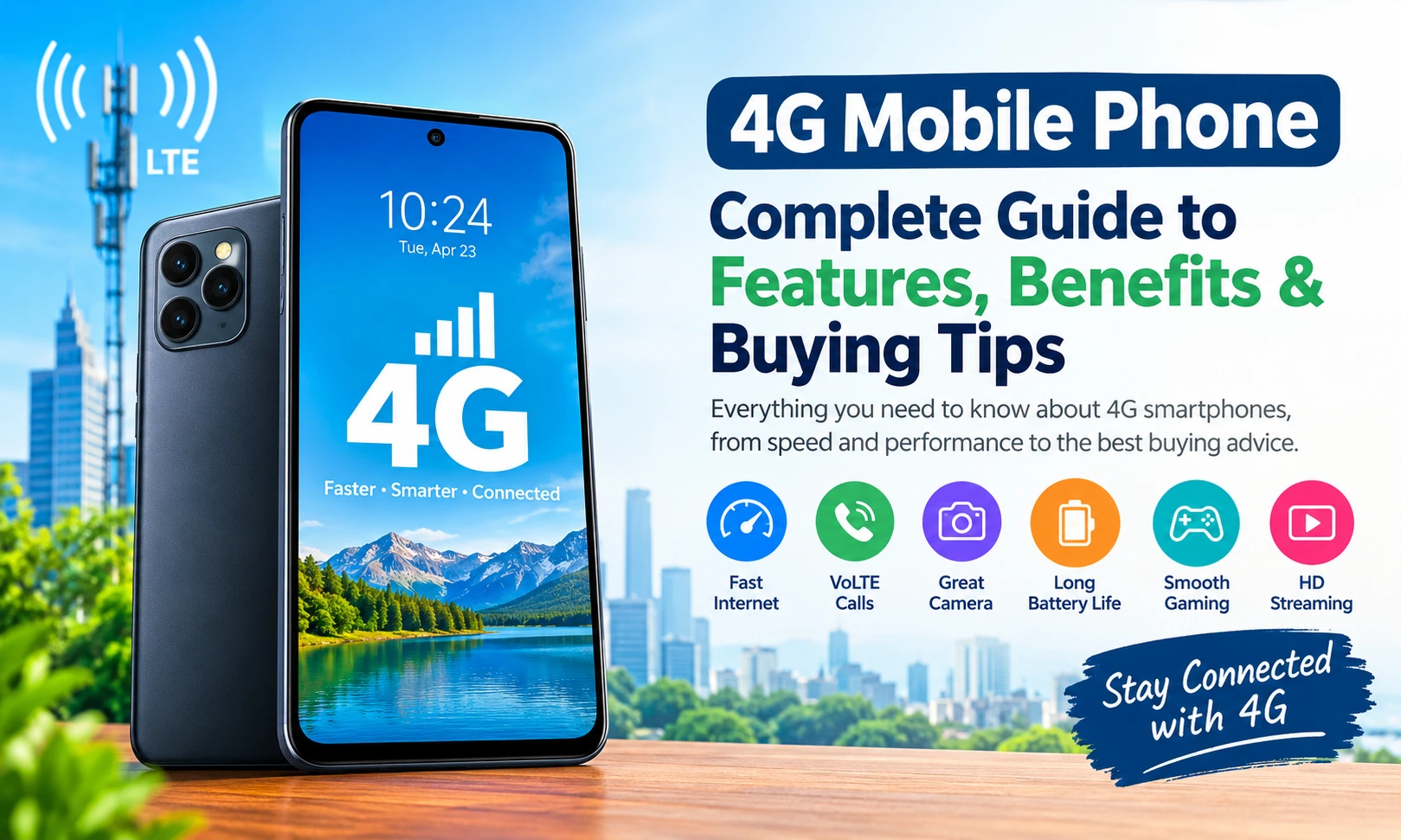
A 4G mobile phone is a smartphone or feature phone designed to connect to fourth-generation mobile networks using technologies such as LTE. 4G transformed the mobile experience by making faster internet access, smoother video streaming, online gaming, social media, video calling, cloud applications, and other data-heavy services practical on a mobile device.
Although 5G smartphones are now widely available, 4G mobile phones remain an important choice for many users. A good 4G phone can provide reliable connectivity, excellent app performance, strong battery life, quality cameras, and an affordable overall experience. For people who primarily browse the web, use WhatsApp, watch videos, use social media, make calls, attend online classes, and perform everyday tasks, a 4G smartphone can still be a practical option.
This comprehensive guide explains everything you need to know about 4G mobile phones, including what 4G means, how 4G LTE works, the advantages of 4G phones, important specifications, VoLTE, battery life, cameras, processors, storage, 4G versus 5G, and how to choose the right device.
What Is a 4G Mobile Phone?
A 4G mobile phone is a mobile device capable of connecting to a fourth-generation cellular network. The term 4G generally refers to advanced mobile broadband technology designed to deliver substantially better data performance than earlier generations such as 3G.
The International Telecommunication Union (ITU) uses the term IMT-Advanced for the formal fourth-generation mobile standard. LTE-Advanced is one of the technologies recognized under IMT-Advanced. These standards were designed to support higher data rates, improved spectrum efficiency, lower latency, and advanced mobile broadband services.
In everyday consumer use, however, the term “4G phone” commonly refers to phones supporting LTE networks.
A 4G smartphone can connect to a compatible cellular network and use mobile data for:
- Web browsing
- Social media
- Video streaming
- Online gaming
- Video calling
- Music streaming
- Online shopping
- Digital payments
- Cloud applications
- Navigation
- Online education
- Business communication
- Mobile banking
The actual experience depends on many factors, including network coverage, spectrum bands, carrier configuration, network congestion, phone hardware, location, and signal quality.
How Does a 4G Mobile Phone Work?
A 4G mobile phone communicates with nearby cellular towers using radio signals. When mobile data is enabled, the phone connects to the network through a compatible LTE radio interface.
The process can be simplified into several steps.
1. The phone searches for a compatible network
Your 4G phone continuously monitors available cellular networks. Once it identifies a compatible network, it attempts to establish a connection.
2. The SIM or eSIM identifies the subscriber
The SIM or eSIM helps the mobile network identify and authenticate the subscriber. The operator then provides access according to the user’s plan and network configuration.
3. The phone connects to an LTE network
The smartphone establishes a radio connection with a nearby cell site. Network equipment manages resources such as spectrum, signal quality, and data traffic.
4. Data is transferred
When you open a website, stream a video, send a message, or use an application, packets of information travel between your phone and the wider internet through the mobile network.
5. The network adjusts the connection
Modern cellular networks can dynamically manage resources depending on signal conditions, network load, and user requirements.
This is why two people using the same type of 4G phone can sometimes experience very different speeds in different locations.
What Is 4G LTE?
LTE stands for Long Term Evolution. It is one of the most important technologies associated with modern 4G mobile networks.
LTE was developed to provide faster and more efficient mobile broadband compared with older cellular technologies. The technology uses an all-IP architecture for mobile data and supports a wide range of internet-based services.
The ITU identifies LTE-Advanced as an IMT-Advanced technology, while LTE itself is widely used commercially as a 4G mobile broadband technology.
When shopping for a phone, you will commonly see specifications such as:
- 4G LTE
- LTE
- LTE Cat 4
- LTE Cat 6
- LTE Cat 7
- LTE Cat 12
- LTE-A
- LTE Advanced
- VoLTE
These specifications can indicate different levels of network capability, although real-world performance still depends heavily on the network operator and local coverage.
Why Is 4G Important for Mobile Phones?
Before 4G became widespread, mobile users relied heavily on 2G and 3G networks for internet access. These technologies were useful but became increasingly limited as users began consuming more online video, social media, cloud services, and interactive applications.
4G helped make smartphones much more capable mobile computing devices.
A 4G mobile phone can support activities such as:
Faster web browsing
Web pages, images, online stores, news sites, and web applications can load more efficiently when network conditions are good.
Video streaming
4G makes mobile video streaming much more practical. Users can watch online videos, educational content, live streams, and entertainment services without depending exclusively on Wi-Fi.
Video calling
Applications such as WhatsApp, Google Meet, Zoom, and other communication platforms can use mobile data for video calls.
Social media
Facebook, Instagram, X, YouTube, and other platforms increasingly depend on images and video. A 4G connection makes these services more convenient.
Online gaming
Many mobile games require a stable internet connection. While network speed matters, latency and connection stability are also important.
Digital services
Mobile banking, online shopping, food delivery, ride-hailing, digital payments, and cloud-based services all benefit from dependable mobile connectivity.
Main Features of a Good 4G Mobile Phone
Buying a 4G phone is not only about checking whether it supports 4G. A smartphone contains many components that determine the overall user experience.
Here are the most important features to consider.
1. 4G LTE Network Support
The first requirement is compatibility with your mobile network.
Before buying a phone, check whether it supports the LTE bands used by your network operator. A phone can be marketed as a 4G device but may not support every band used in your country or region.
For the best experience, check:
- Supported 4G LTE bands
- Carrier compatibility
- VoLTE support
- SIM compatibility
- Dual-SIM functionality
- Network aggregation support where applicable
2. VoLTE Support
VoLTE means Voice over LTE. It allows voice calls to be delivered over an LTE network using an IP-based system.
The GSMA describes VoLTE as a digital packet voice service delivered over an LTE access network. It can provide benefits such as more efficient spectrum use, richer services, and the ability to handle voice and data through LTE-based infrastructure.
VoLTE is particularly important when purchasing a 4G phone because network operators may rely on LTE for voice services.
Potential advantages include:
- Better voice quality
- Faster call setup
- Simultaneous voice and data in supported configurations
- More efficient network usage
- Compatibility with modern operator infrastructure
GSMA documentation also notes that VoLTE can provide enhanced voice quality and faster call establishment compared with traditional circuit-switched voice services.
 Earning
AD admin| Mar 23, 2026| 22 min read
Passive Income Ideas That Can Make You Rich in 2026
3. Processor
The processor is one of the most important components of a smartphone.
A phone with excellent network connectivity but a weak processor may still feel slow.
When choosing a 4G smartphone, look at:
- Processor generation
- CPU architecture
- Number of cores
- Clock speeds
- GPU performance
- Manufacturing process
- Real-world reviews
For basic tasks such as calling, messaging, browsing, and social media, a modest processor may be enough.
For gaming, photo editing, video editing, and multitasking, a more powerful chipset is preferable.
4. RAM
RAM determines how many applications and processes a smartphone can comfortably keep active.
Common RAM capacities include:
- 3GB
- 4GB
- 6GB
- 8GB
- 12GB or more
For basic users, 4GB may be sufficient depending on the software. For heavier multitasking, 6GB or 8GB can provide a more comfortable experience.
However, more RAM does not automatically mean a faster phone. Software optimization and processor performance are also important.
5. Storage
Storage determines how many applications, photos, videos, documents, and games you can keep on your device.
Common options include:
- 32GB
- 64GB
- 128GB
- 256GB
- 512GB
For a modern smartphone, 128GB can be a comfortable option for many users, especially if they take many photos and videos.
If a phone supports a microSD card, expandable storage can provide additional flexibility.
6. Display Quality
The display is the part of the smartphone you interact with most.
Important display specifications include:
- Screen size
- Resolution
- Panel technology
- Refresh rate
- Brightness
- Touch response
- Color reproduction
- Protection against scratches
A larger screen can be useful for watching videos and reading documents, while a smaller display may make the phone easier to handle.
AMOLED displays can provide strong contrast and deep blacks, while LCD screens can still offer excellent viewing experiences depending on quality.
 Gaming
AD admin| Mar 23, 2026| 14 min read
Gaming Laptop: Complete Guide (Best Gaming Laptop Under ₹50,000 & ₹30,000)
7. Battery Life
A good 4G phone should ideally provide enough battery capacity to last through your daily activities.
Battery life depends on:
- Battery capacity
- Processor efficiency
- Display brightness
- Screen refresh rate
- Mobile signal strength
- Background applications
- Gaming
- Video streaming
- GPS usage
- Network activity
A phone with a large battery is not necessarily better if the software and hardware are inefficient.
Look for a balance between battery capacity and overall efficiency.
8. Fast Charging
Fast charging can be extremely useful for people who frequently use their phones throughout the day.
Different manufacturers use different charging technologies and power levels.
When evaluating charging performance, check:
- Charger included in the box
- Charging wattage
- Supported charging standard
- Battery capacity
- Charging time
- Long-term battery health features
A fast charger can provide a significant amount of battery power in a relatively short period.
9. Camera System
Many people purchase smartphones primarily for photography and video.
When choosing a 4G smartphone, do not focus only on megapixels.
Consider:
- Sensor size
- Main camera quality
- Image processing
- Optical image stabilization
- Autofocus
- Low-light performance
- Video recording
- Front camera quality
- Ultrawide camera
- Macro camera
A well-optimized 48MP camera, for example, can produce better results than a poorly implemented higher-megapixel camera.
10. Software and Updates
Software has a major impact on smartphone usability.
Before buying a 4G mobile phone, consider:
- Operating system version
- Manufacturer software
- Security updates
- Major Android updates
- User interface
- Preinstalled applications
- Privacy controls
- Long-term support
A phone that receives regular security updates can remain useful for a longer period.
 Earning
AD admin| Mar 23, 2026| 19 min read
How to Earn .5k–2k Daily Using Your Mobile
Benefits of Using a 4G Mobile Phone
There are many reasons consumers continue to choose 4G smartphones.
Affordable Hardware
4G phones are available across a wide range of prices. Because manufacturers have produced LTE devices for many years, consumers can find affordable smartphones with capable processors, large displays, quality cameras, and good battery life.
Reliable Mobile Internet
Where 4G coverage is strong, LTE can provide dependable mobile internet for everyday activities.
Excellent App Compatibility
Modern applications can run comfortably on many capable 4G smartphones.
Good Battery Efficiency
Some 4G chipsets are highly optimized for everyday use, helping phones achieve good battery life.
Lower Purchase Cost
If you do not need 5G-specific features, a good 4G phone may provide excellent value.
Suitable for Everyday Users
A 4G smartphone can be sufficient for:
- Students
- Senior citizens
- Business users
- Social media users
- Casual gamers
- Streaming users
- Travelers
- Remote workers
- General smartphone users
4G Mobile Phone for Students
Students increasingly use smartphones for education.
A 4G phone can support:
- Online classes
- Educational videos
- Digital textbooks
- Research
- Messaging
- Online assignments
- Cloud documents
- Educational applications
For students, battery life and display quality can be more important than having the most powerful processor.
A balanced 4G smartphone with good battery life, sufficient storage, and a quality display can be an excellent educational tool.
4G Mobile Phone for Business Users
Business professionals often need mobile internet throughout the day.
A 4G smartphone can support:
- Video conferencing
- Business messaging
- Cloud applications
- Document editing
- Mobile banking
- Digital payments
- Social media management
- Customer communication
- Navigation
For professional use, reliability, battery life, security, and software support should be major considerations.
4G Mobile Phone for Gaming
A 4G phone can also be used for mobile gaming.
However, gaming performance depends on much more than the network.
Look for:
- Capable processor
- Good GPU
- Adequate RAM
- High-quality display
- High touch response
- Efficient cooling
- Large battery
- Stable network connection
For online multiplayer games, network latency and stability can be more important than simply having a high download speed.
Earning
AD admin| Mar 23, 2026| 22 min read
Passive Income Ideas That Can Make You Rich in 2026
4G Mobile Phone for Streaming
Streaming video consumes significant amounts of mobile data.
A 4G smartphone with a good display can be used for:
- YouTube
- Movies
- TV shows
- Educational videos
- Live streams
- Social video platforms
For frequent streaming, choose a phone with:
- Good display
- Large battery
- Good speakers
- Stable 4G support
- Sufficient storage
- Strong network compatibility
Remember that streaming quality also depends on the mobile network and your data plan.
4G vs 5G Mobile Phone
One of the most common questions is whether to buy a 4G or 5G smartphone.
The answer depends on your requirements.
| Feature | 4G Mobile Phone | 5G Mobile Phone |
|---|---|---|
| Network generation | Fourth generation | Fifth generation |
| Typical use | Everyday mobile internet | Advanced mobile connectivity |
| Device prices | Often more affordable | Wide range, including premium |
| Network availability | Mature and widespread in many areas | Depends on operator and location |
| Data capability | Excellent for common tasks | Designed for newer and more demanding use cases |
| Battery requirements | Often efficient | Varies by chipset and network |
| Long-term network choice | Depends on local 4G plans | Potentially stronger future focus |
| Best for | Browsing, calls, social media, streaming | High-performance mobile connectivity |
5G is not automatically better for every consumer.
If your local 4G network is reliable and your usage consists primarily of browsing, messaging, video streaming, social media, and calls, a quality 4G smartphone may be enough.
However, if you want a newer device with access to 5G networks and plan to keep it for several years, a 5G phone may make more sense.
Is a 4G Phone Still Worth Buying?
Yes, in many situations.
A 4G phone can still be a smart purchase when:
- Your area has strong 4G coverage.
- Your mobile usage is moderate.
- You want to save money.
- You do not need 5G.
- You want good battery life.
- You primarily use social media and messaging.
- You watch videos occasionally.
- You need a secondary phone.
- You are buying a phone for an older family member.
- You need an affordable smartphone for students.
The most important factor is not simply the network generation printed on the box. It is the complete combination of network compatibility, processor, battery, software, display, camera, storage, and price.
How to Choose the Best 4G Mobile Phone
Choosing the best 4G mobile phone becomes easier if you identify your priorities first.
Step 1: Determine Your Budget
Set a realistic budget before comparing phones.
Avoid spending extra money on specifications you will never use.
Step 2: Check Network Compatibility
Make sure the phone supports the 4G LTE bands used by your carrier.
Step 3: Look for VoLTE
VoLTE support can be important for voice calling on modern LTE networks.
Step 4: Select Enough RAM
For general use, choose enough RAM for your applications and multitasking habits.
Step 5: Choose Suitable Storage
If you take many photos and videos, prioritize larger storage.
Step 6: Check Battery Capacity
Heavy users should prioritize battery life.
Step 7: Examine the Display
If you watch videos or read frequently, display quality matters.
Step 8: Consider Camera Quality
Do not judge cameras only by megapixel count.
Step 9: Check Software Support
Look for manufacturers that provide dependable software and security updates.
Step 10: Compare the Total Package
The best phone is not necessarily the one with the biggest number in every specification.
It is the phone that provides the best combination of performance, reliability, features, software, battery life, and price for your personal needs.
Important 4G Mobile Phone Specifications to Check
When comparing smartphones, create a checklist.
Network
- 4G LTE
- LTE bands
- VoLTE
- Dual SIM
- Wi-Fi
- Bluetooth
Performance
- Processor
- CPU
- GPU
- RAM
- Storage
Display
- Size
- Resolution
- Refresh rate
- Brightness
- Panel type
Battery
- Capacity
- Charging speed
- Charger support
Camera
- Main sensor
- Front camera
- Ultrawide
- OIS
- Video capabilities
Software
- Android version
- Security updates
- Software support period
- User interface
Build
- Materials
- Weight
- Thickness
- Water resistance
- Screen protection
What Is VoLTE and Why Does It Matter on a 4G Phone?
VoLTE deserves special attention because mobile networks are increasingly built around IP-based technologies.
Traditional cellular voice systems relied on dedicated circuit-switched technologies. VoLTE allows voice communication to operate over LTE using an IP Multimedia Subsystem.
According to GSMA, VoLTE enables operators to use LTE for voice and messaging services and can provide benefits including improved voice quality and faster call setup.
For consumers, this can mean:
- Clearer voice calls
- Faster call connection
- Better integration between voice and data
- Support for modern network architecture
- More efficient use of network resources
When buying an LTE phone, checking VoLTE compatibility is therefore a smart step.
4G Mobile Phone and Mobile Hotspot
Many 4G smartphones can operate as mobile hotspots.
A mobile hotspot allows other devices to access the internet through the phone’s cellular connection.
For example, you could connect:
- Laptop
- Tablet
- Smart TV
- Another smartphone
- Gaming device
This can be particularly useful when Wi-Fi is unavailable.
However, hotspot usage can consume a lot of mobile data and battery power, so users should monitor both.
4G Mobile Phone Battery Saving Tips
Even a large battery can drain quickly if the phone is heavily used.
Try these techniques to extend battery life:
Reduce unnecessary screen brightness
The display can be one of the largest sources of battery consumption.
Disable unused connections
Turn off Bluetooth, GPS, or hotspot functions when you do not need them.
Restrict background applications
Some apps continuously use processing power and mobile data.
Use battery-saving modes
Most modern smartphones include power-saving options.
Keep applications updated
Software updates can sometimes improve efficiency and fix background activity issues.
Avoid excessive heat
High temperatures can negatively affect battery health.
How to Improve 4G Internet Speed
If your 4G phone feels slow, the phone itself may not be the problem.
Try these steps:
- Move to an area with better signal.
- Restart the phone.
- Enable and disable airplane mode.
- Check whether your data plan has reached a limit.
- Close unnecessary background applications.
- Check network settings.
- Ensure the phone supports your operator’s LTE bands.
- Test the connection at different times.
- Check for network congestion.
- Contact your carrier if the problem continues.
A strong 4G signal does not always guarantee maximum speed because network congestion and available bandwidth also affect performance.
Why 4G Speed Can Vary
Many users expect a fixed “4G speed,” but there is no single real-world speed that every 4G phone will deliver.
Performance depends on:
- Carrier
- Location
- Distance from cell site
- Indoor or outdoor environment
- Network congestion
- Spectrum
- Supported LTE bands
- Carrier aggregation
- Phone modem
- Signal quality
- Network configuration
- Data plan
Therefore, two phones connected to the same general 4G network can produce different results.
Theoretical peak performance and actual consumer performance are also different concepts.
4G Mobile Phone and Dual SIM
Dual-SIM functionality is useful for people who manage two numbers.
Common uses include:
- Personal and business numbers
- Two different network operators
- Travel SIM and home SIM
- Separate calling and data plans
Before buying a dual-SIM 4G phone, check whether both SIM slots support 4G and whether VoLTE is available on the desired SIM configuration.
Some devices have limitations when both SIMs are active, so specifications should be checked carefully.
4G Phone Camera Features to Consider
A modern 4G smartphone can have a surprisingly capable camera system.
Important features include:
Night mode
Improves photographs in low-light environments.
HDR
Helps balance bright and dark areas.
Portrait mode
Creates background blur around a subject.
Ultrawide camera
Useful for landscapes and group photographs.
Optical image stabilization
Helps reduce camera shake.
Electronic image stabilization
Can improve handheld video.
AI image processing
Modern processors can use computational photography to improve images.
The quality of image processing is often more important than simply increasing megapixel numbers.
4G Mobile Phone Security
A smartphone contains personal information, financial information, messages, photographs, and accounts.
When selecting a 4G phone, consider security features such as:
- Fingerprint scanner
- Face unlock
- Secure lock screen
- Regular security updates
- App permissions
- Encryption
- Secure payments
- Find-my-device features
Users should also avoid installing applications from unknown sources.
Keeping the operating system updated is one of the simplest ways to improve smartphone security.
4G Mobile Phone for Senior Citizens
A 4G smartphone can be a good choice for senior users when configured properly.
Useful features include:
- Large display
- Loud speakers
- Simple user interface
- Large text
- Good battery life
- Reliable calling
- VoLTE
- Emergency features
- Easy charging
For senior users, simplicity can be more important than advanced specifications.
4G Mobile Phone for Children
Parents may also choose an affordable 4G phone for children.
Important features can include:
- Strong battery
- Reliable calling
- GPS
- Parental controls
- Durable construction
- Affordable replacement cost
- Adequate performance
Parents should configure privacy and safety settings before giving a connected smartphone to a child.
Common Mistakes When Buying a 4G Smartphone
Mistake 1: Choosing Only by Price
The cheapest phone is not always the best value.
Mistake 2: Focusing Only on RAM
More RAM does not automatically mean better performance.
Mistake 3: Looking Only at Megapixels
Camera quality depends on sensors, optics, image processing, and software.
Mistake 4: Ignoring LTE Bands
A phone should be compatible with your network.
Mistake 5: Ignoring VoLTE
VoLTE can be important for modern LTE-based voice calling.
Mistake 6: Forgetting Software Updates
Long-term software support can significantly affect the usable life of a phone.
Mistake 7: Buying More Storage Than Needed
If your usage is light, you may not need the highest storage option.
Mistake 8: Ignoring Battery Efficiency
Battery capacity alone does not determine battery life.
Frequently Asked Questions About 4G Mobile Phones
A 4G mobile phone is a device capable of connecting to fourth-generation mobile broadband networks, commonly using LTE technologies.
The terms are often used together in consumer marketing, but they are not technically identical in every context. LTE is a family of mobile communication technologies, while the ITU’s formal 4G designation is associated with IMT-Advanced. LTE-Advanced is recognized by ITU as an IMT-Advanced technology.
Yes. A capable 4G phone can handle web browsing, social media, streaming, video calls, online education, cloud services, and many other everyday activities
No. VoLTE support depends on the phone, modem, software, carrier configuration, and network. Always check compatibility before purchasing.
Yes. Video calls can be made through applications such as WhatsApp, Google Meet, Zoom, and other internet-based services. Some carrier-based video services may have additional requirements.
Yes. 4G cellular connectivity and Wi-Fi are separate technologies. A smartphone can generally use either cellular data or Wi-Fi depending on availability and settings.
Many 4G smartphones support mobile hotspot functionality. Availability and carrier restrictions can vary.
For many users, yes. A good 4G connection can support video streaming, although the available video quality depends on network speed and stability.
A 4G connection can support online gaming. However, latency, stability, server distance, and network congestion can be just as important as download speed.
Consider your budget, local network availability, expected ownership period, and usage requirements. If you want an affordable phone for everyday tasks, a 4G model can still make sense. If you want access to 5G networks and plan to keep the phone for several years, 5G may be worth considering.
Does 4G consume more battery?
Battery consumption depends on many factors, including signal strength, network activity, modem efficiency, screen usage, and applications. Poor cellular signal can increase power consumption because the phone works harder to maintain connectivity.
Can a 4G phone work without a SIM?
A smartphone can perform many Wi-Fi-based functions without a SIM, but cellular calls and mobile data generally require an active compatible SIM or eSIM and network service.
How long does a 4G smartphone last?
A smartphone’s useful life depends on hardware quality, battery health, software updates, storage, and user requirements. A well-maintained device can remain useful for several years.
Future of 4G Mobile Phones
Although the mobile industry continues to move toward 5G and newer technologies, 4G remains an important part of mobile connectivity.
The ITU describes successive generations through its IMT framework, with IMT-Advanced associated with 4G and IMT-2020 associated broadly with 5G.
At the same time, operators are evolving their networks. The GSMA has highlighted the transition toward IP-based voice services and the growing importance of VoLTE as operators modernize networks and phase out some legacy technologies.
This means consumers should not assume that simply having a “4G” label guarantees future compatibility. Network operators can change technology deployments over time.
When buying a phone, therefore, consider not only today’s network but also how long you expect to use the device.
Final Buying Checklist for a 4G Mobile Phone
Before purchasing a 4G smartphone, ask yourself these questions:
Network
- Does it support my carrier?
- Does it support the required 4G LTE bands?
- Does it support VoLTE?
Performance
- Is the processor powerful enough?
- Is there enough RAM?
- Is the storage sufficient?
Display
- Is the screen large enough?
- Is the resolution good?
- Is the brightness sufficient?
Battery
- Is the battery large enough?
- Does it support fast charging?
- Is the processor energy efficient?
Camera
- Is the main camera good?
- Does it perform well in low light?
- Does it record good video?
Software
- Is the operating system modern?
- Does the manufacturer provide security updates?
- Is the interface easy to use?
Connectivity
- Does it support Wi-Fi?
- Bluetooth?
- GPS?
- Dual SIM?
- Mobile hotspot?
Value
- Does the phone provide the features you actually need?
- Is there a better option at a similar price?
- How long do you plan to keep it?
Conclusion: Is a 4G Mobile Phone Right for You?
A 4G mobile phone remains a practical and affordable choice for many smartphone users. It can provide reliable mobile internet, voice calling, video streaming, social media, online education, mobile banking, navigation, gaming, and countless other everyday services.
The most important thing is to choose a phone based on your actual requirements rather than simply buying the device with the largest specification numbers.
For a good 4G smartphone, pay particular attention to LTE compatibility, VoLTE, processor performance, RAM, storage, battery life, display quality, camera performance, software support, and overall build quality.
A budget-conscious user may find that a well-designed 4G phone delivers everything they need without paying extra for features they will never use. On the other hand, users who want the newest network technology and a longer future-oriented upgrade path may prefer a 5G smartphone.
Ultimately, the best 4G mobile phone is the one that offers dependable network connectivity, smooth performance, strong battery life, useful features, reliable software, and good value for your specific needs.
As mobile networks continue to evolve, understanding the technology behind your smartphone helps you make a smarter purchasing decision. Whether you are buying your first smartphone, replacing an old device, choosing a phone for a student or senior family member, or looking for an affordable secondary device, a carefully selected 4G mobile phone can still provide a strong everyday mobile experience.
Leave a Reply