Introduction
Mobile networks are among the greatest technological inventions in human history. They changed how people communicate, share information, conduct business, and access entertainment. Today, billions of people use smartphones daily for calling, messaging, online shopping, education, banking, gaming, navigation, and social media. However, this advanced digital world was built gradually over several decades through continuous improvements in wireless communication technology.
The journey from 1G to 5G is not just about faster internet speeds. It is a story of innovation, competition, engineering, and global transformation. Each generation of mobile networks solved problems faced by previous generations while introducing new capabilities that reshaped society. Early mobile phones were heavy and only capable of voice calls, while modern smartphones function like powerful portable computers connected to ultra-fast internet networks.
Mobile communication has influenced every part of modern life. Businesses can operate globally through mobile internet, students can attend online classes, doctors can provide remote healthcare, and families can stay connected regardless of distance. Mobile networks have also created entirely new industries, including app development, mobile gaming, streaming services, and social media platforms.
This article explores the complete history of mobile networks from 1G to 5G, including their technologies, features, challenges, societal impact, and the future of wireless communication.
Table of Contents
- What Are Mobile Networks?
- The Beginning of Wireless Communication
- Understanding Mobile Network Generations
- The First Generation – 1G
- Features and Limitations of 1G
- The Rise of 2G Networks
- GSM Technology and Digital Communication
- SMS and Mobile Messaging Revolution
- Mobile Internet Begins with 2.5G
- The Arrival of 3G Networks
- Mobile Internet Revolution
- Video Calling and Multimedia Era
- The Development of 4G LTE
- How 4G Changed Smartphones
- Streaming, Gaming, and Social Media Growth
- Introduction to 5G Networks
- Features and Advantages of 5G
- Smart Cities and Internet of Things
- Challenges of 5G Technology
- Differences Between 1G, 2G, 3G, 4G, and 5G
- Future of Mobile Networks Beyond 5G
- Impact of Mobile Networks on Society
- Mobile Networks in India
- Conclusion
What Are Mobile Networks?
Mobile networks are wireless communication systems that allow electronic devices to exchange information without physical cables. These networks use radio frequencies and cellular towers to transmit voice, text, video, and internet data between users.
The concept of cellular networking is based on dividing geographic regions into smaller areas called cells. Each cell contains a base station or tower responsible for communicating with nearby mobile devices. When users move from one area to another, the network automatically transfers the connection between towers to maintain uninterrupted communication.
Modern mobile networks consist of several important components:
- Cellular towers
- Base stations
- Switching centers
- Frequency spectrum
- Fiber-optic infrastructure
- Satellites
- User devices like smartphones and tablets
Mobile networks support many services such as:
- Voice calling
- SMS messaging
- Video calling
- Internet browsing
- Mobile banking
- GPS navigation
- Streaming services
- Online gaming
Without mobile networks, modern smartphones would not function effectively. The development of these networks enabled global digital connectivity and transformed communication from a luxury into a necessity.
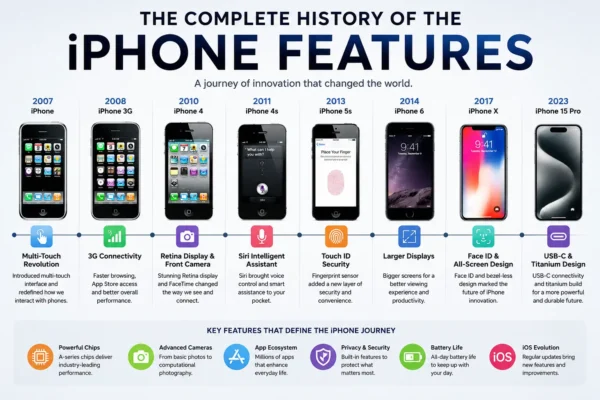
The Complete History of the iPhone
The Beginning of Wireless Communication
The origins of mobile communication can be traced back to the invention of radio technology in the late 19th century. Scientists and engineers experimented with transmitting signals wirelessly over long distances using electromagnetic waves.
Guglielmo Marconi played a major role in developing wireless telegraph systems. His inventions demonstrated that communication could occur without physical wires, laying the foundation for modern wireless technologies.
During the early 20th century, wireless communication was mainly used for:
- Military communication
- Ship communication
- Emergency systems
- Aviation
- Broadcasting
In the 1940s and 1950s, some cities introduced basic car phone systems. However, these systems had serious limitations:
- Very limited network capacity
- Large and expensive devices
- Poor audio quality
- Limited coverage
Engineers soon realized that a more efficient system was needed to support growing demand for wireless communication.
The breakthrough came with the concept of cellular networks. Instead of using one large tower to cover an entire city, engineers divided regions into smaller cells. Frequencies could then be reused in different cells, dramatically increasing network capacity.
This innovation became the basis of modern mobile communication systems.
Understanding Mobile Network Generations
Mobile network generations represent major technological improvements in wireless communication standards. Every new generation introduced better performance, faster speeds, improved efficiency, and additional features.
The term “G” stands for generation. Each generation typically appears after major technological upgrades in network infrastructure and communication protocols.
Why Generations Matter
Every generation solved problems faced by earlier technologies:
- Better voice quality
- Improved security
- Faster internet
- Lower latency
- Higher network capacity
- Support for multimedia services
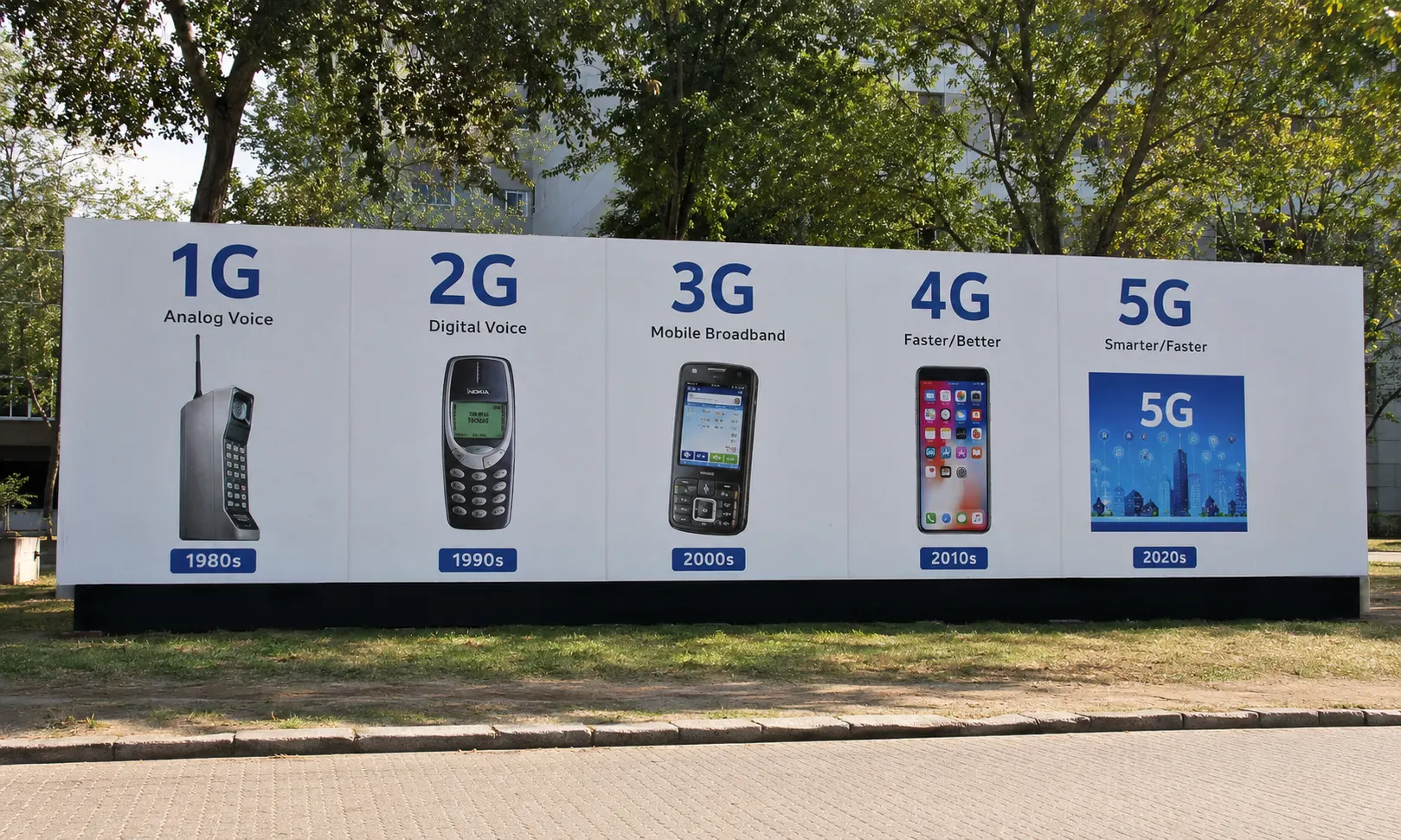
Timeline of Mobile Generations
- 1G – 1980s
- 2G – 1990s
- 3G – 2000s
- 4G – 2010s
- 5G – 2020s
Each generation changed how people used mobile devices. For example:
- 1G enabled wireless calling
- 2G introduced texting
- 3G enabled mobile internet
- 4G powered HD streaming
- 5G supports smart technologies and AI systems
The evolution of mobile generations reflects the rapid growth of digital technology worldwide.
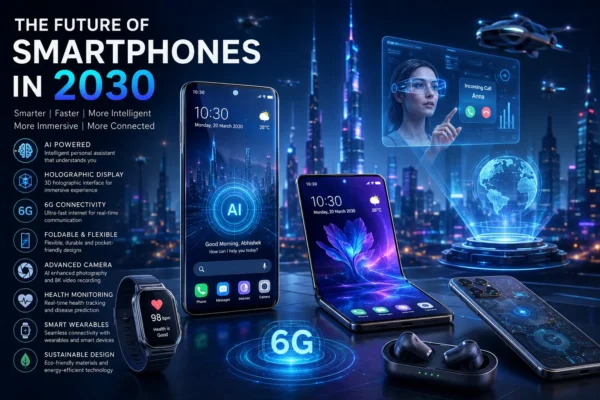
The Future of Smartphones in 2030: How Mobile Technology Will Transform Human Life
The First Generation – 1G


6
The first generation of mobile networks, commonly called 1G, was launched during the early 1980s. This was the first commercially successful cellular communication system in the world.
1G networks used analog technology to transmit voice signals. Analog systems converted sound directly into radio signals for communication.
Popular 1G technologies included:
- AMPS in the United States
- NMT in Nordic countries
- TACS in the United Kingdom
The first generation marked the beginning of portable mobile communication. Before 1G, wireless communication systems were limited and expensive.
Martin Cooper from Motorola made the first handheld mobile phone call in 1973, which became one of the most important moments in communication history.
Although 1G phones were bulky and costly, they represented freedom because users could communicate while moving instead of relying on landline phones.
Businesses, government officials, and wealthy consumers became the first users of mobile phones during this era.
Features and Limitations of 1G
Main Features of 1G
The first generation introduced several revolutionary concepts:
Wireless Voice Calling
People could make calls without fixed telephone lines.
Cellular Technology
The use of cellular towers improved coverage and communication efficiency.
Mobility
Users could communicate while traveling.
Large Regional Coverage
1G networks covered large cities and highways.
Limitations of 1G
Despite being revolutionary, 1G had serious weaknesses.
Poor Audio Quality
Calls often suffered from static noise and interference.
Weak Security
Analog signals were not encrypted, making them vulnerable to eavesdropping.
Limited Battery Life
Early mobile phones consumed large amounts of power.
Expensive Devices
Only wealthy individuals could afford mobile phones.
Large Size
Phones were heavy and difficult to carry.
No Internet or Messaging
1G networks only supported voice communication.
These limitations motivated engineers to develop more advanced digital systems.
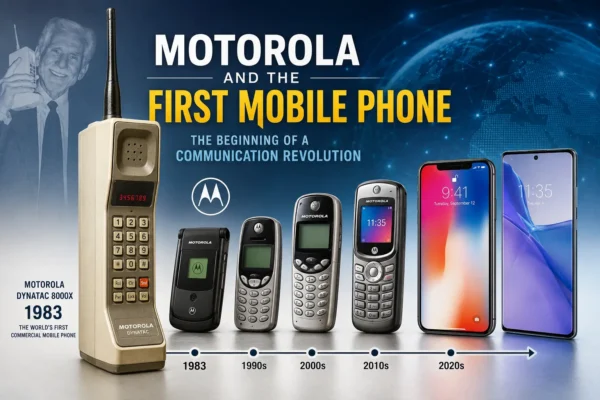
The Story of Motorola and the First Mobile Phone
The Rise of 2G Networks


6
The second generation of mobile communication, known as 2G, appeared during the early 1990s and transformed the telecommunications industry.
Unlike 1G, 2G used digital technology instead of analog systems. Digital communication improved call quality, increased network efficiency, and introduced stronger security.
2G networks supported:
- Digital voice calls
- SMS messaging
- Basic data services
Major 2G technologies included:
- GSM
- CDMA
- TDMA
The introduction of 2G made mobile phones smaller, cheaper, and more accessible to the public.
This period saw massive growth in mobile phone adoption worldwide. Mobile devices became lifestyle products instead of luxury business tools.
Companies like Nokia and Samsung became global leaders during the 2G era.
GSM Technology and Digital Communication
Global System for Mobile Communications became the most successful mobile communication standard in history.
GSM standardized mobile communication across countries and enabled international roaming.
Important Features of GSM
SIM Cards
SIM cards stored user identity information and allowed users to switch devices easily.
Improved Security
Digital encryption protected conversations from interception.
Better Call Quality
Digital transmission improved audio clarity.
International Compatibility
Users could use their phones in different countries.
Efficient Spectrum Usage
Networks could support more users simultaneously.
The widespread adoption of GSM accelerated global mobile phone growth and helped establish modern telecom industries.
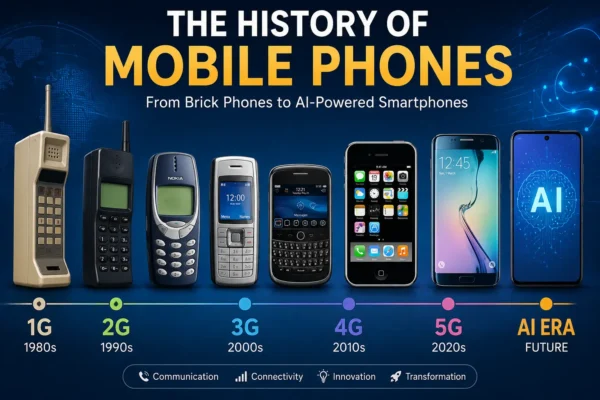
The History of Mobile Phones: From Brick Phones to AI-Powered Smartphones
SMS and Mobile Messaging Revolution
SMS, or Short Message Service, became one of the most popular features introduced during the 2G era.
Text messaging changed communication forever because it allowed users to send short written messages instantly and cheaply.
SMS became popular because:
- It was affordable
- Messages could be stored
- Communication became faster
- Users could communicate silently
The SMS revolution changed social communication habits, especially among teenagers and young adults.
Businesses also adopted SMS for:
- Promotional campaigns
- Banking alerts
- OTP verification
- Customer notifications
During the late 1990s and early 2000s, billions of text messages were sent globally every day.
The popularity of SMS proved that mobile phones could be used for much more than voice communication.

Best Phones Under ₹30,000 in 2026 – Complete Buying Guide
Mobile Internet Begins with 2.5G
As internet usage increased globally, telecom companies introduced improved versions of 2G networks known as 2.5G.
Technologies like:
- GPRS
- EDGE
allowed mobile devices to access the internet for the first time.
Although internet speeds were very slow compared to modern standards, 2.5G enabled several new services:
- Email access
- Basic web browsing
- Multimedia messaging
- Downloadable wallpapers and ringtones
This period marked the beginning of mobile internet culture.
Users became increasingly interested in online connectivity, motivating companies to develop faster networks.
The success of 2.5G demonstrated that mobile devices could become internet communication platforms in the future.
The Arrival of 3G Networks


3G networks arrived during the early 2000s and represented a major breakthrough in wireless data communication.
Unlike previous generations, 3G focused heavily on internet services.
Key 3G technologies included:
- UMTS
- WCDMA
- CDMA2000
3G networks provided significantly faster speeds than 2G, enabling smoother online experiences.
This generation introduced:
- Mobile web browsing
- App downloads
- Video streaming
- Video calling
- Social networking
The rise of smartphones closely matched the growth of 3G infrastructure worldwide.
Users no longer viewed phones only as communication devices. Smartphones became portable entertainment and productivity systems.
Mobile Internet Revolution
3G networks triggered the mobile internet revolution.
People could now access websites, email, maps, and online services directly from their phones.
The launch of the iPhone and Android smartphones accelerated this transformation.
Mobile internet changed industries such as:
- Media
- Advertising
- Retail
- Education
- Banking
Social media platforms like:
- YouTube
- Twitter/X
grew rapidly because users could access them from anywhere.
The app economy also exploded during the 3G era. Millions of developers started creating mobile applications for communication, gaming, finance, shopping, and entertainment.
Video Calling and Multimedia Era
3G networks introduced multimedia communication features that were impossible on older networks.
Video Calling
Users could finally see each other during conversations using front-facing cameras.
Mobile Music
People began streaming and downloading music on their phones.
Online Video
Mobile video streaming became practical for the first time.
Mobile Photography Sharing
Users could instantly upload photos online.
3G also accelerated the popularity of mobile entertainment, making smartphones central to daily digital life.
This era laid the foundation for modern content creation and influencer culture.
The Development of 4G LTE


4G networks were introduced around 2010 and focused on delivering broadband-level internet speeds.
LTE, or Long Term Evolution, became the dominant 4G standard globally.
Compared to 3G, 4G offered:
- Much faster speeds
- Lower latency
- Better reliability
- Higher bandwidth
4G transformed mobile internet from a convenience into a necessity.
This generation enabled:
- HD streaming
- Cloud computing
- High-quality gaming
- Real-time navigation
- Faster downloads
Telecom companies invested heavily in expanding 4G infrastructure because consumer demand for internet services increased rapidly.
How 4G Changed Smartphones
4G networks completely changed smartphone usage patterns.
With faster internet, smartphones became powerful multimedia devices capable of replacing computers for many tasks.
HD Streaming
Users could watch movies and videos in high definition without buffering.
Cloud Services
People stored photos and documents online.
Video Conferencing
Apps like video meeting platforms became practical on mobile devices.
App Ecosystem Growth
Applications became larger and more advanced.
Streaming platforms such as:
- Netflix
- Spotify
grew massively because of reliable 4G connectivity.
The smartphone industry expanded rapidly during this era.
Streaming, Gaming, and Social Media Growth
4G played a massive role in the growth of entertainment industries.
Streaming Services
People increasingly consumed entertainment through smartphones instead of televisions.
Mobile Gaming Industry
Online multiplayer games became extremely popular.
Games such as:
- PUBG Mobile
- Call of Duty: Mobile
required stable high-speed internet connections.
Social Media Revolution
Platforms became more video-focused during the 4G era.
Short videos, live streaming, influencer marketing, and mobile content creation exploded globally.
Social media also became a major business and advertising industry.
Introduction to 5G Networks


5G is the fifth generation of mobile communication technology and one of the biggest advancements in wireless networking history.
Unlike earlier generations focused mainly on consumer smartphones, 5G also targets industries, automation, AI systems, and smart infrastructure.
5G networks offer:
- Extremely high speeds
- Very low latency
- Massive device connectivity
- Improved efficiency
Telecom companies and governments worldwide are rapidly investing in 5G deployment.
Major companies involved include:
- Ericsson
- Huawei
- Qualcomm
- Nokia
5G is expected to power future technologies like autonomous vehicles, smart factories, and advanced robotics.
Features and Advantages of 5G
Ultra-Fast Internet Speeds
5G can deliver speeds exceeding 1 Gbps under ideal conditions.
Low Latency
Communication delays are dramatically reduced.
Better Network Capacity
Millions of devices can connect simultaneously.
Improved Reliability
5G networks perform better in crowded locations.
Advanced Technology Support
5G enables:
- Augmented reality
- Virtual reality
- AI systems
- Remote healthcare
- Autonomous transportation
The technology is expected to transform industries worldwide.
Smart Cities and Internet of Things
5G supports the growth of smart cities and the Internet of Things (IoT).
IoT refers to devices connected through the internet that communicate automatically.
Examples include:
- Smart traffic systems
- Connected cars
- Smart homes
- Industrial robots
- Healthcare monitoring systems
5G’s high capacity and low latency make these systems more efficient and reliable.
Governments are exploring smart city projects to improve:
- Transportation
- Energy management
- Public safety
- Environmental monitoring
The future of urban infrastructure will heavily depend on advanced wireless communication systems.
Challenges of 5G Technology
Despite its advantages, 5G faces several important challenges.
High Infrastructure Costs
Building 5G networks requires expensive upgrades.
Limited Range
High-frequency signals travel shorter distances.
Device Compatibility Issues
Older phones cannot fully use 5G services.
Cybersecurity Risks
More connected devices increase security concerns.
Energy Consumption
Large-scale networks require substantial power.
Many countries continue improving infrastructure and regulations to overcome these issues.
Differences Between 1G, 2G, 3G, 4G, and 5G
| Generation | Main Technology | Major Feature | Speed |
|---|---|---|---|
| 1G | Analog | Voice Calls | Very Slow |
| 2G | Digital GSM | SMS and Secure Calling | Kbps |
| 3G | UMTS/WCDMA | Mobile Internet | Mbps |
| 4G | LTE | Broadband Internet | 100+ Mbps |
| 5G | Advanced Wireless | Smart Connectivity and AI | 1+ Gbps |
Each generation introduced significant improvements that changed communication technology forever.
Future of Mobile Networks Beyond 5G
Researchers are already working on future communication technologies like 6G.
Possible future advancements include:
- Holographic communication
- AI-powered networks
- Space-based internet systems
- Real-time language translation
- Fully immersive virtual worlds
6G could provide:
- Terabit-level speeds
- Near-zero latency
- Intelligent network automation
The future of communication technology will likely become even more integrated with artificial intelligence and smart systems.
Impact of Mobile Networks on Society
Mobile networks changed human civilization dramatically.
Education
Students can access online classes worldwide.
Healthcare
Doctors provide telemedicine services remotely.
Business
Companies operate internationally using mobile connectivity.
Entertainment
Streaming and gaming industries rely heavily on mobile internet.
Social Connectivity
Families and friends stay connected globally.
Mobile networks have become essential for economic growth and digital transformation.
Mobile Networks in India


7
India is one of the world’s largest telecommunications markets.
The country experienced rapid mobile growth during the 2000s and 2010s.
Major telecom companies include:
- Reliance Jio
- Airtel
- Vi India
Affordable smartphones and low-cost internet plans increased digital access across urban and rural areas.
The launch of affordable 4G services transformed internet usage in India, making online streaming, education, digital payments, and social media more accessible.
India is now rapidly expanding 5G infrastructure to support future digital development.
Conclusion
The history of mobile networks from 1G to 5G represents one of humanity’s most important technological journeys. Each generation improved communication systems while transforming industries and society.
1G introduced wireless calling. 2G brought digital communication and SMS. 3G enabled mobile internet. 4G powered streaming and smartphone ecosystems. 5G is now creating a world driven by artificial intelligence, automation, and smart connectivity.
Mobile networks have changed education, healthcare, entertainment, transportation, business, and everyday life. Billions of people now rely on mobile communication for personal and professional activities.
As technology continues evolving toward 6G and beyond, the future promises even faster, smarter, and more connected communication systems that could redefine how humans interact with technology and each other.
FAQs
The difference between 1G, 2G, 3G, 4G, and 5G mobile networks lies mainly in their technology, speed, features, and capabilities. Each generation introduced major improvements over the previous one and completely changed how people use mobile phones and internet services.
1G was the first generation of mobile networks introduced in the 1980s. It used analog technology and mainly supported voice calls. Call quality was poor, security was weak, and devices were large and expensive. Despite its limitations, 1G marked the beginning of wireless communication.
2G arrived in the 1990s and introduced digital communication technology. This generation improved voice quality, security, and network efficiency. One of the biggest innovations of 2G was SMS messaging, which became extremely popular worldwide. Technologies like GSM and CDMA made mobile communication more reliable and accessible.
3G networks emerged during the early 2000s and introduced mobile internet services. This generation allowed users to browse websites, send emails, use social media, and make video calls. Smartphones became more powerful because 3G networks could handle internet data much better than earlier generations. The rise of app stores and online streaming also began during this period.
4G brought high-speed broadband internet to mobile devices. Introduced around 2010, 4G LTE dramatically improved internet speeds, allowing users to stream HD videos, play online games, conduct video conferences, and use cloud services smoothly. Social media platforms and streaming apps became more advanced because of 4G technology.
5G is the latest generation and focuses on ultra-fast speeds, low latency, and massive connectivity. It supports technologies like smart cities, autonomous vehicles, artificial intelligence, virtual reality, and the Internet of Things. 5G networks can connect millions of devices simultaneously and provide significantly faster internet than previous generations.
Overall, every generation improved communication systems and expanded the possibilities of mobile technology. The journey from 1G to 5G reflects the rapid growth of global digital connectivity and innovation.
Mobile networks completely transformed human life and communication by making information and connectivity accessible anytime and anywhere. Before mobile networks became popular, communication mainly depended on landline telephones and physical meetings. Today, billions of people use smartphones for communication, education, entertainment, healthcare, and business activities because of advanced mobile networks.
One of the biggest changes brought by mobile networks is instant communication. People can now make voice calls, send text messages, conduct video calls, and use social media platforms from almost any location. Families and friends living in different countries can stay connected easily through mobile internet and messaging applications.
Mobile networks also revolutionized access to information. With the growth of 3G, 4G, and 5G networks, users can browse the internet, search for knowledge, watch educational videos, and attend online classes directly from smartphones. This has significantly improved education opportunities worldwide, especially in remote areas.
The business world has also changed dramatically because of mobile communication. Companies can operate globally, employees can work remotely, and digital marketing industries have grown rapidly. Mobile banking and digital payment systems allow users to transfer money and manage finances securely using smartphones.
Healthcare services improved because doctors can now provide telemedicine consultations through mobile networks. Patients in rural areas can communicate with medical professionals without traveling long distances. Emergency communication systems also became more efficient because mobile networks enable faster disaster response and public safety coordination.
Entertainment industries experienced massive growth due to mobile internet. Streaming services, online gaming, social media, and content creation became central parts of modern life. Influencers, YouTubers, and online creators now depend heavily on high-speed mobile networks.
Social behavior also changed significantly. People spend more time on digital platforms, social networking apps, and online communities. Mobile communication became an essential part of daily routines worldwide.
Overall, mobile networks transformed society by improving communication, increasing access to information, supporting economic growth, and creating a highly connected digital world.
5G is considered revolutionary because it goes far beyond faster internet speeds and introduces entirely new possibilities for communication, automation, and smart technologies. Unlike previous generations that mainly focused on improving smartphone experiences, 5G is designed to support future technologies such as artificial intelligence, autonomous vehicles, smart cities, industrial automation, and the Internet of Things.
One of the biggest advantages of 5G is extremely high speed. Under ideal conditions, 5G networks can achieve speeds exceeding 1 Gbps, allowing users to download large files within seconds. This makes streaming 4K and even 8K videos smoother and improves cloud-based applications significantly.
Another important feature of 5G is low latency. Latency refers to the delay between sending and receiving data. 5G dramatically reduces this delay, enabling real-time communication. This is especially important for applications like remote surgery, autonomous driving, online gaming, and industrial robotics, where even small delays can cause major problems.
5G also supports massive device connectivity. Millions of smart devices can connect to a single network simultaneously without reducing performance. This capability is essential for smart cities, where traffic systems, surveillance cameras, vehicles, sensors, and public services need continuous communication.
Industries are expected to benefit greatly from 5G technology. Smart factories can use connected robots and automated systems to improve production efficiency. Healthcare systems can provide remote monitoring and advanced telemedicine services. Transportation systems can support self-driving vehicles with real-time communication.
Virtual reality and augmented reality technologies also become more practical with 5G because they require fast and stable connections. Educational institutions, gaming companies, and businesses are exploring new immersive digital experiences powered by 5G networks.
Despite its advantages, 5G also faces challenges such as infrastructure costs, cybersecurity concerns, and limited coverage in some regions. However, governments and telecom companies are investing heavily in expanding 5G infrastructure worldwide.
Overall, 5G is revolutionary because it is creating the foundation for a smarter, faster, and more connected future where digital systems and intelligent technologies become deeply integrated into everyday life.
Modern mobile networks face several important challenges despite major technological advancements. As billions of users and connected devices depend on wireless communication, telecom companies and governments must continuously improve infrastructure, security, and network performance to meet growing demand.
One of the biggest challenges is infrastructure cost. Building and maintaining mobile networks requires enormous investment. Telecom companies need to install towers, fiber-optic cables, data centers, and advanced equipment to support faster internet services like 4G and 5G. Expanding networks into rural and remote areas can be especially expensive.
Another major challenge is increasing data consumption. People now use smartphones for streaming videos, gaming, video conferencing, cloud storage, and social media. High-definition content consumes massive amounts of bandwidth, putting pressure on network capacity. Telecom companies must constantly upgrade systems to handle growing internet traffic.
Cybersecurity is also a serious concern for modern mobile networks. As more devices connect to the internet through mobile networks, the risk of hacking, data theft, and cyberattacks increases. 5G networks support millions of connected devices, which creates additional security vulnerabilities. Protecting user privacy and sensitive information has become a critical priority.
Spectrum availability is another challenge. Mobile networks rely on radio frequency spectrum for communication, but spectrum resources are limited. Governments regulate spectrum allocation, and telecom operators compete for access to suitable frequency bands.
Coverage limitations can also affect user experience. High-frequency 5G signals provide fast speeds but travel shorter distances and struggle to penetrate buildings. This means telecom companies need many additional towers and small cells to provide stable coverage.
Energy consumption is becoming increasingly important as networks expand globally. Large data centers, towers, and communication systems consume significant electricity. Telecom companies are exploring energy-efficient technologies and renewable power sources to reduce environmental impact.
Device compatibility is another issue because older smartphones may not support newer network technologies. Consumers often need to upgrade devices to access advanced services like 5G.
Overall, modern mobile networks face technical, financial, security, and environmental challenges. However, continuous innovation and global investment are helping the telecommunications industry overcome these obstacles and improve connectivity worldwide.
The future of mobile networks after 5G is expected to be even more advanced, intelligent, and transformative. Researchers and technology companies are already exploring next-generation communication systems often referred to as 6G. Although 5G is still expanding globally, the development of future wireless technologies has already begun because demand for faster and smarter connectivity continues growing rapidly.
6G networks are expected to provide speeds far beyond current 5G capabilities. Some experts believe future networks could achieve terabit-per-second speeds, making data transfer nearly instantaneous. This would allow users to download massive files within moments and support highly advanced digital experiences.
Artificial intelligence will likely play a major role in future mobile networks. AI-powered systems could automatically optimize network performance, reduce congestion, improve cybersecurity, and manage communication between billions of connected devices. Intelligent automation may make future networks more efficient and reliable than ever before.
Future mobile technologies may also support holographic communication. Instead of traditional video calls, users could experience realistic 3D hologram interactions for business meetings, education, healthcare, and entertainment. This could completely change digital communication methods.
Space-based internet systems are another major area of development. Satellite communication networks may provide global internet coverage, including remote regions where traditional mobile towers are difficult to build. Companies worldwide are investing heavily in satellite internet technologies to improve global connectivity.
The growth of smart cities and autonomous systems will depend heavily on future mobile networks. Connected vehicles, intelligent transportation systems, industrial robots, and smart infrastructure will require extremely reliable and low-latency communication networks to function safely and efficiently.
Virtual reality and augmented reality technologies are also expected to become more immersive. Future networks could enable highly realistic digital environments used for gaming, education, healthcare training, and remote collaboration.
However, future mobile technologies will also face challenges such as cybersecurity risks, energy consumption, infrastructure costs, and privacy concerns. Governments and technology companies will need to create strong regulations and advanced security systems to protect users.
Overall, the future of mobile networks after 5G promises a world where communication becomes faster, smarter, and deeply integrated with artificial intelligence and advanced digital systems. These technologies could transform how humans live, work, learn, and interact with the world around them.
Leave a Reply