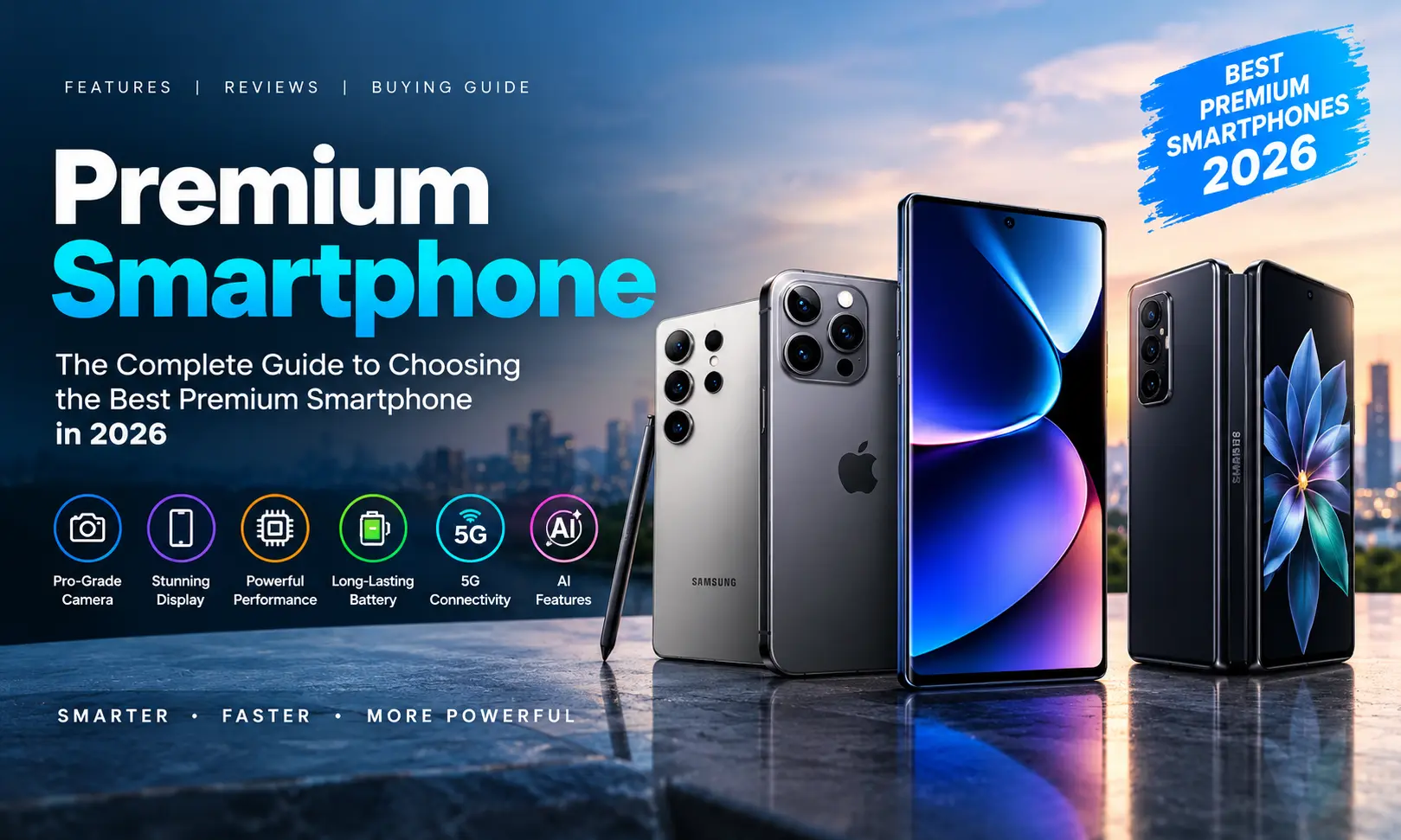
A premium smartphone is more than an expensive mobile phone. It is designed to deliver a combination of high-end performance, advanced cameras, beautiful displays, premium materials, powerful processors, long-term software support, fast connectivity, intelligent features, and an overall experience that feels noticeably better than an ordinary smartphone.
The premium smartphone market has changed dramatically in recent years. Flagship phones now compete not only on processor speed and camera megapixels but also on artificial intelligence, computational photography, privacy, gaming performance, battery efficiency, charging technology, display quality, durability, and ecosystem integration.
In 2026, premium smartphones include traditional flagship models as well as sophisticated foldable phones. Industry buyer guides continue to place flagship and foldable devices at the highest end of the smartphone market, with manufacturers competing across performance, cameras, displays, design, and software experiences.
This comprehensive guide explains everything you should know before buying a premium smartphone. Whether you are a professional, content creator, gamer, photographer, business user, student, or someone who simply wants the best possible mobile experience, this guide will help you understand what actually matters.
What Is a Premium Smartphone?
A premium smartphone is generally a high-end device that offers superior hardware, software, design, cameras, display technology, performance, and connectivity compared with budget and mid-range smartphones.
Premium smartphones are commonly called:
- Flagship smartphones
- High-end smartphones
- Premium mobile phones
- Luxury smartphones
- Flagship mobile phones
- Top-tier smartphones
- Performance smartphones
- Professional smartphones
However, expensive does not automatically mean premium.
A phone can have a high price because of its brand, design, limited availability, or luxury materials while offering fewer practical advantages than a conventional flagship. Therefore, buyers should evaluate the complete experience rather than simply choosing the most expensive model.
A genuinely premium smartphone should provide strong performance, excellent display quality, dependable cameras, good battery endurance, quality construction, useful software, strong security, reliable connectivity, and long-term usability.
For example, current flagship devices demonstrate how manufacturers are combining advanced processors, AI capabilities, sophisticated camera systems, high-quality displays, thermal management, and fast charging into a single device. Samsung’s Galaxy S26 Ultra, for example, combines a large anti-reflective display, a customized high-end processor, advanced camera hardware, AI features, a vapor chamber cooling system, and fast charging.
Why Choose a Premium Smartphone?
The biggest reason people purchase a premium smartphone is the overall experience.
A budget phone may perform basic tasks such as messaging, calling, social media, browsing, and video streaming. A premium smartphone aims to make those activities faster, smoother, more reliable, and more enjoyable while also supporting demanding workloads.
1. Faster Performance
Premium phones usually use high-end processors designed for intensive workloads.
This means you can:
- Open demanding applications quickly
- Switch between multiple apps
- Edit photos and videos
- Play advanced games
- Use AI-powered features
- Record high-resolution video
- Multitask efficiently
- Perform demanding professional tasks
Modern flagship processors also include dedicated hardware for artificial intelligence, graphics processing, image processing, and energy management.
2. Better Cameras
Camera quality is one of the most important reasons consumers upgrade to premium smartphones.
High-end phones may include:
- Large main camera sensors
- Ultra-wide cameras
- Telephoto cameras
- Periscope zoom cameras
- Advanced stabilization
- Computational photography
- Improved night photography
- High-resolution video recording
- Professional shooting modes
- AI-powered editing
The number of megapixels is only one part of camera quality. Sensor size, lens quality, image processing, stabilization, autofocus, dynamic range, and software optimization can be equally important.
3. Superior Displays
A premium smartphone usually features an advanced OLED or AMOLED display with excellent brightness, contrast, color accuracy, viewing angles, and refresh rate.
A good display can make:
- Movies look more immersive
- Games feel smoother
- Photos appear more detailed
- Websites easier to read
- Video editing more accurate
- Outdoor use more comfortable
Some modern premium smartphones also introduce specialized privacy technologies. For example, Samsung’s Galaxy S26 Ultra includes a built-in Privacy Display designed to limit visibility from side angles.
4. Premium Build Quality
Premium smartphones often use carefully engineered materials such as:
- Aluminum
- Titanium
- Advanced glass
- Ceramic
- High-strength protective glass
The design is usually more refined than inexpensive devices.
However, premium construction should not be confused with unlimited durability. A high-end phone can still be damaged by drops, water, heat, or improper use.
5. Longer-Term Value
A premium smartphone can remain useful for many years when the manufacturer provides strong software support and the hardware remains capable.
This can make an expensive smartphone more economical over its useful life than repeatedly replacing cheaper phones.
Premium Smartphone vs Budget Smartphone
The difference between premium and budget smartphones is not limited to price.
A budget phone is generally designed to deliver essential smartphone functionality at a lower cost. A premium phone is designed to maximize performance, camera quality, materials, display technology, connectivity, and software capabilities.
| Feature | Budget Smartphone | Premium Smartphone |
|---|---|---|
| Processor | Basic/Mid-range | High-end flagship |
| Display | LCD or basic OLED | Advanced OLED/AMOLED |
| Refresh Rate | Often 60–120Hz | Usually high refresh rate |
| Cameras | Good for everyday use | Advanced multi-camera systems |
| Zoom | Usually limited | Advanced telephoto/periscope options |
| Video | Standard | Advanced stabilization and recording |
| Build | Plastic/common materials | Premium glass/metal materials |
| Gaming | Casual gaming | High-performance gaming |
| AI | Basic features | Advanced AI capabilities |
| Storage | Limited/moderate | High storage options |
| Charging | Basic/fast | Fast or ultra-fast |
| Connectivity | Standard 5G/Wi-Fi | Advanced connectivity |
| Software | Standard | Premium features and longer support |
| Price | Lower | Higher |
This does not mean that every premium smartphone is better for every person.
For someone who primarily uses WhatsApp, calls, YouTube, Instagram, and web browsing, a premium phone may provide more performance than necessary.
For a photographer, gamer, business professional, content creator, or technology enthusiast, however, the additional capabilities can be much more valuable.
The Most Important Premium Smartphone Features
Before buying a high-end phone, focus on the features that will actually affect your daily experience.
1. Processor and Performance
The processor is the central component responsible for much of a smartphone’s performance.
Premium processors are designed to handle demanding workloads while maintaining efficiency.
When comparing processors, consider:
- CPU performance
- GPU performance
- AI/NPU performance
- Power efficiency
- Thermal management
- Image processing
- Gaming performance
- Modem capabilities
Do not choose a smartphone based solely on benchmark numbers.
Real-world performance matters more.
A phone that performs extremely well for ten minutes but becomes excessively hot during extended gaming may be less useful than a slightly slower phone with better sustained performance.
Modern flagship manufacturers increasingly combine powerful processors with advanced cooling systems. Samsung, for example, describes a larger vapor chamber in the Galaxy S26 Ultra to help manage heat during demanding gaming and AI workloads.
2. Display Quality
The display is one of the components you interact with every day.
For a premium smartphone, look at:
Resolution
Higher resolution can provide sharper images and text, although resolution is not the only factor determining display quality.
Refresh Rate
A higher refresh rate can make scrolling, animations, and gaming feel smoother.
Brightness
High peak brightness is particularly useful outdoors.
Color Accuracy
Accurate colors are important for photographers, designers, video editors, and content creators.
HDR
HDR support can improve compatible movies, photographs, and games by providing greater contrast and richer highlights.
Touch Response
Fast touch response is especially important for mobile gaming.
Adaptive Refresh Rate
Some premium displays can dynamically adjust their refresh rate depending on what is happening on the screen. This can help balance smoothness and battery consumption.
A premium display should therefore be evaluated as a complete package rather than simply by resolution or refresh-rate numbers.
 Earning
AD admin| Apr 07, 2026| 4 min read
Instagram Se Paise Kaise Kamaye (Real Guide 2026)
3. Premium Smartphone Camera System
The camera is often the most important feature for premium-phone buyers.
Today’s flagship smartphones can replace many casual users’ dedicated cameras for everyday photography and video.
Main Camera
The main camera is normally the most important camera on the phone.
Look for:
- Large sensor
- Good low-light performance
- Fast autofocus
- Optical stabilization
- Natural colors
- Strong dynamic range
- Consistent processing
Ultra-Wide Camera
An ultra-wide camera is useful for:
- Landscapes
- Architecture
- Group photographs
- Travel
- Interior photography
Telephoto Camera
Telephoto cameras allow you to photograph distant subjects without relying entirely on digital zoom.
They are useful for:
- Portraits
- Sports
- Wildlife
- Concerts
- Travel
- Street photography
Periscope Zoom
Some premium smartphones use folded optical designs to provide longer-range zoom within a relatively thin phone.
This is particularly useful for photography enthusiasts.
Front Camera
The selfie camera matters for:
- Video calls
- Selfies
- Social media
- Online meetings
- Vlogging
But image quality depends on more than megapixels.
4. Computational Photography
One of the biggest advantages of premium smartphones is computational photography.
The phone combines:
- Camera hardware
- Image signal processors
- AI
- Machine learning
- Multiple exposures
- Software algorithms
to create the final photograph.
This allows smartphones to improve:
- HDR
- Night photography
- Skin tones
- Noise reduction
- Sharpening
- Portrait separation
- Stabilization
- Video quality
This is why two smartphones with similar camera specifications can produce very different results.
For premium smartphone buyers, real-world camera samples and reviews can therefore be more useful than a specification sheet alone.
5. Video Recording
Content creators should pay particular attention to video capabilities.
Important features include:
- 4K recording
- High-frame-rate recording
- Optical stabilization
- Electronic stabilization
- HDR video
- Good microphone quality
- Low-light video
- Cinematic modes
- Professional controls
Premium phones increasingly use AI and advanced image processing to improve video quality.
Apple’s current iPhone lineup, for example, emphasizes features such as Action mode, Audio Mix, Cinematic mode, Camera Control, and advanced camera processing.
6. Battery Life
A powerful phone is not useful if its battery cannot last through your day.
When evaluating battery performance, consider:
- Battery capacity
- Processor efficiency
- Display efficiency
- Software optimization
- Background activity
- Charging speed
- Wireless charging
- Battery health features
Battery capacity is normally measured in mAh, but a larger number does not automatically guarantee better battery life.
A highly optimized phone with a smaller battery can sometimes last longer than a poorly optimized phone with a larger battery.
 Gaming
AB Abhishek Gupta| Apr 04, 2026| 15 min read
What is AI PC / Copilot+ Laptop? (Complete Guide 2026)
7. Fast Charging
Premium smartphones increasingly offer fast charging.
Fast charging is useful when:
- You travel frequently
- You use GPS
- You play games
- You record video
- You forget to charge overnight
- You spend long hours away from a power outlet
However, charging speed should not be the only consideration.
Battery longevity and thermal management are also important.
Samsung’s current flagship information, for example, highlights both fast charging and battery-health considerations rather than treating charging speed as the only goal.
8. Storage
Premium smartphones often provide significantly more storage than basic phones.
Storage matters because modern applications, photographs, games, and especially high-resolution videos can consume large amounts of space.
128GB
Suitable for light users.
256GB
A good choice for many premium smartphone buyers.
512GB
Recommended for photographers, gamers, and people who store large amounts of video.
1TB
Useful for professional creators and extremely heavy users.
For example, Samsung’s Galaxy S26 Ultra is offered with storage configurations reaching 1TB, while its 1TB version is paired with 16GB memory.
If you plan to keep your phone for several years, buying more storage can be worthwhile.
9. RAM
RAM helps the smartphone keep applications available for quick switching.
More RAM can be useful for:
- Heavy multitasking
- Gaming
- Photo editing
- Video editing
- AI applications
- Large applications
However, more RAM does not automatically make every phone faster.
Software optimization is extremely important.
Therefore, do not buy a smartphone simply because it advertises the largest RAM number.
10. 5G and Connectivity
A premium smartphone should offer modern connectivity.
Important technologies include:
- 5G
- Wi-Fi
- Bluetooth
- NFC
- GPS
- eSIM
- USB-C
- Modern cellular standards
Connectivity can vary by region, so buyers should verify the exact model available in their country.
For Indian consumers, compatibility with local 5G networks and carrier bands should be checked before purchasing an imported smartphone.
 Gaming
AB Abhishek Gupta| Apr 01, 2026| 10 min read
Best AI Laptops in 2026: The Future of Smart Computing (Detailed Guide)
Premium Smartphones and Artificial Intelligence
Artificial intelligence has become one of the defining features of modern premium smartphones.
AI can assist with:
- Photo editing
- Translation
- Writing
- Search
- Voice commands
- Summaries
- Image generation
- Productivity
- Call assistance
- Personalization
The important question is not whether a phone has AI.
Almost every modern flagship can advertise AI features.
The better question is:
Does the AI actually solve problems you have?
For example, a content creator may benefit from AI photo editing and transcription, while a business user may benefit more from summarization, translation, productivity tools, and document assistance.
Samsung’s current flagship software emphasizes AI functions such as Photo Assist, Creative Studio, and contextual assistance.
Apple similarly integrates AI-oriented processing into its current flagship silicon and camera experience.
Premium Smartphone for Gaming
Gaming is one area where flagship hardware can make a significant difference.
A premium gaming-capable smartphone should have:
- Powerful CPU
- Strong GPU
- High-refresh-rate display
- Fast touch response
- Effective cooling
- Large battery
- Fast charging
- Good sustained performance
- Quality speakers
- Reliable network connectivity
Thermal performance is particularly important.
When the phone becomes too hot, performance can decrease through thermal throttling.
This is why premium gaming phones often use advanced cooling systems.
The broader 2026 gaming-phone market includes devices emphasizing powerful processors, large batteries, advanced cooling, and high-refresh-rate displays.
Premium Smartphone for Photography
If photography is your main priority, do not choose a phone simply because it has the highest megapixel count.
Instead, compare:
- Main camera sensor
- Lens quality
- Optical stabilization
- Autofocus
- Telephoto performance
- Ultra-wide quality
- Night photography
- Portrait photography
- Skin tones
- Video stabilization
- Camera application
- RAW/pro controls
A 200MP camera is not automatically better than a 50MP camera.
Sensor quality and image processing often matter more than the headline resolution.
For example, Samsung’s current flagship camera system combines a 200MP main camera with additional telephoto hardware and AI/image-processing technologies.
Premium Smartphone for Content Creators
Content creators need more than a good camera.
A creator-focused smartphone should provide:
- Excellent cameras
- High-quality video
- Large storage
- Fast processor
- Strong microphones
- Good speakers
- Bright display
- Long battery life
- Fast charging
- Reliable connectivity
- Good editing applications
If you create YouTube videos, Instagram Reels, TikTok videos, travel content, product reviews, or professional social media content, storage can become especially important.
A 4K video library can consume storage very quickly.
For creators who record frequently, 512GB or 1TB can be more practical than choosing a cheaper model with limited storage.
Premium Smartphone for Business Users
Business professionals may prioritize different features.
Important factors include:
- Security
- Privacy
- Battery life
- Reliable connectivity
- Productivity software
- Email performance
- Document handling
- Video conferencing
- Multitasking
- Long-term software support
Privacy is increasingly important in premium smartphones.
Modern devices are beginning to incorporate hardware and software features specifically designed to protect sensitive information from people nearby. Samsung’s Galaxy S26 Ultra, for instance, includes an integrated Privacy Display with configurable privacy behavior.
Gaming
AB Abhishek Gupta| Apr 04, 2026| 15 min read
What is AI PC / Copilot+ Laptop? (Complete Guide 2026)
Premium Smartphone for Travelers
Travelers should prioritize:
- Battery endurance
- Fast charging
- Camera quality
- GPS
- 5G
- eSIM support
- Dual-SIM capabilities
- Storage
- Durability
- Water resistance
A good travel smartphone can function as:
- Camera
- GPS
- Translator
- Boarding-pass holder
- Payment device
- Communication tool
- Entertainment device
- Emergency information source
This makes smartphone reliability particularly important when traveling.
Premium Smartphone Design and Build Quality
Premium smartphones are increasingly designed to feel like high-quality consumer electronics rather than simple communication devices.
Common design priorities include:
- Thin construction
- Narrow bezels
- Strong frames
- Premium glass
- Refined camera modules
- Ergonomic edges
- Better water resistance
- Improved haptics
But design should always be evaluated alongside usability.
An extremely thin phone may look beautiful but may provide less room for battery capacity or thermal management.
Likewise, a huge phone may have a fantastic display but be uncomfortable for one-handed use.
Foldable Premium Smartphones
Foldable smartphones represent another category within the premium market.
There are two major approaches.
Book-Style Foldables
These open like a small tablet.
They are useful for:
- Multitasking
- Reading
- Productivity
- Large-screen gaming
- Video editing
- Document work
Flip-Style Foldables
These fold vertically into a smaller package.
Their main advantages include:
- Pocketability
- Unique design
- Compact storage
- Flexible camera modes
- External displays
Foldables can provide experiences traditional smartphones cannot easily replicate, but buyers should carefully consider durability, weight, thickness, hinge design, software support, and price.
Current flagship buyer guides treat foldables as an increasingly important part of the premium smartphone category.
Software Experience Matters
Hardware is only half of a premium smartphone.
The software experience can determine whether a phone feels genuinely premium.
Important software considerations include:
- Operating system
- Update policy
- Security updates
- User interface
- AI integration
- Multitasking
- Customization
- Privacy controls
- Ecosystem integration
- Pre-installed applications
Before buying, check how long the manufacturer promises software and security support for the exact model.
A premium phone should ideally remain secure and useful for many years.
Android vs iPhone for Premium Buyers
The choice between Android and iPhone is largely about ecosystem and personal preference.
Android Premium Smartphones
Android flagships generally provide:
- Greater customization
- More hardware variety
- Foldable options
- Advanced multitasking
- Multiple manufacturer choices
- Wider price range
- More hardware experimentation
Android flagship manufacturers include brands such as Samsung, Google, Xiaomi, OnePlus, Oppo, Vivo, Honor, and others.
iPhone
The iPhone offers:
- Strong ecosystem integration
- Consistent software experience
- Powerful processors
- Advanced video capabilities
- Strong app ecosystem
- Integration with other Apple products
Apple’s current iPhone lineup continues to focus heavily on its own silicon, camera processing, video capabilities, and ecosystem features.
Neither platform is universally best.
The best choice depends on the user’s existing devices, preferred applications, workflow, camera needs, gaming habits, and personal preferences.
How Much Should You Spend on a Premium Smartphone?
There is no single correct premium smartphone budget.
Instead, divide your budget according to your needs.
Mid-Premium
Suitable for buyers who want:
- Good cameras
- Strong performance
- High-quality display
- 5G
- Premium design
without paying for every flagship feature.
Flagship
Suitable for users who want:
- Top performance
- Excellent cameras
- Premium display
- Advanced AI
- Strong build quality
- Long-term use
Ultra-Premium
Suitable for buyers who want:
- Maximum storage
- Best camera hardware
- Largest display
- Specialized features
- Advanced materials
- Foldable designs
- Maximum performance
The most expensive smartphone is not necessarily the best value.
How to Choose the Best Premium Smartphone
Use this simple process.
Step 1: Determine Your Primary Use
Ask yourself:
What do I do most with my phone?
If you mostly take photos, prioritize cameras.
If you play games, prioritize processor, GPU, display, cooling, and battery.
If you create content, prioritize cameras, storage, microphones, battery, and editing performance.
If you run a business, prioritize security, software, productivity, and battery life.
Step 2: Select Your Operating System
Choose Android or iOS based on your ecosystem and preferences.
Step 3: Decide Your Ideal Size
Choose between:
- Compact
- Standard
- Large
- Foldable
Step 4: Compare Cameras
Do not look only at megapixels.
Compare actual photographs and video samples.
Step 5: Check Battery and Charging
Look for reliable all-day battery life and charging technology.
Step 6: Check Storage
For long-term use, 256GB or more can be a sensible starting point for many premium buyers.
Step 7: Check Software Support
A premium phone should ideally receive updates for several years.
Step 8: Compare the Complete Package
Finally, compare:
- Price
- Performance
- Camera
- Display
- Battery
- Charging
- Software
- Durability
- Storage
- Warranty
- After-sales service
Common Premium Smartphone Buying Mistakes
Mistake 1: Buying Based Only on Megapixels
More megapixels do not automatically produce better photos.
Mistake 2: Buying the Most Expensive Model
You may pay for features you never use.
Mistake 3: Ignoring Battery Life
A powerful processor and beautiful display mean little if the phone constantly needs charging.
Mistake 4: Ignoring Storage
Running out of storage can become frustrating after years of photographs and videos.
Mistake 5: Ignoring Software Updates
Hardware can remain powerful while outdated software becomes a problem.
Mistake 6: Ignoring Size and Weight
A large phone may provide a fantastic display but become uncomfortable to carry.
Mistake 7: Believing Marketing Numbers
Terms such as “AI,” “Pro,” “Ultra,” “Max,” and “Extreme” are not guarantees of superior real-world performance.
Always examine independent testing and actual user needs.
Premium Smartphone Buying Checklist
Before purchasing your next premium smartphone, check the following:
Performance
- Flagship-class processor
- Strong GPU
- Good thermal management
- Sufficient RAM
Display
- OLED/AMOLED technology
- High refresh rate
- Strong outdoor brightness
- Good color accuracy
- HDR support
Camera
- High-quality main camera
- Ultra-wide camera
- Telephoto camera
- Optical stabilization
- Good low-light photography
- Strong video recording
Battery
- All-day battery life
- Fast charging
- Good battery management
- Wireless charging if required
Storage
- At least enough storage for your expected usage
- 256GB+ for many heavy users
- 512GB/1TB for serious creators
Software
- Long-term updates
- Strong security
- Useful AI tools
- Good ecosystem integration
Durability
- Strong frame
- Protective glass
- Water/dust resistance
- Reliable warranty
Is a Premium Smartphone Worth It?
For many users, the answer is yes—but only when the features match their needs.
A premium smartphone can be worth the extra cost if you:
- Keep phones for several years
- Take many photographs
- Record videos
- Play demanding games
- Use productivity applications
- Need high performance
- Travel frequently
- Want the best display
- Need advanced connectivity
- Want premium materials
- Value long-term software support
On the other hand, if you mainly use your phone for messaging, calls, social media, music, and basic browsing, a mid-range smartphone may offer much better value.
The key is to purchase capability, not status.
Premium Smartphone Trends in 2026
The premium smartphone market is evolving quickly.
Several trends are particularly important.
AI Becomes More Practical
Instead of AI being limited to demonstrations, manufacturers are integrating it into everyday smartphone functions such as editing, search, productivity, translation, and personalization.
Cameras Become More Computational
Smartphone photography increasingly depends on the combination of sensors, processors, AI, and software.
Foldables Continue to Evolve
Foldable devices are becoming more sophisticated and are increasingly positioned as premium productivity and entertainment devices.
Privacy Becomes a Hardware Feature
Privacy is moving beyond software permissions toward dedicated hardware and display technologies.
Better Thermal Management
As processors become more powerful, manufacturers need improved cooling to maintain performance.
Larger Storage Options
High-resolution video, games, AI applications, and large media libraries make high-capacity storage increasingly useful.
Faster Charging
Manufacturers continue to improve charging speeds while also focusing on battery health and thermal management.
These trends demonstrate that premium smartphones are no longer competing only on raw specifications. They are increasingly becoming complete computing, photography, communication, entertainment, and productivity platforms.
The Future of Premium Smartphones
The premium smartphone of the future will likely become even more intelligent and context-aware.
Future devices may offer stronger:
- On-device AI
- Computational photography
- Real-time translation
- Voice interaction
- Personal productivity
- Privacy technologies
- Battery efficiency
- Satellite connectivity
- Foldable displays
- Professional video capabilities
The processor will continue to become more important because AI workloads require specialized hardware.
At the same time, battery efficiency will remain one of the biggest challenges.
The ideal future smartphone will not simply be faster.
It will understand what the user wants while consuming less energy and protecting personal information.
Frequently Asked Questions About Premium Smartphones
There is no single best premium smartphone for everyone. The ideal model depends on whether your priorities are camera quality, gaming, battery life, display, productivity, software ecosystem, or design. Current flagship buyer guides show that the premium category includes conventional flagship phones as well as foldables.
Premium smartphones typically combine flagship processors, advanced cameras, high-quality displays, premium construction, strong connectivity, advanced software, high storage options, and additional features such as AI and advanced security.
A premium smartphone is generally more capable, but it is not necessarily better value for every user. If you only need basic smartphone functions, a mid-range device may be sufficient
Not necessarily. Megapixel count is only one specification. Sensor size, lens quality, stabilization, autofocus, image processing, and software can have a major effect on image quality.
The ideal amount depends on the operating system and workload. Heavy multitaskers and power users may benefit from higher memory configurations, but RAM should be considered alongside processor performance and software optimization.
For many users, yes. However, photographers, gamers, and content creators who record large amounts of high-resolution video may benefit from 512GB or 1TB.
Yes. Flagship processors, advanced GPUs, high-refresh-rate displays, fast storage, and sophisticated cooling can make premium smartphones excellent gaming devices.
Yes. Foldables are generally positioned in the premium segment because of their advanced displays, hinge systems, engineering, and higher manufacturing costs.
Only if the AI features are useful to you. AI should be considered an additional capability rather than the sole reason to purchase a phone.
A good premium smartphone can remain useful for several years, depending on software support, battery health, hardware durability, and the user’s requirements.
Final Verdict: Choosing the Right Premium Smartphone
A premium smartphone should provide more than impressive specifications.
The best premium phone for you should deliver the right balance of:
Performance + Camera + Display + Battery + Software + Storage + Design + Durability + Connectivity.
Do not buy a smartphone simply because it has the highest processor score, largest camera sensor, most RAM, or highest megapixel count.
Instead, think about how you use your phone every day.
If you are a photographer, choose a phone with excellent cameras and computational photography.
If you are a gamer, prioritize performance, GPU power, display quality, cooling, and battery life.
If you are a content creator, focus on cameras, video quality, microphones, storage, processing power, and battery endurance.
If you are a business user, prioritize security, productivity, privacy, connectivity, and software support.
If you want an all-round premium experience, look for a flagship smartphone that balances all of these areas.
The premium smartphone market in 2026 demonstrates that flagship devices are becoming complete personal computing platforms rather than simply communication tools. Manufacturers are combining powerful processors, advanced displays, sophisticated camera systems, AI capabilities, fast charging, improved cooling, privacy technologies, and premium construction into increasingly capable devices.
Ultimately, the best premium smartphone is not necessarily the most expensive smartphone—it is the one that gives you the features you will actually use and the experience you want for years to come.
Before buying, compare real-world camera performance, battery life, software support, comfort, durability, storage, performance, and total cost. Specifications are useful for narrowing down choices, but your daily experience should be the final deciding factor.
A premium smartphone is an investment in a device you may use every day for years. Choose carefully, prioritize your actual needs, and focus on long-term value rather than marketing numbers.
Leave a Reply