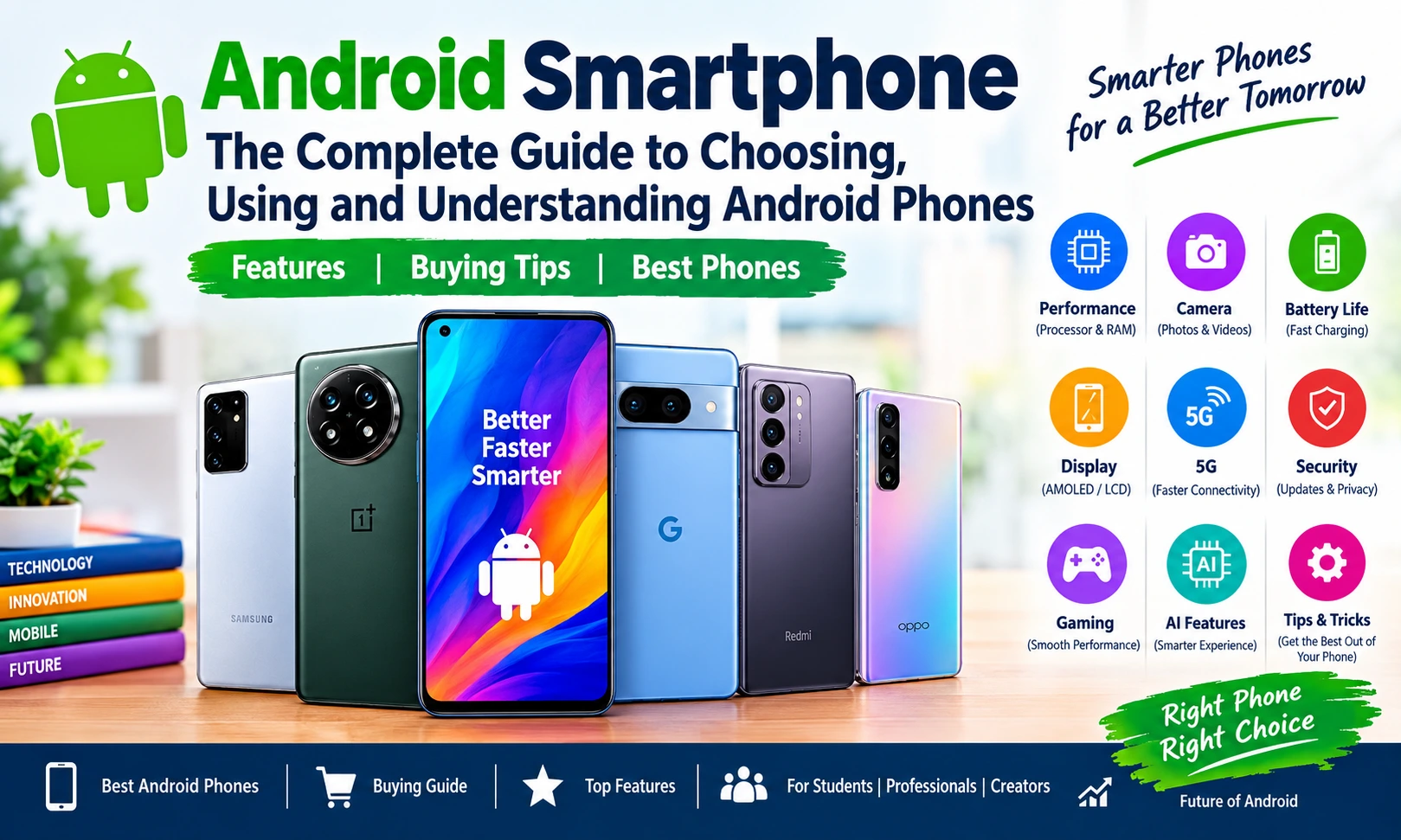
Android smartphones have become an essential part of modern life. From communication and entertainment to online banking, photography, shopping, education, business, and productivity, a smartphone can perform many of the tasks that once required a computer. Among the different mobile platforms available today, Android remains one of the most widely used smartphone operating systems because it offers a huge variety of devices, features, price ranges, and customization options.
Whether you are purchasing your first smartphone, upgrading an old phone, comparing Android phones, or simply trying to understand which features matter most, choosing the right Android smartphone can be confusing. Manufacturers offer hundreds of models with different processors, displays, cameras, batteries, storage options, software versions, and prices.
This comprehensive Android smartphone guide explains everything you need to know before buying a new device. It covers Android phone features, performance, cameras, displays, battery life, storage, security, software updates, gaming, connectivity, artificial intelligence, and important buying considerations.
What Is an Android Smartphone?
An Android smartphone is a mobile phone that uses the Android operating system. Android is a mobile operating system designed to support smartphones, tablets, wearable devices, televisions, cars, and other connected products.
Unlike a traditional basic mobile phone, an Android smartphone can run applications, access the internet, stream videos, capture high-quality photos and videos, play games, use navigation services, conduct video calls, manage documents, and perform many other tasks.
One of the biggest advantages of Android is the variety of hardware available. Consumers can choose from affordable Android phones, mid-range smartphones, premium flagship devices, gaming phones, camera-focused smartphones, foldable phones, and specialized devices.
This variety makes Android attractive to users with different budgets and requirements.
Why Are Android Smartphones So Popular?
Android smartphones are popular because they offer flexibility and choice. Users can select devices based on their preferred price, specifications, design, camera capabilities, gaming performance, battery capacity, or other requirements.
Some of the major advantages include:
- Wide range of prices
- Large selection of smartphone brands
- Many screen sizes and display technologies
- Extensive application ecosystem
- Customizable user interface
- Expandable functionality through apps
- Powerful cameras
- Fast mobile connectivity
- Large battery options
- Advanced security features
- AI-powered smartphone functions
- Multiple storage and memory configurations
Another important advantage is that Android smartphones are available from many manufacturers. This means consumers are not limited to one type of hardware design.
Android Smartphone Buying Guide
Buying an Android smartphone should begin with your personal requirements rather than simply choosing the phone with the highest specifications.
A student may need a reliable and affordable smartphone for classes, social media, communication, and entertainment. A professional may prioritize productivity, battery life, security, and multitasking. A mobile gamer may need a powerful processor, high refresh-rate display, efficient cooling, and a large battery.
Before purchasing an Android phone, consider the following factors.
1. Smartphone Budget
Your budget is one of the most important factors.
Android smartphones are available across almost every price category. Entry-level phones can handle basic communication and everyday applications, while premium smartphones provide advanced cameras, powerful processors, sophisticated displays, and additional features.
Instead of focusing only on the maximum amount you can spend, think about the features you actually need.
For example, someone who mainly uses WhatsApp, YouTube, web browsing, email, and social media may not need a premium flagship smartphone.
On the other hand, users who edit videos, play demanding games, take professional-style photographs, or use their phones for intensive work may benefit from investing in a higher-performance device.
2. Processor and Smartphone Performance
The processor is one of the most important components inside an Android smartphone.
It affects application performance, gaming, multitasking, image processing, artificial intelligence features, battery efficiency, and overall responsiveness.
Modern smartphone processors are designed with multiple CPU cores and often include dedicated components for graphics processing and AI-related tasks.
When comparing Android smartphones, do not look only at the processor’s name. Consider the complete platform, including:
- CPU performance
- GPU performance
- AI processing capabilities
- Power efficiency
- Manufacturing technology
- Thermal management
- Real-world performance
A powerful processor can make applications open quickly, improve gaming performance, and help the phone remain responsive while multiple applications are running.
 Earning
AD admin| Mar 16, 2026| 7 min read
10 Best Ways to Earn Money Online in 2026
RAM: How Much Memory Does an Android Phone Need?
RAM helps a smartphone keep applications and processes available for quick access.
More RAM can be useful for multitasking, but higher RAM does not automatically mean that a smartphone is better.
For everyday activities such as messaging, browsing, social media, video streaming, and basic productivity, a moderate amount of RAM can be sufficient.
Users who frequently switch between many applications, edit videos, play demanding games, or use advanced applications may benefit from additional RAM.
When buying a smartphone, it is better to consider RAM together with the processor, software optimization, storage technology, and operating system.
Internal Storage
Storage determines how much data you can keep on your smartphone.
Your applications, photos, videos, documents, games, downloads, and system files all require storage space.
A phone with limited storage can become inconvenient if you regularly record high-resolution videos or install large games.
When choosing an Android smartphone, consider how you use your phone.
A user who mainly uses messaging, browsing, and streaming may require less storage than someone who stores thousands of photos and videos.
If you frequently download large files or games, choosing a higher storage capacity can provide more flexibility.
Cloud storage can also help reduce the amount of locally stored data.
Android Smartphone Display
The display is the part of the smartphone you interact with most.
A good display can improve video streaming, gaming, photography, reading, browsing, and everyday usability.
Important display specifications include:
- Screen size
- Resolution
- Refresh rate
- Brightness
- Color accuracy
- HDR support
- Touch response
- Display technology
AMOLED vs LCD
Many modern smartphones use advanced display technologies such as AMOLED or OLED, while other devices use LCD panels.
AMOLED-style displays can provide strong contrast and deep blacks because individual pixels can be controlled differently. LCD technology can still provide good image quality and may be used in more affordable smartphones.
The best choice depends on the device and its overall display implementation.
Refresh Rate
Refresh rate describes how many times the display can update the image each second.
A higher refresh rate can make scrolling, animations, and supported games appear smoother.
However, refresh rate is only one part of the display experience. Brightness, response time, resolution, color quality, and software optimization also matter.
 YouTube
AD admin| Feb 27, 2026| 3 min read
YouTube Channel Kaise Grow Kare – 2026 Complete Guide (Step-by-Step)
Android Smartphone Camera
Camera performance is one of the most important considerations for many smartphone buyers.
Modern Android smartphones can include multiple cameras designed for different purposes.
Common camera types include:
- Main camera
- Ultra-wide camera
- Telephoto camera
- Macro camera
- Depth camera
- Front-facing selfie camera
However, the number of cameras does not necessarily determine image quality.
A smartphone with two well-designed cameras can produce better results than a phone with several low-quality sensors.
Main Camera
The primary camera is generally the most important camera on a smartphone.
Its performance depends on factors such as sensor size, lens quality, image stabilization, image processing, and software algorithms.
Ultra-Wide Camera
An ultra-wide camera is useful when you want to capture a larger area in one frame.
It can be useful for:
- Landscapes
- Architecture
- Group photographs
- Travel photography
- Interior photography
Telephoto Camera
A telephoto camera can provide optical magnification without relying entirely on digital zoom.
This can be particularly useful for photographing distant subjects.
Front Camera
The front camera is primarily used for selfies, video calls, social media content, and facial recognition on supported devices.
Camera quality should always be evaluated through real-world performance rather than megapixel numbers alone.
Smartphone Battery Life
Battery life is another major factor when selecting an Android smartphone.
A larger battery can provide longer usage, but battery capacity alone does not determine how long a phone lasts.
Battery performance also depends on:
- Processor efficiency
- Display technology
- Screen brightness
- Refresh rate
- Network connectivity
- Application usage
- Background processes
- Software optimization
A well-optimized smartphone can sometimes provide excellent battery life without having the largest battery in its category.
Fast Charging
Fast charging technology allows users to recharge a smartphone more quickly.
This can be especially useful for people with busy schedules.
However, charging speed should be considered alongside battery health, charger compatibility, thermal management, and manufacturer support.
Always use compatible charging equipment and follow the manufacturer’s recommendations.
 Movies
AD admin| Feb 26, 2026| 3 min read
Upcoming Movies 2026: 2026 में आने वाली सभी बड़ी फिल्में (Hollywood & Bollywood)
Android Smartphone Software
Hardware is only one part of the smartphone experience. Software has an equally important role.
Android provides the foundation for smartphone functionality, while manufacturers may add their own interface, applications, customization options, and additional features.
Software affects:
- User interface
- Application compatibility
- Security
- Battery management
- Camera processing
- Notifications
- Multitasking
- Customization
- AI features
When purchasing an Android smartphone, check how long the manufacturer intends to provide operating-system and security updates.
Long-term software support can make a smartphone more useful and secure for a longer period.
Android Updates and Security
Security updates are important because smartphones contain sensitive information.
People use smartphones for email, banking, payments, social media, personal photographs, documents, passwords, and private conversations.
Regular security updates can help protect devices against newly discovered vulnerabilities.
Before buying an Android smartphone, check the manufacturer’s official software-support policy.
A phone with strong long-term update support may provide better value than a device that is inexpensive initially but receives limited software support.
Smartphone Security Features
Modern Android smartphones can provide multiple security features.
Depending on the device, these may include:
- Fingerprint authentication
- Face recognition
- Screen lock
- Encryption
- Secure application permissions
- Security updates
- Find-device functionality
Users should always configure a strong screen lock and keep their smartphone software updated.
Avoid installing applications from unknown sources unless you understand the security implications.
Android Apps
One of the biggest strengths of Android is its extensive application ecosystem.
Users can install applications for:
- Communication
- Social networking
- Education
- Banking
- Shopping
- Photography
- Video editing
- Music
- Fitness
- Travel
- Productivity
- Gaming
- Business
Before installing an application, review its permissions and download it from a trusted source whenever possible.
Android Smartphone for Gaming
Mobile gaming has become a major smartphone use case.
A gaming-focused Android smartphone typically benefits from:
- Powerful processor
- Strong GPU
- High-refresh-rate display
- Responsive touch controls
- Effective cooling
- Large battery
- Fast charging
- Sufficient storage
- Good network connectivity
However, a gaming phone is not always necessary for casual players.
If you mainly play lightweight games, a mid-range smartphone may provide enough performance.
For demanding 3D games, hardware performance and thermal management become more important.
Android Smartphone for Photography
If photography is your priority, look beyond megapixel numbers.
Important factors include:
- Sensor quality
- Lens quality
- Optical stabilization
- Autofocus
- Dynamic range
- Low-light performance
- Computational photography
- Portrait processing
- Video stabilization
Modern smartphones use software processing to improve photographs significantly.
This means the image processor and camera software can be just as important as the physical camera hardware.
YouTube
AD admin| Feb 27, 2026| 3 min read
YouTube Channel Kaise Grow Kare – 2026 Complete Guide (Step-by-Step)
Android Smartphone for Video Recording
Many Android smartphones support high-resolution video recording.
For video creators, important features include:
- Video resolution
- Frame rates
- Stabilization
- Autofocus
- Microphone quality
- Dynamic range
- Low-light performance
- Front-camera video quality
- Storage capacity
If you regularly create social media videos, tutorials, vlogs, or short-form content, consider these features carefully.
Connectivity
Modern Android smartphones support multiple connectivity technologies.
These may include:
- 4G
- 5G
- Wi-Fi
- Bluetooth
- NFC
- GPS
- USB connectivity
Network compatibility is particularly important when purchasing a smartphone.
Make sure the device supports the cellular bands and network technologies used by your carrier.
5G Android Smartphones
5G smartphones can provide access to newer mobile networks where compatible service is available.
However, purchasing a 5G phone does not automatically guarantee faster internet in every location.
Actual network performance depends on:
- Carrier coverage
- Network congestion
- Supported frequency bands
- Location
- Signal strength
- Network plan
- Device compatibility
If you plan to keep your smartphone for several years, 5G support may be worth considering.
NFC and Mobile Payments
NFC can allow compatible smartphones to communicate with nearby payment terminals and other NFC-enabled devices.
Depending on your region and supported services, NFC may be useful for:
- Contactless payments
- Device pairing
- Access systems
- Data exchange
- Digital identification
If mobile payments are important to you, check whether the Android smartphone supports the required NFC and payment functionality.
Smartphone Design and Build Quality
Design affects both appearance and usability.
Important factors include:
- Weight
- Thickness
- Materials
- Grip
- Button placement
- Camera design
- Screen protection
- Water and dust resistance
A lightweight phone can be comfortable for long periods, while a heavier device may provide additional hardware or a larger battery.
Build quality is particularly important if you plan to keep your smartphone for several years.
Water and Dust Resistance
Some Android smartphones have official resistance ratings against water and dust.
These ratings can provide additional protection against accidental exposure, but they should not be interpreted as a guarantee that a phone is completely waterproof under every condition.
Always follow the manufacturer’s instructions regarding water exposure.
Smartphone Audio
Audio quality is often overlooked when buying a smartphone.
Consider whether the device provides:
- Stereo speakers
- Good speaker volume
- Clear voice-call quality
- Bluetooth audio support
- Wired audio compatibility if required
If you regularly watch videos or listen to music without headphones, speaker quality can make a noticeable difference.
Android Smartphone for Students
Students often need a phone that balances affordability, battery life, performance, and reliability.
Useful features include:
- Long battery life
- Good display
- Reliable performance
- Adequate storage
- Good camera
- Fast connectivity
- Productivity applications
A mid-range Android phone can often provide a strong balance for students without the expense of a premium flagship.
Android Smartphone for Professionals
Professionals may have different priorities.
A business-oriented user may value:
- Strong battery life
- Reliable performance
- Security
- Excellent communication features
- Large storage
- High-quality display
- Multitasking
- Document support
- Long software support
A smartphone can function as a portable productivity device when paired with the right applications and accessories.
Android Smartphone for Content Creators
Content creators often require more specialized hardware.
Important considerations include:
- High-quality cameras
- Good microphones
- Powerful processor
- Large storage
- Fast charging
- Stable video recording
- Good display
- Strong image processing
Creators who record large amounts of video should pay particular attention to storage capacity because high-resolution video can consume significant space.
Artificial Intelligence in Android Smartphones
Artificial intelligence is becoming increasingly important in modern smartphones.
AI-powered features can assist with:
- Photo editing
- Image enhancement
- Voice recognition
- Translation
- Writing assistance
- Search
- Call features
- Personalization
- Productivity
- Object recognition
AI capabilities vary significantly between smartphone manufacturers and models.
When comparing AI features, focus on practical usefulness rather than marketing terminology.
Smartphone Storage Management
Even a smartphone with large storage can eventually become full.
To maintain free space:
- Remove unused applications
- Delete unnecessary downloads
- Back up photographs
- Remove duplicate files
- Review large videos
- Clear unnecessary cached data
- Use cloud storage when appropriate
Keeping sufficient free storage can make everyday smartphone management easier.
How to Make an Android Smartphone Faster
If your smartphone becomes slower over time, several steps may help.
Start by updating the operating system and applications.
Then review installed applications and remove software you no longer use.
You can also:
- Free up storage
- Restart the phone
- Reduce unnecessary background activity
- Review battery settings
- Update applications
- Remove suspicious applications
- Avoid excessive multitasking
If performance problems continue, backing up important data and performing a factory reset may be an option, although this should be treated as a last resort.
How to Extend Android Battery Life
You can often improve battery life through simple changes.
Reduce unnecessary screen brightness and use automatic brightness where appropriate.
Other useful steps include:
- Turn off unused connectivity features
- Limit unnecessary background activity
- Use battery-saving modes when needed
- Reduce unnecessary notifications
- Keep applications updated
- Avoid extreme temperatures
- Use appropriate charging accessories
Battery usage varies significantly depending on how the phone is used.
Gaming, video recording, navigation, mobile data, and high screen brightness can consume considerably more power than basic messaging.
Android Smartphone Maintenance
Taking care of your smartphone can extend its useful life.
Use a suitable protective case and screen protection if desired.
Keep charging ports clean and avoid exposing the device to unnecessary moisture or extreme temperatures.
Install software updates regularly and monitor application permissions.
Back up important photographs, contacts, documents, and other data so that you are prepared if the phone is lost, damaged, or replaced.
Common Android Smartphone Buying Mistakes
Many smartphone buyers focus too heavily on specifications.
One common mistake is choosing a phone based solely on megapixel count.
Another is buying more RAM than necessary while ignoring processor performance and software quality.
Other mistakes include:
- Ignoring software support
- Choosing insufficient storage
- Ignoring network compatibility
- Buying based only on benchmark scores
- Overlooking display quality
- Ignoring battery efficiency
- Purchasing an unsuitable size
- Focusing only on charging speed
- Ignoring warranty and service availability
The best smartphone is not necessarily the phone with the longest specification list.
How to Compare Two Android Smartphones
When comparing two Android smartphones, create a practical checklist.
Compare:
- Price
- Processor
- RAM
- Storage
- Display
- Battery
- Charging
- Main camera
- Front camera
- Video capabilities
- Software
- Update policy
- Connectivity
- Build quality
- Warranty and service
Then decide which features matter most to your specific usage.
For example, a photographer may prioritize cameras, while a gamer may prioritize processor and cooling.
Flagship vs Mid-Range Android Smartphones
Flagship smartphones generally offer the manufacturer’s most advanced hardware and features.
They may provide:
- Premium displays
- Powerful processors
- Advanced camera systems
- Better build materials
- More sophisticated software features
- Longer support in some cases
Mid-range smartphones focus on providing strong value.
They may offer excellent displays, capable cameras, good processors, and large batteries at a lower price.
For many users, a well-designed mid-range Android phone can provide everything needed for everyday use.
Budget Android Smartphones
Budget Android smartphones can be excellent choices for basic users.
If your primary activities include calling, messaging, social media, web browsing, video streaming, and occasional photography, an affordable phone may be sufficient.
However, check reviews and specifications carefully because budget devices can vary significantly in performance and software support.
Foldable Android Smartphones
Foldable smartphones introduce new form factors.
They can provide a larger screen when opened while remaining relatively compact when folded.
Potential advantages include:
- Larger display
- Better multitasking
- More immersive media experience
- Unique photography options
- Improved productivity
However, foldable devices can be more expensive and may have different durability considerations compared with traditional smartphones.
Future of Android Smartphones
The Android smartphone industry continues to evolve.
Future devices are likely to place greater emphasis on artificial intelligence, energy efficiency, camera processing, connectivity, security, and new display technologies.
AI may increasingly operate directly on smartphones, allowing certain tasks to be completed without relying entirely on cloud services.
Camera systems are also likely to continue improving through a combination of advanced sensors and computational photography.
Battery technology and charging systems will remain important areas of development.
Frequently Asked Questions About Android Smartphones
An Android smartphone is a mobile device that uses the Android operating system. It can run applications, access the internet, take photographs and videos, stream content, communicate with other devices, and perform many computing tasks.
The best Android smartphone depends on your budget and requirements. There is no single model that is ideal for every user. Consider performance, camera quality, battery life, display, software support, storage, and price.
The amount of RAM you need depends on your usage. Basic users generally need less memory than people who frequently multitask, edit videos, or play demanding games.
No. Megapixel count is only one part of camera performance. Sensor quality, lens quality, image processing, stabilization, and software can have a major impact on the final photograph.
Battery capacity is important, but it does not tell the complete story. Processor efficiency, display technology, software optimization, network usage, and user behavior also influence battery life.
If 5G service is available in your area and you plan to keep the phone for several years, 5G support can be useful. However, check network compatibility before purchasing.
The useful life of a smartphone depends on hardware quality, software support, battery condition, and how the device is used. A well-maintained phone with strong software support can remain useful for several years.
Android offers extensive hardware choice, customization, application availability, and flexibility. Whether it is better depends on the user’s preferences and requirements.
Check the processor, RAM, storage, display, camera, battery, charging, software-update policy, network compatibility, build quality, warranty, and price.
Final Thoughts
Choosing an Android smartphone does not have to be complicated. The key is understanding which features actually matter for your daily usage.
Start with your budget and requirements. Then compare processor performance, RAM, storage, display quality, cameras, battery life, charging, software support, connectivity, and build quality.
Avoid choosing a smartphone based only on one specification. A balanced device with good software optimization, reliable hardware, long-term updates, a quality display, capable cameras, and strong battery performance can provide a much better experience than a phone with impressive specifications but poor overall optimization.
Whether you need an affordable Android smartphone for everyday communication, a powerful device for gaming, a camera-focused phone for photography, or a premium smartphone for professional work, there are Android devices available for almost every type of user.
The most important thing is to choose a smartphone that matches your actual needs rather than simply buying the most expensive model.
As smartphone technology continues to evolve, Android devices are becoming more capable, intelligent, connected, and versatile. By understanding the major smartphone features explained in this guide, you can make a more informed decision and choose an Android smartphone that delivers better value and a better experience for years to come.
Leave a Reply