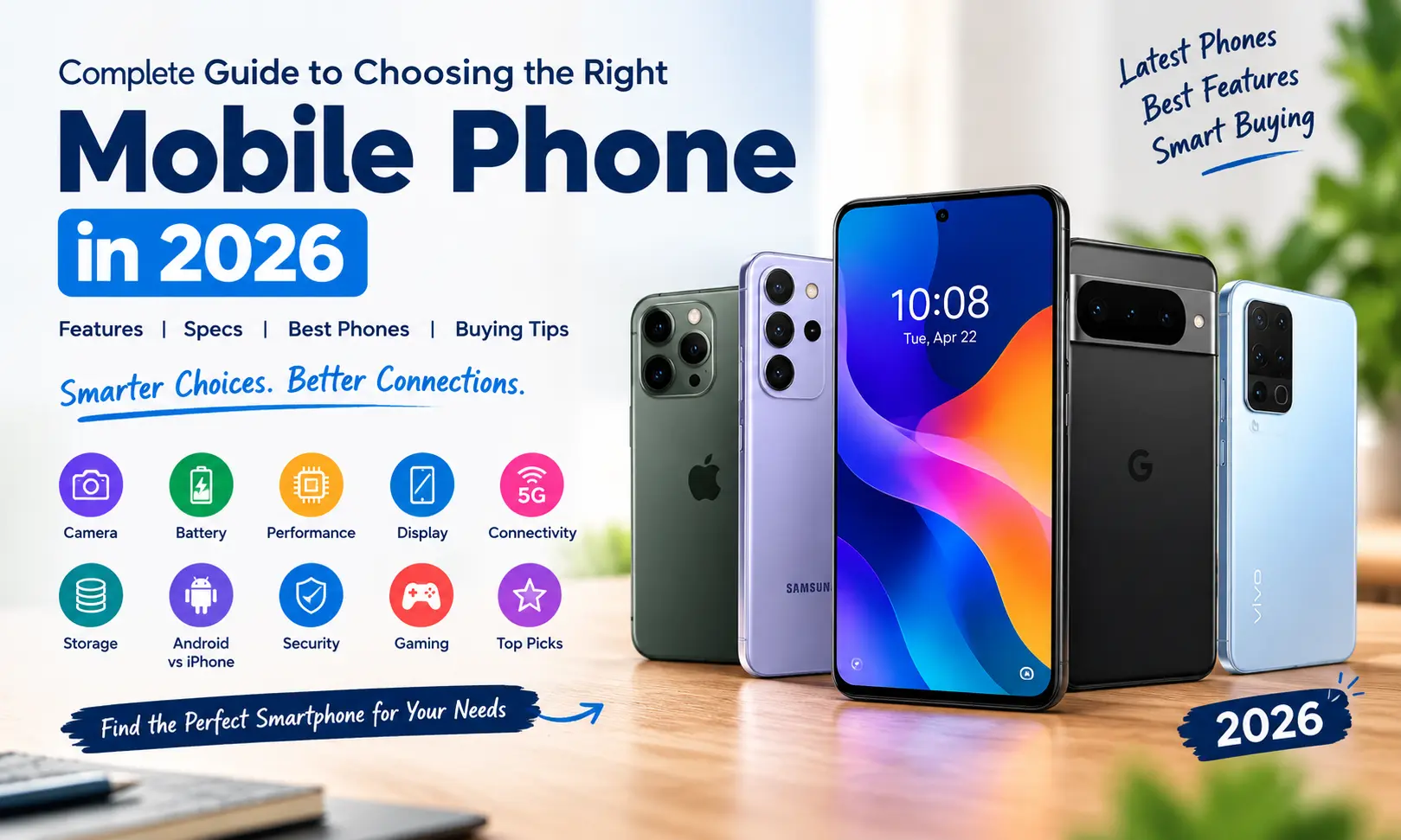
A mobile phone is no longer simply a device for making calls and sending messages. Today, a smartphone can work as a camera, gaming console, navigation system, entertainment center, banking tool, office assistant, learning device, social-media platform, and even an AI-powered productivity assistant. Because smartphones have become such an important part of everyday life, choosing the right mobile phone requires more than simply looking at a brand name or the biggest number on a specification sheet.
The smartphone market in 2026 offers an enormous variety of devices across different budgets and use cases. Buyers can find affordable phones for everyday communication, mid-range smartphones with premium features, gaming-focused devices, camera phones, compact models, foldable phones, and high-end flagship smartphones. Current buying guides increasingly emphasize that real-world performance, battery life, camera quality, software support, display quality, and long-term reliability matter more than individual headline specifications. (NDTV Shopping)
This complete guide explains everything you should know about mobile phones and smartphones, including important specifications, operating systems, displays, processors, RAM, storage, cameras, batteries, charging, 5G, software updates, security, gaming, photography, AI features, durability, and how to choose the right phone for your budget.
1. What Is a Mobile Phone?
A mobile phone is a portable electronic communication device that allows people to communicate wirelessly through cellular networks. Early mobile phones were mainly designed for voice calls and text messages. Modern smartphones are much more advanced.
A smartphone combines the basic functions of a telephone with the capabilities of a small computer. It can connect to the internet, install applications, take high-quality photographs, record videos, stream movies, play games, make video calls, use GPS navigation, manage documents, access banking services, and perform many other tasks.
Modern smartphones generally include:
- Touchscreen display
- Mobile network connectivity
- Wi-Fi
- Bluetooth
- GPS
- Cameras
- Microphones
- Speakers
- Processor
- RAM
- Internal storage
- Rechargeable battery
- Operating system
- Security features
- Sensors
- USB connectivity
Because these components work together, a phone with impressive specifications in one area can still provide a poor experience if other components are weak.
For example, a phone may advertise a very high-megapixel camera but produce average photographs because its sensor, lens, image processing, and stabilization are not equally strong.
 Mobile Phones
SH Shiva Verma| Sep 13, 2026| 18 min read
iPhone 18 Pro vs iPhone 18 Pro Max: Complete Guide, Features, Specifications, Price, Camera, Battery and More
2. Why Choosing the Right Mobile Phone Matters
Buying a smartphone is an important decision because many people use the same device for several years. A good phone should not only perform well when it is new; it should remain useful as applications become more demanding.
The wrong phone can cause problems such as:
- Slow application loading
- Poor battery life
- Overheating
- Weak camera performance
- Limited storage
- Software bugs
- Poor network connectivity
- Short software-support period
- Lack of useful features
- Expensive repairs
On the other hand, a well-balanced smartphone can provide excellent value for several years.
The most important principle is simple:
Do not buy the phone with the biggest specifications. Buy the phone that best matches your actual needs.
For example, someone who mainly uses WhatsApp, YouTube, Instagram, calls, maps, and banking applications does not necessarily need the most powerful flagship processor.
A mobile gamer may prioritize processor performance and cooling. A photographer may care more about camera sensors and image processing. A business user may prioritize battery life, security, software support, and storage.
3. Decide Your Budget Before Buying a Smartphone
The first step in choosing a mobile phone is deciding how much you can comfortably spend.
In India, smartphones are available across a very wide price range. Current buying guides commonly divide the market into budget, mid-range, upper-mid-range, and flagship categories. (TechnoFee)
Budget Smartphones
Budget phones are designed for basic and everyday tasks.
They are suitable for:
- Calls
- Social media
- YouTube
- Online classes
- Browsing
- UPI payments
- Navigation
- Light gaming
The main goal at this level should be reliability and balance rather than premium specifications.
Mid-Range Smartphones
Mid-range phones generally provide a better combination of:
- Performance
- Camera quality
- Display
- Battery life
- Charging
- Design
- Software
This category is often attractive for people who want a premium experience without paying flagship prices.
Premium and Flagship Smartphones
Flagship smartphones generally provide the best combination of:
- Processor performance
- Camera systems
- Display technology
- Materials
- Haptics
- Speakers
- Software features
- Connectivity
- Long-term support
However, paying more does not automatically mean you will get better value. A flagship may provide features that a normal user rarely uses.
4. Smartphone Display: One of the Most Important Features
The display is the part of a mobile phone you interact with constantly.
Whether you are reading messages, watching videos, browsing websites, editing photographs, or playing games, the display directly affects your experience.
Important display specifications include:
- Display technology
- Screen size
- Resolution
- Refresh rate
- Brightness
- Color accuracy
- HDR support
- Touch sampling
- Screen protection
 YouTube
AB Abhishek Gupta| Jun 16, 2026| 15 min read
YouTube Play Button: Everything You Need to Know
5. AMOLED vs LCD Displays
There are several display technologies used in smartphones.
LCD
LCD displays use a backlight to illuminate the screen.
Advantages include:
- Lower manufacturing cost
- Good brightness on many devices
- Reliable performance
However, LCD screens generally cannot produce the same deep blacks as OLED-based displays because the backlight remains active.
AMOLED/OLED
OLED displays control individual pixels, allowing pixels to turn off completely when displaying black.
This can produce:
- Deep blacks
- High contrast
- Vibrant colors
- Better viewing experience
- Potential power savings in suitable situations
Many modern smartphones use AMOLED or OLED displays, particularly in mid-range and flagship categories. Current smartphone guides commonly recommend AMOLED/OLED panels when possible, especially for users who spend significant time watching content or reading on their phones. (Reliance Digital)
6. What Does 60Hz, 90Hz, or 120Hz Mean?
Refresh rate describes how many times the screen can update every second.
A 60Hz screen refreshes 60 times per second.
A 120Hz display can refresh up to 120 times per second.
Higher refresh rates can make:
- Scrolling smoother
- Animations feel faster
- Gaming more responsive
- Menus feel more fluid
However, refresh rate is not the only factor that determines display quality.
A poorly calibrated 120Hz display is not automatically better than a high-quality 90Hz or 60Hz panel.
For many users, a modern 90Hz or 120Hz display provides a noticeably smoother experience.
7. Screen Size: Bigger Is Not Always Better
Large smartphone displays are excellent for:
- Movies
- Gaming
- Reading
- Document editing
- Multitasking
- Photo editing
However, larger phones can be:
- Heavier
- Harder to use with one hand
- Less comfortable in pockets
Compact phones can be easier to carry and operate but may sacrifice battery capacity or screen area.
The best size depends on your hands, usage habits, and preference.
8. Smartphone Processor: The Brain of the Phone
The processor, also called the chipset or SoC, is one of the most important components of a smartphone.
It affects:
- App performance
- Gaming
- Camera processing
- AI features
- Video recording
- Multitasking
- Battery efficiency
- Connectivity
A powerful processor can help a smartphone remain responsive for a longer period.
However, processor performance should be considered alongside thermal management and software optimization. A chipset that performs extremely well for short periods may not maintain that performance if the phone becomes too hot.
This is particularly important for gamers.
 Earning
SH Shiva Verma| Jun 06, 2026| 31 min read
How to Earn Through Sponsored Posts (Complete Guide for Beginners in 2026)
9. Why Processor Generation Matters
Processor names can be confusing because manufacturers release multiple generations and variants.
A newer processor is not always automatically superior to every older processor, but generation, architecture, manufacturing technology, CPU/GPU design, modem capabilities, and efficiency all matter.
Instead of asking:
“How many GHz does this phone have?”
you should consider:
- Processor generation
- CPU architecture
- GPU performance
- Manufacturing process
- Thermal performance
- Power efficiency
- Real-world benchmarks
- Gaming performance
- Software optimization
Modern smartphones are powerful enough that most users should focus on balanced performance rather than chasing benchmark numbers alone. (Tech Advisor)
10. RAM: How Much RAM Does a Smartphone Need?
RAM temporarily stores data used by active applications.
More RAM can help a phone keep more applications available in memory.
Common RAM capacities include:
- 4GB
- 6GB
- 8GB
- 12GB
- 16GB
- More on specialized devices
For everyday users, 6GB or 8GB can be sufficient depending on the operating system and software optimization. Users who frequently multitask, edit videos, play demanding games, or use professional applications may benefit from more RAM.
However, RAM alone does not determine performance.
A phone with 12GB RAM and a weak processor can perform worse than a phone with 8GB RAM and a much stronger processor.
Therefore:
Processor + RAM + storage speed + software optimization = overall performance.
11. Internal Storage: 128GB, 256GB, 512GB or 1TB?
Storage determines how much data your phone can keep.
Your storage contains:
- Applications
- Photos
- Videos
- Music
- Documents
- Games
- Downloads
- Offline content
- System files
64GB
This may feel restrictive for modern smartphone users.
128GB
A practical starting point for many users.
256GB
Excellent for people who take lots of photos and videos or install many applications and games.
512GB
Useful for heavy users, creators, and people who store large video files.
1TB
Designed primarily for users with very high storage requirements.
Storage should be considered carefully because many modern phones do not provide expandable microSD storage.
12. Smartphone Camera: More Than Megapixels
Camera marketing often focuses on megapixels.
You may see cameras advertised as:
- 50MP
- 64MP
- 108MP
- 200MP
But megapixels are only one part of image quality.
A good smartphone camera also depends on:
- Sensor size
- Lens quality
- Aperture
- Optical image stabilization
- Autofocus
- Image signal processor
- Computational photography
- HDR
- Low-light processing
- Color science
- Telephoto capabilities
Current smartphone buying guides specifically warn buyers not to judge camera quality from megapixel counts alone. (Reliance Digital)
A well-designed 50MP camera can produce better photographs than a poorly implemented 108MP or 200MP camera.
13. What Is OIS?
OIS means Optical Image Stabilization.
It helps compensate for small hand movements while taking photographs or recording video.
OIS can be particularly useful when:
- Photographing at night
- Taking pictures indoors
- Recording video
- Using zoom
- Shooting with slower shutter speeds
For people who care about photography, OIS can be a more meaningful specification than an extremely high megapixel number.
14. Main Camera, Ultra-Wide, and Telephoto Cameras
Modern smartphones may include multiple rear cameras.
Main Camera
Usually designed for everyday photography.
Ultra-Wide Camera
Useful for:
- Landscapes
- Buildings
- Group photographs
- Travel photography
Telephoto Camera
Designed for optical zoom and distant subjects.
Macro Camera
Designed for close-up photographs but can vary significantly in usefulness depending on implementation.
Instead of counting the number of cameras, evaluate whether each camera is genuinely useful.
A phone with three excellent cameras can be much more useful than a phone with four mediocre cameras.
15. Front Camera and Selfies
The front camera is important for:
- Selfies
- Video calls
- Social media
- Online meetings
- Face unlock on some devices
Important factors include:
- Resolution
- HDR
- Skin-tone processing
- Video quality
- Stabilization
- Low-light performance
- Autofocus
For people who regularly create social-media content, front-camera video quality can be particularly important.
16. Smartphone Battery: What Should You Look For?
Battery capacity is generally measured in mAh, or milliamp-hours.
Many modern smartphones offer batteries around 5,000mAh or higher, while some newer designs use larger capacities.
However, battery capacity alone does not determine battery life.
Battery endurance also depends on:
- Processor efficiency
- Display technology
- Screen brightness
- Refresh rate
- Network strength
- Background applications
- Software optimization
- Gaming
- Camera usage
A phone with a smaller battery can sometimes last longer than a phone with a larger battery if it is more efficient.
17. Fast Charging
Fast charging can significantly reduce the amount of time required to recharge a smartphone.
Different manufacturers use different charging technologies and power levels.
Fast charging can be particularly useful for:
- Travelers
- Students
- Business users
- Gamers
- Heavy smartphone users
However, charging speed should be considered alongside battery health, charger availability, thermal management, and safety.
Do not choose a phone solely because its charging specification has the highest wattage.
18. Wireless Charging
Wireless charging allows compatible smartphones to charge without physically connecting a charging cable to the phone.
Advantages include:
- Convenience
- Easy desk charging
- Reduced cable handling
Some premium smartphones also support reverse wireless charging, which can be useful for compatible earbuds or other accessories.
However, wireless charging may not be essential for everyone.
19. 5G Connectivity
5G is the next-generation cellular network technology that can provide higher speeds, lower latency, and increased network capacity compared with earlier generations under suitable network conditions.
A phone advertised as 5G-capable should still be evaluated for:
- Supported 5G bands
- Carrier compatibility
- Modem quality
- Network performance
- Power efficiency
In India, buyers should make sure the specific phone variant supports the relevant bands used by their mobile operator.
20. Wi-Fi and Bluetooth
Modern smartphones also depend heavily on wireless connectivity.
Wi-Fi is important for:
- Home internet
- Office networks
- Streaming
- Downloads
- Online gaming
Bluetooth is used for:
- Wireless headphones
- Speakers
- Smartwatches
- Cars
- Controllers
- Accessories
Newer connectivity standards can improve speed, efficiency, reliability, and latency.
21. Android vs iPhone
One of the biggest smartphone decisions is choosing between Android and Apple’s iOS ecosystem.
Android
Android phones are available from many manufacturers and across many price ranges.
Advantages can include:
- Huge device selection
- Greater hardware variety
- More customization
- Multiple price categories
- Foldable options
- Different camera systems
- Gaming-focused phones
iPhone
Apple’s iPhone ecosystem emphasizes:
- Hardware/software integration
- Long-term ecosystem continuity
- Consistent interface
- Strong video capabilities
- Integration with other Apple devices
- Regular software updates
Neither operating system is universally better.
The better option depends on your preferences and existing devices.
22. Software Updates Are Extremely Important
One of the most overlooked smartphone features is software support.
A smartphone can have excellent hardware but become less attractive if the manufacturer stops providing security updates quickly.
Software updates can provide:
- New features
- Security improvements
- Bug fixes
- Performance improvements
- Compatibility updates
When buying a phone, check the manufacturer’s official update policy.
Longer support can make a phone more valuable because you can safely use it for more years. Current smartphone buying guidance increasingly identifies update commitments as a major long-term purchasing factor. (TechnoFee)
23. Smartphone Security
Your phone may contain extremely sensitive information.
This can include:
- Photos
- Emails
- Messages
- Contacts
- Banking information
- Passwords
- Personal documents
- Work information
Important security features can include:
- Fingerprint sensor
- Face authentication
- Secure hardware
- Encryption
- Security updates
- Application permissions
- Device tracking
Always keep your operating system updated and use strong authentication.
24. Fingerprint vs Face Unlock
Fingerprint sensors are convenient and can provide fast authentication.
They may be placed:
- Under the display
- On the side
- On the rear of older devices
Face unlock uses facial recognition technology.
The security level varies by implementation. Some systems use advanced depth or infrared technology, while others use simpler camera-based systems.
For sensitive applications such as banking, the security requirements of the specific authentication system matter more than convenience alone.
25. Smartphone Design and Build Quality
Design affects both appearance and durability.
Modern smartphones may use:
- Plastic
- Aluminum
- Stainless steel
- Titanium
- Glass
- Ceramic
Premium materials can provide a more luxurious feel, but material choice is not the only factor determining durability.
Also consider:
- Screen protection
- Frame strength
- Water resistance
- Dust resistance
- Repairability
- Case availability
26. Water and Dust Resistance
Some smartphones have official IP ratings.
An IP rating indicates resistance to dust and water under defined testing conditions.
For example, certain phones may have ratings such as IP67 or IP68.
However, water resistance does not mean a phone is indestructible.
Water resistance can change with:
- Physical damage
- Aging
- Repairs
- Wear and tear
Therefore, it is still sensible to avoid unnecessary exposure to water.
27. Gaming Smartphones
Gaming is one of the most demanding smartphone activities.
A good gaming phone should have:
- Powerful processor
- Strong GPU
- High-refresh-rate display
- Good cooling
- Large battery
- Fast charging
- Responsive touch system
- Good sustained performance
Cooling is especially important.
A phone may deliver excellent benchmark results for several minutes but slow down after extended gaming if heat becomes excessive.
Current gaming-phone comparisons emphasize processor performance, cooling, display refresh rate, battery capacity, and sustained performance rather than processor specifications alone. (TechRadar)
28. Mobile Phone for Photography
If photography is your priority, focus on the complete camera system.
Look for:
- Large primary sensor
- OIS
- Reliable autofocus
- Good HDR
- Natural colors
- Strong night photography
- Useful telephoto camera
- Good video stabilization
Do not automatically choose a phone because it has the highest megapixel number.
Camera reviews and real-world sample photographs are more useful than specification sheets alone.
29. Mobile Phone for Students
Students generally need a balanced smartphone.
Important features include:
- Reliable battery
- Good display
- Smooth performance
- Enough storage
- Good front camera
- Strong connectivity
- Long software support
Students may use their phones for:
- Online classes
- Research
- Educational applications
- PDFs
- Video lectures
- Messaging
- Social media
- Photography
A mid-range phone can often provide everything a student needs without the cost of a flagship.
30. Mobile Phone for Business Users
Business users may prioritize:
- Battery life
- Security
- Storage
- Email performance
- Video conferencing
- Document editing
- Reliable connectivity
- Software updates
A business phone should remain stable during long working days.
Good microphones and speakers are also valuable for calls and online meetings.
31. Mobile Phone for Content Creators
Content creators need more than a good main camera.
They may need:
- High-quality video recording
- Good front camera
- OIS
- Fast storage
- Large storage capacity
- Powerful processor
- Good microphone support
- Strong battery
- Fast charging
Video editing is also processor-intensive, so a stronger chipset can significantly improve the editing experience.
32. Artificial Intelligence in Modern Smartphones
AI has become an increasingly important smartphone feature.
Modern phones can use AI for:
- Photo enhancement
- Object removal
- Voice transcription
- Translation
- Summarization
- Search
- Writing assistance
- Image generation
- Call features
- Personalization
- Battery optimization
However, not every feature marketed as “AI” provides meaningful value.
The important question is:
Does the AI feature actually make your daily work easier?
The smartphone industry is increasingly integrating AI capabilities into both hardware and software, including advanced camera processing and on-device features.
33. Foldable Mobile Phones
Foldable smartphones are one of the most interesting developments in the smartphone market.
There are two major styles:
Foldable Book-Style Phones
These open into a larger screen resembling a small tablet.
They are useful for:
- Multitasking
- Reading
- Productivity
- Large-screen entertainment
Flip Phones
These fold vertically into a compact shape.
Advantages include:
- Pocket-friendly design
- Compact size
- External display features
- Unique style
The disadvantages can include:
- Higher price
- More complicated construction
- Potential durability concerns
- Higher repair costs
34. Common Smartphone Buying Mistakes
Many smartphone buyers make similar mistakes.
Mistake 1: Buying Based Only on Megapixels
A 200MP camera does not automatically produce better photos than a 50MP camera.
Mistake 2: Buying Based Only on RAM
More RAM does not compensate for a weak processor.
Mistake 3: Ignoring Software Updates
Short software support can reduce the long-term value of a phone.
Mistake 4: Ignoring Battery Efficiency
A large battery is useful, but efficiency matters too.
Mistake 5: Buying More Storage Than Necessary
Extra storage is useful only if you actually need it.
Mistake 6: Ignoring After-Sales Service
Repair availability can be extremely important.
Mistake 7: Choosing a Phone Only Because It Is Popular
Popularity does not guarantee that the phone matches your requirements.
Mistake 8: Focusing on One Specification
A smartphone is a complete system.
35. How to Compare Two Mobile Phones
When comparing two smartphones, create categories instead of focusing on one specification.
Compare:
| Feature | Phone A | Phone B |
|---|---|---|
| Processor | Check generation | Check generation |
| RAM | Check capacity | Check capacity |
| Storage | Check capacity/type | Check capacity/type |
| Display | OLED/AMOLED/LCD | OLED/AMOLED/LCD |
| Refresh Rate | Check Hz | Check Hz |
| Main Camera | Sensor + OIS | Sensor + OIS |
| Battery | Capacity | Capacity |
| Charging | Speed | Speed |
| 5G | Supported bands | Supported bands |
| Software | Update policy | Update policy |
| Build | Materials | Materials |
| Water Resistance | IP rating | IP rating |
| Service | Availability | Availability |
| Price | Current price | Current price |
This method provides a much clearer picture than comparing only RAM, megapixels, or processor speed.
36. How to Choose the Right Smartphone for Your Needs
A useful approach is to identify your top three priorities.
If Battery Is Your Priority
Look for:
- Efficient processor
- Large battery
- Good software optimization
- Fast charging
If Camera Is Your Priority
Look for:
- Large primary sensor
- OIS
- Good image processing
- Useful telephoto
- Strong video recording
If Gaming Is Your Priority
Look for:
- High-end chipset
- Powerful GPU
- High-refresh-rate display
- Effective cooling
- Large battery
If You Want Long-Term Use
Look for:
- Strong processor
- Long software support
- Good battery
- Durable construction
- Adequate storage
If You Want Value
Avoid paying for features you will never use.
37. How Long Should a Mobile Phone Last?
The lifespan of a smartphone depends on:
- Hardware quality
- Software support
- Battery health
- Usage
- Repairability
- Storage requirements
A phone with good hardware and long software support can remain useful for several years.
Battery degradation is one of the most common reasons people replace older smartphones.
Therefore, if you intend to keep your phone for three or four years, software support and battery health should be major considerations.
38. How to Take Care of Your Smartphone
Proper care can extend the useful life of a mobile phone.
Use a Protective Case
A case can reduce damage from accidental drops.
Protect the Display
A suitable screen protector can help prevent scratches.
Avoid Extreme Heat
High temperatures can negatively affect battery health and device performance.
Keep Software Updated
Install official software and security updates.
Avoid Untrusted Apps
Install applications from trusted sources whenever possible.
Keep Storage Under Control
Delete unnecessary files and applications when storage becomes full.
Protect Charging Ports
Keep charging ports clean and avoid forcing damaged cables into them.
39. How to Improve Smartphone Battery Life
You can often improve battery life without changing the phone.
Try:
- Reduce unnecessary screen brightness
- Use adaptive brightness
- Disable unnecessary background permissions
- Turn off unused connectivity features
- Use battery-saving modes when appropriate
- Remove applications you do not use
- Keep software updated
- Reduce unnecessary location access
The biggest battery consumers are often the screen, demanding applications, games, cameras, and poor network conditions.
40. Should You Buy a New Mobile Phone Every Year?
For most users, there is no need to replace a smartphone every year.
Annual upgrades may provide:
- Better processor
- Better camera
- New software
- Improved battery
- New AI features
But if your current phone performs well and receives updates, keeping it longer can provide better financial value.
Upgrade when your current phone no longer meets your needs rather than simply because a new model has launched.
41. New vs Refurbished Mobile Phones
A refurbished smartphone can sometimes provide excellent value.
However, buyers should carefully check:
- Battery health
- Warranty
- Device condition
- Originality
- IMEI information
- Repair history
- Screen quality
- Camera functionality
- Charging
- Network compatibility
A reputable seller with a clear warranty is preferable to an unknown source offering an unusually low price.
42. Online vs Offline Smartphone Buying
Both online and offline purchases have advantages.
Online
Advantages:
- More choices
- Easy price comparison
- Reviews
- Discounts
- Convenient delivery
Offline
Advantages:
- You can physically hold the phone
- You can test the display
- You can test weight and size
- You can ask questions
- Immediate purchase may be possible
Regardless of where you buy, verify the model, storage configuration, warranty, seller, and return policy.
43. Check Your Smartphone After Delivery
When a new phone arrives, do not immediately throw away all packaging.
First check:
- Model number
- Storage capacity
- RAM configuration
- IMEI information
- Display
- Cameras
- Speakers
- Microphones
- Charging
- Buttons
- Fingerprint sensor
- Wi-Fi
- Bluetooth
- Mobile network
- GPS
Also inspect the device for physical damage.
This can make it easier to resolve problems within the applicable return or replacement period.
44. The Most Important Smartphone Specifications
If you want a quick checklist, focus on these:
1. Processor
Determines overall performance and efficiency.
2. Display
Look at panel quality, brightness, resolution, and refresh rate.
3. Camera
Evaluate sensor quality, stabilization, processing, and real-world results.
4. Battery
Look at capacity and actual endurance.
5. Charging
Consider charging speed and charger availability.
6. RAM
Choose enough for your multitasking needs.
7. Storage
128GB can be a useful baseline for many buyers, while heavier users may prefer 256GB or more.
8. Software
Check operating system version and update policy.
9. Connectivity
Check 5G, Wi-Fi, Bluetooth, NFC, and supported network bands where relevant.
10. Durability
Consider build quality, screen protection, and water/dust resistance.
45. The Future of Mobile Phones
The smartphone industry is moving toward increasingly intelligent, efficient, and connected devices.
Future smartphones are likely to continue improving in areas such as:
- Artificial intelligence
- On-device processing
- Battery technology
- Camera systems
- Foldable displays
- Satellite connectivity
- Gaming performance
- Wireless connectivity
- Privacy
- Personalization
AI is particularly important because smartphones are becoming capable of processing more tasks locally rather than relying entirely on remote servers.
New chip generations are also increasingly designed with dedicated AI capabilities.
The future smartphone may become less like a simple communication device and more like a personal computing assistant.
46. Frequently Asked Questions About Mobile Phones
There is no single best smartphone for everyone. The right choice depends on budget, camera requirements, gaming needs, battery expectations, software preference, and desired lifespan.
For many everyday users, 6GB to 8GB can be sufficient. Heavy users may prefer 12GB or more, but processor and software optimization are also important.
Not necessarily. Sensor quality, lens design, OIS, image processing, and software can matter more than megapixel count.
If you plan to keep your phone for several years and 5G service is available where you live, buying a compatible 5G phone can make sense.
AMOLED generally provides deeper blacks and high contrast, while LCD can still offer excellent viewing quality depending on implementation.
128GB is a practical starting point for many users. If you record lots of videos or install many large games, 256GB or more may be better.
No. Processor efficiency, display, software optimization, brightness, network conditions, and usage all affect endurance.
Only if gaming is an important part of your smartphone usage. A normal flagship or performance-oriented phone may provide a better all-around experience for many users.
Conclusion: How to Choose the Best Mobile Phone
Choosing the right mobile phone does not have to be complicated.
The smartphone market is full of impressive specifications, aggressive marketing, and constantly changing models. The best approach is to ignore the noise and focus on the features that actually affect your daily experience.
Start with your budget. Then identify your priorities.
If you are a photographer, prioritize the camera system. If you are a gamer, prioritize the processor, GPU, cooling, display, and battery. If you are a student, look for reliable performance, battery life, display quality, and value. If you are a business user, consider security, software support, storage, battery life, and connectivity.
Most importantly, do not buy a smartphone simply because it has the largest number.
A 200MP camera does not automatically mean better photography. More RAM does not automatically mean better performance. A larger battery does not guarantee longer endurance. A higher refresh rate does not automatically mean a better display.
The best mobile phone is the one that provides the right balance of performance, display quality, camera capability, battery life, software support, storage, durability, connectivity, and price.
In 2026, smartphone choices are broader than ever, making it possible for almost every buyer to find a device suited to their needs. Current buying guides similarly recommend evaluating the complete experience rather than relying on individual specifications. (NDTV Shopping)
So before purchasing your next mobile phone, make a simple checklist:
Budget → Processor → Display → Camera → Battery → Storage → Software Updates → Connectivity → Durability → After-Sales Service → Price.
Follow this process, and you will be much more likely to choose a smartphone that remains useful, fast, secure, and enjoyable for years instead of simply buying the phone with the most impressive specification sheet.
Leave a Reply