









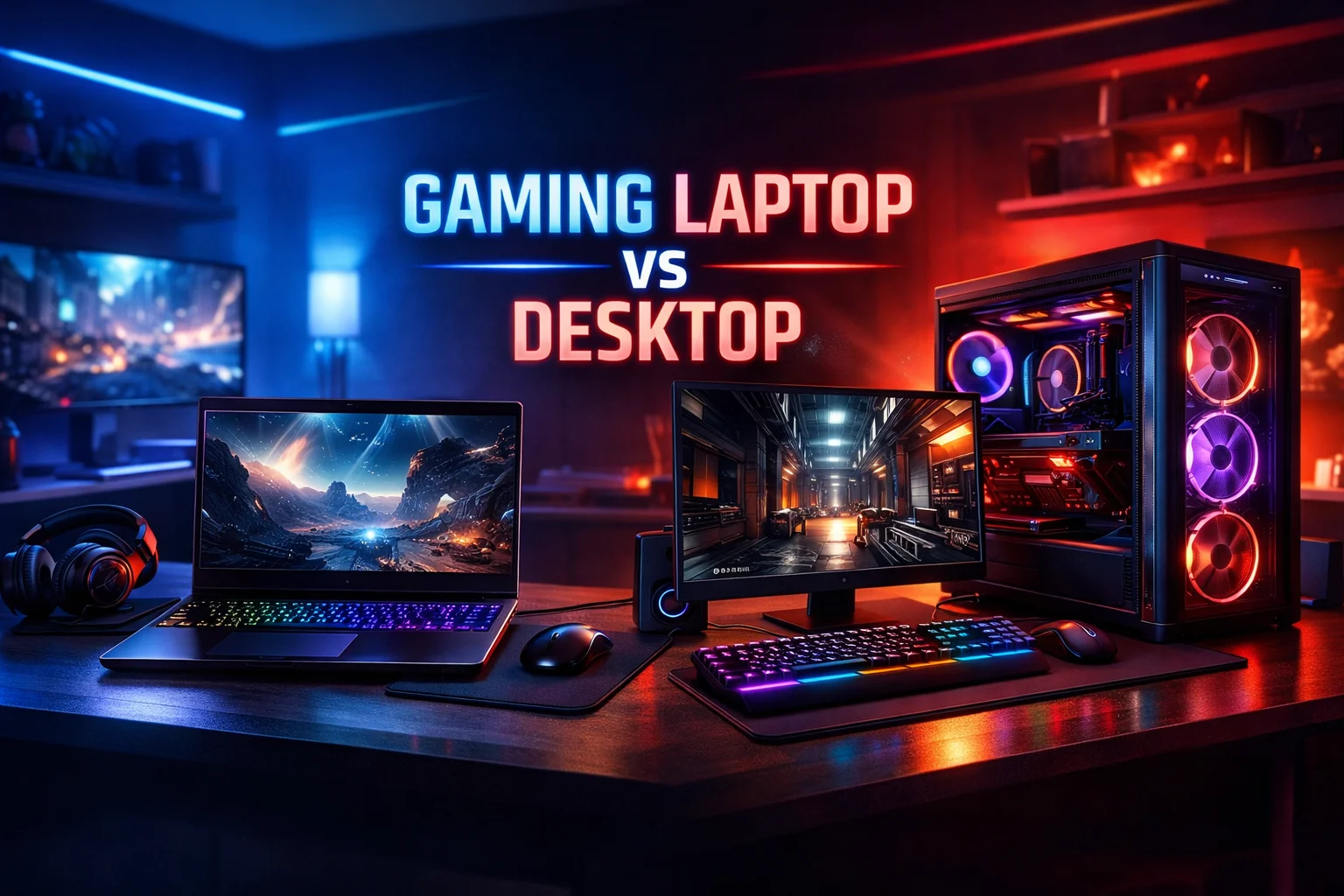
Gaming has transformed from a casual hobby to a serious industry with millions of players worldwide. Choosing the right gaming setup is crucial for both casual gamers and professionals. The age-old debate between gaming laptops and gaming desktops is more relevant than ever. While laptops promise portability, desktops are known for raw power and customization. This article dives deep into every aspect of gaming laptops and desktops to help you make an informed choice in 2026.
Gaming Laptop: Complete Guide (Best Gaming Laptop Under ₹50,000 & ₹30,000)
What is a Gaming Laptop?
A gaming laptop is a portable computer specifically designed for gaming. Unlike regular laptops, it houses dedicated GPUs, high-speed CPUs, and enhanced cooling systems to handle the demands of modern games. Gaming laptops are sleek, lightweight, and often come with gaming-specific features like RGB keyboards, high-refresh-rate displays, and advanced audio systems.
Key Features of Gaming Laptops
- Portability: The biggest advantage of gaming laptops is the ability to game anywhere. You can play in a cafe, hostel, or even on a train without carrying a bulky setup.
- Built-in Display & Keyboard: No need to buy extra accessories. Modern laptops have displays capable of 144Hz or more, combined with mechanical-like keyboards.
- Power Efficiency: Optimized components allow gaming laptops to perform well without consuming as much electricity as desktops.
- All-in-One Design: Everything is integrated—GPU, CPU, storage, display, battery, and cooling—making it convenient for those with limited space.
Gaming laptops are ideal for users who prioritize flexibility and mobility. However, this convenience comes at a cost—both in price and long-term performance.
Best Gaming Laptop Under ₹50,000 in India (2026) – Complete Buying Guide
What is a Gaming Desktop?
A gaming desktop is a stationary computer designed for maximum performance and customization. Unlike laptops, desktops can house full-sized GPUs, multiple cooling solutions, and large storage arrays. They also allow users to replace and upgrade individual components over time, making them a long-term investment.
Key Features of Gaming Desktops
- High Performance: Desktops can support high-end GPUs like NVIDIA RTX 4080 or AMD Radeon 7900 XT without worrying about thermal limitations.
- Customizability: Users can choose their CPU, GPU, RAM, storage, and even cooling solutions, tailoring the machine to their exact needs.
- Better Cooling: Larger chassis allow for airflow optimization, advanced fans, and liquid cooling solutions, ensuring stable performance.
- Immersive Experience: Desktops support larger monitors, mechanical keyboards, and multi-monitor setups, offering an immersive gaming experience.
For gamers who want the ultimate experience, desktops are unparalleled. They provide superior FPS, visual quality, and performance longevity compared to laptops.
Gaming Laptop vs Desktop: Quick Comparison
| Feature | Gaming Laptop | Gaming Desktop |
|---|---|---|
| Performance | Good but limited | Exceptional |
| Portability | High | Low |
| Upgradeability | Very limited | High |
| Price | Higher for same performance | More cost-effective |
| Cooling | Limited | Advanced |
| Lifespan | Medium | Long |
| Power Consumption | Low | High |
| Gaming Experience | Portable, smaller screens | Immersive, larger setups |
This comparison highlights the key differences and helps you decide based on your priorities.
What is a Gaming Laptop? Full Guide + Best Gaming Laptops 2026
Performance Comparison
Gaming Desktop Performance
Gaming desktops are the undisputed champions of performance. They can accommodate the most powerful CPUs and GPUs because of better cooling and space. High-end desktops can run AAA games at 4K resolution, with ultra settings and ray tracing enabled, all while maintaining smooth frame rates.
Desktops also allow for overclocking, further boosting performance. Whether it’s Call of Duty, Cyberpunk 2077, or Elden Ring, a gaming desktop ensures your experience is flawless even at max settings.
Gaming Laptop Performance
Gaming laptops have improved drastically in the last few years. Modern laptops now feature mobile versions of high-end GPUs and powerful CPUs. They can handle 1080p and 1440p gaming smoothly and are capable of running competitive esports titles like CS2, Valorant, and Fortnite at high frame rates.
However, gaming laptops are limited by thermal throttling. Prolonged gaming sessions can cause performance dips due to heat buildup. While laptops are capable machines, they cannot match the raw power of a desktop with the same price point.
Verdict:
Desktops dominate when it comes to raw performance, especially for high-end gaming and heavy multitasking.
Top 10 Gaming Laptops Under ₹50,000 (2026 Updated)
Price Comparison
Gaming Laptop Pricing
Gaming laptops are significantly more expensive than desktops with similar specifications. This is because manufacturers must pack high-performance components into a compact, portable design. For example, a ₹1,00,000 gaming laptop may only offer mid-range performance equivalent to a ₹70,000 desktop.
Additionally, laptops include integrated components like display, keyboard, and battery, which further increases the cost. In short, you pay a premium for portability.
Gaming Desktop Pricing
Desktops offer better performance per rupee. A desktop in the ₹70,000–₹80,000 range can outperform a ₹1,00,000 gaming laptop. You also have the flexibility to build your own PC, which can save thousands compared to prebuilt systems.
Another advantage is upgradeability: instead of replacing the whole system, you can upgrade individual parts as needed, spreading the cost over several years.
Verdict:
Desktops provide better value for money in terms of performance and longevity.
Portability: Laptop Wins Easily
If you prioritize mobility, gaming laptops are your best option. You can:
- Carry your laptop to college, work, or friends’ houses
- Game anywhere without worrying about space
- Avoid the hassle of cables and monitors
Desktops, on the other hand, are stationary. Moving a desktop requires disassembling multiple components, making portability virtually impossible.
Verdict:
For gamers who travel or need flexibility, laptops are unmatched.
Upgradeability
Gaming Desktop Upgrade Options
Desktops are highly upgradeable, making them future-proof. You can:
- Replace GPU with a newer model
- Upgrade CPU without changing other components
- Increase RAM or storage as required
- Add advanced cooling systems
- Switch to larger monitors
This ensures that a gaming desktop can last 7–8 years if maintained well.
Gaming Laptop Upgrade Limitations
Laptops offer minimal upgrade options. Usually, you can only:
- Add or replace RAM
- Upgrade the SSD
Most laptops have soldered CPUs and GPUs, meaning you cannot replace or upgrade them. This limits their lifespan and future potential.
Verdict:
Desktops are superior for gamers who want long-term flexibility.
High Performance Gaming Laptops (2026 Guide): Ultimate Buying Guide for Gamers
Cooling and Thermal Performance
Desktop Cooling
Gaming desktops can house large fans, liquid cooling systems, and airflow-optimized chassis. This prevents overheating and maintains consistent FPS, even during prolonged gaming sessions. Advanced desktops can sustain overclocked CPUs and GPUs without thermal throttling.
Laptop Cooling
Laptops have limited cooling space, and powerful components generate heat in a confined area. Prolonged gaming may lead to:
- FPS drops
- Throttled CPU/GPU performance
- Shortened component lifespan
Gaming laptops often require external cooling pads to manage temperatures, which is an added cost and inconvenience.
Verdict:
Desktops provide superior cooling, ensuring stable performance during intense gaming sessions.
Lifespan and Durability
Desktop Lifespan
Desktops are more durable and have a longer lifespan than laptops. You can replace components individually without discarding the entire system. With proper care, desktops can last 5–8 years, making them a great investment for serious gamers.
Laptop Lifespan
Gaming laptops typically last 3–5 years. Batteries degrade over time, and heat accumulation can reduce component efficiency. After 4–5 years, most gamers find laptops unable to run the latest games at high settings.
Verdict:
Desktops offer longer lifespan and better value over time.
Power Consumption
Gaming desktops consume more power because of high-wattage CPUs and GPUs, and often require UPS or surge protectors. This increases electricity costs. Laptops, being energy-efficient, consume less power and can even run on battery for light gaming sessions.
Verdict:
Laptops are better for energy-conscious users or those without consistent power supply.
Gaming Experience
Desktop Experience
- Larger monitors and multiple displays
- Mechanical keyboards with customizable keys
- High-end audio systems
- Immersive lighting and peripheral setups
Desktops deliver the best gaming immersion, whether for AAA titles or esports.
Laptop Experience
- Limited screen size
- Integrated keyboard and trackpad
- Less customizable audio and visuals
While gaming laptops provide excellent performance, the experience is not as immersive as a desktop.
Verdict:
For true gaming immersion, desktops win hands down.
Best Use Cases
When to Choose a Gaming Laptop
Gaming laptops are ideal if:
- You travel frequently or live in small spaces
- You are a student or professional on the move
- Portability is more important than raw performance
When to Choose a Gaming Desktop
Desktops are ideal if:
- Maximum performance is your priority
- You plan to play AAA titles at high settings
- You want the option to upgrade in the future
- Streaming or content creation is your goal
Pros and Cons
Gaming Laptop Pros
- Highly portable
- Compact and all-in-one design
- Low power consumption
- Can be used anywhere
Gaming Laptop Cons
- More expensive for similar performance
- Limited cooling and thermal management
- Minimal upgrade options
- Shorter lifespan
Gaming Desktop Pros
- Superior performance
- Better cooling and thermal stability
- Easy upgrades and maintenance
- Cost-effective for high-end builds
Gaming Desktop Cons
- Not portable
- Requires significant desk space
- Higher power consumption
Future of Gaming Devices in 2026
- Gaming laptops are getting more powerful with mobile GPUs and CPUs, but thermal constraints remain.
- Cloud gaming may reduce the need for extreme hardware on both laptops and desktops.
- AI-based gaming optimizations could improve performance on laptops.
However, desktops remain the gold standard for performance, upgradeability, and longevity.
Final Verdict: Gaming Laptop or Desktop?
- Choose Gaming Laptop if portability, flexibility, and convenience are your top priorities.
- Choose Gaming Desktop if performance, upgradeability, and immersive experience matter more.
Ultimately, your choice depends on lifestyle, budget, and gaming goals. Both have evolved immensely, but for 2026, desktops still lead in raw power and longevity, while laptops dominate in portability.
Frequently Asked Questions (FAQ) – Gaming Laptop vs Desktop
1. Which is better for gaming, a laptop or a desktop?
The answer depends on your priorities. Gaming desktops are better if you want raw performance, higher FPS, and long-term upgradability. They can run AAA titles at ultra settings and support 4K gaming, large monitors, and multi-screen setups. Gaming laptops, on the other hand, are portable and convenient for gaming on the go. They perform well for competitive games and casual AAA gaming at 1080p or 1440p, but thermal throttling and smaller components can limit peak performance. If performance is your top priority, desktops are ideal; if portability matters more, choose a laptop.
2. Are gaming laptops as powerful as desktops?
Not exactly. Gaming laptops have become much more powerful in recent years, with mobile versions of high-end GPUs and CPUs. However, laptops are limited by thermal constraints, battery capacity, and compact design. This means that even if a laptop has a GPU like an RTX 4070 Laptop GPU, it will still perform slightly lower than a desktop with the full RTX 4070 due to lower power limits. For casual gaming or esports titles like CS2, Fortnite, or Valorant, laptops perform excellently. But for 4K AAA gaming and heavy multitasking, desktops remain superior.
3. Can gaming laptops be upgraded?
Gaming laptops have very limited upgrade options. Most laptops allow you to upgrade RAM and storage (SSD/HDD), but components like CPU and GPU are usually soldered and cannot be changed. Some premium models offer external GPU (eGPU) support, but this adds cost and reduces portability. In contrast, desktops allow full upgradeability—you can replace the GPU, CPU, RAM, storage, cooling, and even add multiple monitors. If long-term upgrades are important, desktops clearly have the advantage.
4. How long do gaming laptops last?
The typical lifespan of a gaming laptop is 3–5 years, depending on usage, maintenance, and thermal management. Laptops often suffer from battery degradation and heating issues, which can reduce overall performance over time. Heavy AAA gaming or long gaming sessions can accelerate component wear. Desktops, on the other hand, can last 5–8 years or more if parts are replaced and upgraded. Laptops are best suited for users who prioritize portability over longevity.
5. Why are gaming laptops more expensive than desktops?
Gaming laptops cost more than desktops with similar specifications due to compact engineering and portability. Manufacturers pack high-performance components into a small chassis with integrated displays, keyboards, batteries, and cooling systems. This miniaturization increases production costs. Additionally, high-refresh-rate screens, RGB keyboards, and premium materials further raise the price. Desktops don’t require this compact design and often provide better performance per rupee, making them a more cost-effective choice.
6. Which setup is better for streaming and content creation?
For streaming and content creation, gaming desktops are the superior choice. Desktops can handle multi-tasking with ease, allowing you to game, stream, and run video editing software simultaneously. Large GPUs and CPUs support high-quality streaming at 1080p, 1440p, or even 4K resolutions. Laptops can also stream, but performance may be limited during extended sessions due to thermal throttling and power constraints. For professional streamers, desktops offer stability, upgradeability, and better cooling.
7. Are gaming desktops future-proof?
Yes. Gaming desktops are inherently more future-proof because components can be upgraded individually over time. You can replace your GPU, add more RAM, upgrade your storage, or even switch to a better CPU without discarding the whole system. This flexibility ensures desktops remain capable for many years. Laptops, in contrast, offer minimal upgrade paths and often require full replacement within a few years to stay current with the latest games.
8. Which is better for students or people who travel frequently?
Gaming laptops are ideal for students or frequent travelers. They are compact, portable, and all-in-one, allowing you to game anywhere—at college, cafes, or during trips. Laptops can double as productivity devices for study, office work, or content creation, making them versatile. Desktops are not portable and require a fixed setup, making them unsuitable for students or those who move frequently.
9. How do gaming laptops handle heat compared to desktops?
Gaming laptops have limited cooling space, and powerful components generate a lot of heat in a confined area. This can lead to thermal throttling, reduced performance, and shorter component lifespan if not managed properly. External cooling pads can help but are not as effective as the larger fans and liquid cooling solutions available in desktops. Gaming desktops provide better airflow, larger fans, and advanced cooling options, making them more reliable for long gaming sessions.
10. Is the gaming experience different between laptops and desktops?
Yes. Gaming desktops provide a more immersive experience with larger monitors, mechanical keyboards, high-quality audio systems, and customizable setups. Laptops, while portable and convenient, offer smaller screens, limited audio output, and compact keyboards. While modern gaming laptops can deliver excellent graphics and frame rates, the overall experience cannot fully match the setup options and immersion of a desktop. Desktops are preferred by competitive gamers and content creators for this reason.