Introduction
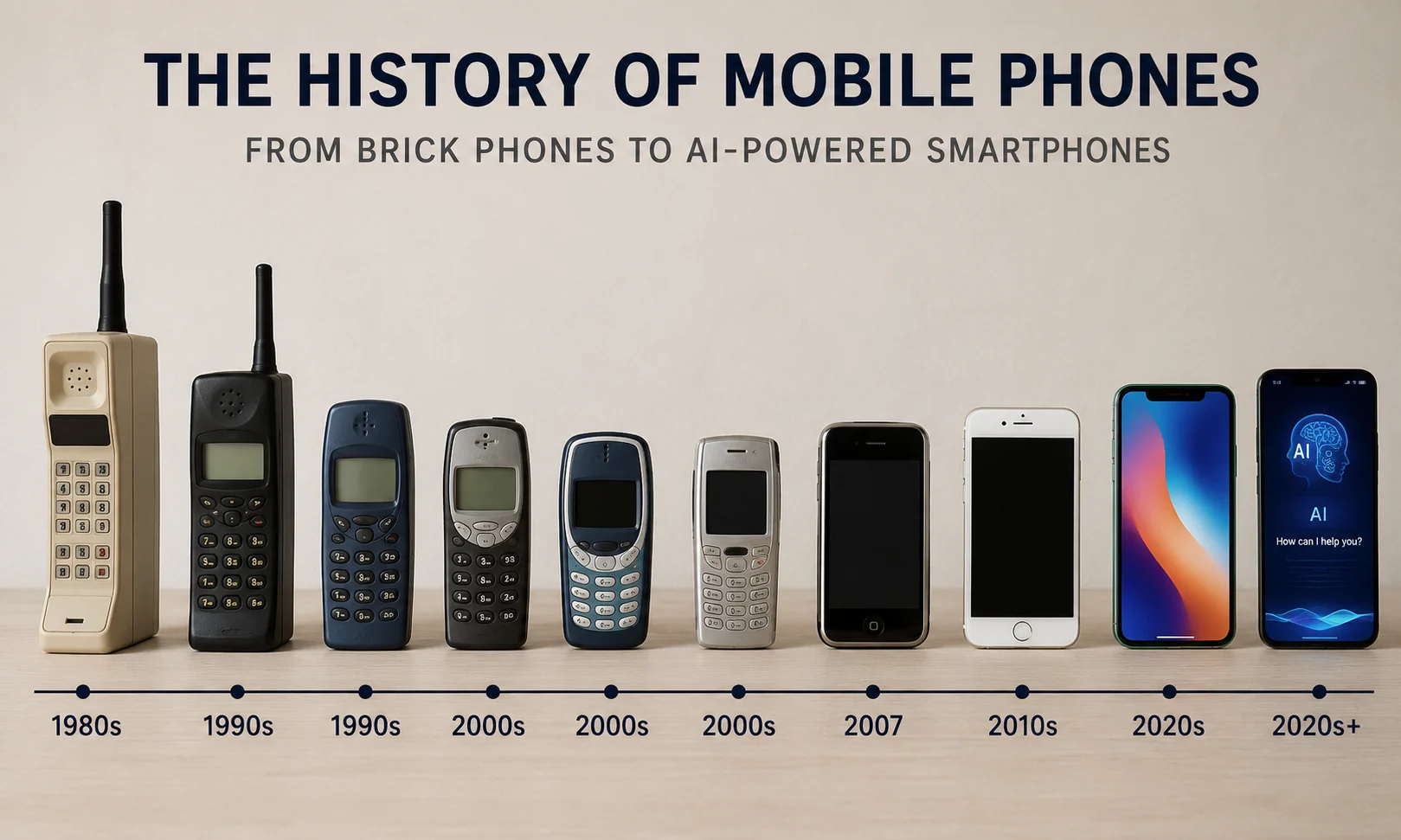
Hello readers, my name is Abhishek Gupta, and in this article, I will take you on a fascinating journey through the history of mobile phones. Mobile phones have become one of the most important inventions in modern human life. From simple communication devices used only for calling to today’s powerful AI-driven smartphones, mobile technology has evolved in extraordinary ways over the decades.
The history of mobile phones is not just about technology; it is also about innovation, human creativity, and the changing lifestyle of society. Earlier, people depended on letters, landline telephones, and telegrams to communicate over long distances. Today, a smartphone can perform thousands of tasks within seconds, including video calling, photography, gaming, online banking, social media, education, and business management.
The journey of mobile phones began with bulky and expensive devices often called “brick phones.” These early mobile phones had very limited battery life and basic calling features. However, with continuous advancements in wireless communication, mobile networks, processors, batteries, cameras, and software, smartphones have now become compact supercomputers that fit inside our pockets.
Modern smartphones are powered by advanced technologies such as artificial intelligence, 5G connectivity, cloud computing, and high-resolution cameras. They have completely transformed the way people communicate, work, study, shop, travel, and entertain themselves. Mobile phones are now deeply connected to everyday life and continue shaping the future of humanity.
In this detailed article, we will explore the complete history of mobile phones, including their invention, evolution, major technological advancements, smartphone revolution, mobile internet growth, and the future of mobile technology.
Mobile phones are among the greatest technological inventions in human history. Over the last few decades, they have transformed from simple communication devices into powerful smart machines that can perform tasks once possible only on computers. Today, smartphones are used for calling, messaging, photography, gaming, education, banking, shopping, navigation, social networking, and even artificial intelligence-based assistance.
The journey of mobile phones reflects the rapid progress of science and technology. Every generation of mobile phones introduced revolutionary changes that shaped how people communicate and interact with the world. From large and heavy devices with limited features to ultra-thin foldable smartphones with advanced AI capabilities, mobile phones have evolved dramatically.
Modern smartphones have become an essential part of everyday life. People depend on them for work, entertainment, business, learning, and staying connected with family and friends. In many ways, smartphones have become digital companions that help users manage almost every aspect of their daily routines.
The history of mobile phones is not only about technology but also about changing lifestyles, social behavior, and global connectivity. Mobile communication has broken geographical barriers and made instant communication possible from almost anywhere on Earth.
In this detailed article, we will explore the complete history of mobile phones, their invention, technological evolution, famous devices, network advancements, smartphone revolution, and the future of mobile technology.
Table of Contents
- Introduction
- Early Communication Before Mobile Phones
- The Invention of the First Mobile Phone
- The First Generation (1G) Mobile Phones
- Analog Technology
- Limited Battery Life
- High Costs
- Poor Security
- Limited Network Coverage
- The Rise of 2G Technology
- Better Voice Quality
- Improved Security
- Smaller Devices
- Longer Battery Life
- Introduction of SMS
- SMS and Text Messaging Revolution
- The Era of Flip Phones and Compact Designs
- Nokia 3310
- Motorola Razr
- Sony Ericsson Walkman Series
- BlackBerry Devices
- The Introduction of 3G Networks
- Video Calling
- Faster Internet
- Multimedia Messaging
- Music and Video Streaming
- Mobile Email
- Birth of Smartphones
- The Impact of Apple iPhone
- Multi-Touch Technology
- App Ecosystem
- Modern Web Browsing
- Elegant Design
- Android and the Smartphone Explosion
- The Rise of Mobile Internet
- Evolution of Mobile Phone Cameras
- Multiple Camera Lenses
- AI Photography
- Night Mode
- High-Resolution Video
- Portrait Photography
- Social Media and Mobile Phones
- Mobile Gaming Revolution
- Foldable Phones and Modern Innovations
- Artificial Intelligence in Smartphones
- 5G Technology and Future Connectivity
- Faster Internet Speeds
- Lower Latency
- Better Connectivity
- Support for Future Technologies
- The Impact of Mobile Phones on Society
- Positive Effects
- Negative Effects
- The Future of Mobile Phones
- Conclusion
Early Communication Before Mobile Phones
Before mobile phones existed, long-distance communication was much slower and less convenient. People mainly depended on letters, telegrams, and wired landline telephones. Communication systems during the early 20th century were limited because people could only make calls from fixed locations such as homes, offices, or telephone booths.
The invention of the traditional telephone by Alexander Graham Bell changed communication forever, but telephones still required wires and physical infrastructure. People could not carry phones while traveling or moving from one place to another.
During World War II, wireless radio communication technology advanced rapidly. Military forces used radio systems to communicate over long distances without physical wires. These radio systems inspired engineers to imagine portable communication devices for civilians.
By the 1940s and 1950s, scientists and engineers started developing mobile radio telephones that could be installed inside vehicles. These systems were mainly used by police departments, taxis, and emergency services. However, they were very expensive, large, and limited in functionality.
The concept of a truly portable handheld mobile phone still seemed impossible for ordinary people at that time. Engineers faced many technical challenges, including battery limitations, signal transmission issues, and hardware size constraints.
Despite these challenges, technological research continued for decades. Scientists worked tirelessly to improve wireless communication systems, and eventually, these experiments led to the birth of the modern mobile phone industry.
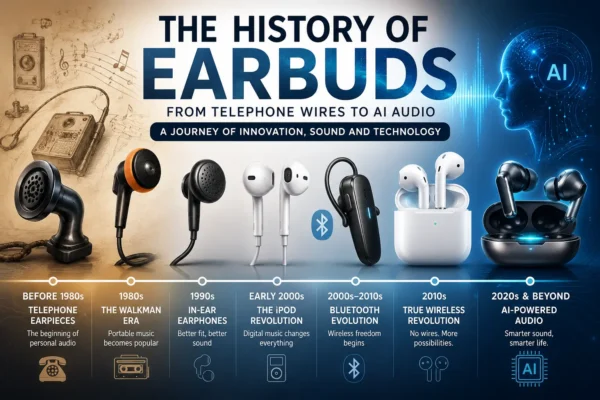
The History of Earbuds: From Telephone Wires to AI Audio
The Invention of the First Mobile Phone
The invention of the first mobile phone marked a revolutionary moment in communication history. The person most widely credited with inventing the handheld mobile phone is Martin Cooper, an engineer working at Motorola.
On April 3, 1973, Martin Cooper made the first public handheld mobile phone call using a prototype device known as the Motorola DynaTAC. This historic call demonstrated that wireless personal communication was possible without being connected to a vehicle or fixed location.
The prototype device was very different from modern smartphones. It weighed almost one kilogram and was extremely large compared to today’s slim devices. The battery provided only about 30 minutes of talk time and required several hours of charging.
Interestingly, Martin Cooper made the first phone call to a competitor working at Bell Labs. This moment became one of the most important milestones in telecommunications history.
Although the first mobile phone prototype was created in the 1970s, commercial mobile phones did not become available immediately. Companies needed years to improve network infrastructure, battery technology, and manufacturing capabilities before mobile phones could reach consumers.
The invention of the mobile phone changed the future of communication forever. It opened the door for portable communication technology that would later evolve into smartphones, mobile internet, and global digital connectivity.
The First Generation (1G) Mobile Phones
The first generation of mobile phones, known as 1G, appeared during the 1980s. These phones used analog communication technology and represented the beginning of commercial mobile communication systems.
1G networks allowed users to make wireless voice calls for the first time. Although the technology was revolutionary, early mobile phones had many limitations compared to modern devices.
The first commercially available mobile phone was the Motorola DynaTAC 8000X, released in 1983. It became a symbol of wealth and business success because of its extremely high price. Only wealthy professionals and business executives could afford such devices.
1G phones were often called “brick phones” because they were very large, heavy, and bulky. Carrying them was inconvenient, and their batteries lasted only for short periods.
Characteristics of 1G Phones
Analog Technology
1G networks transmitted analog signals, which meant call quality was often poor and connections were unstable.
Limited Battery Life
Battery technology during the 1980s was not advanced enough to support long conversations. Most phones required frequent charging.
High Costs
Both the devices and call charges were extremely expensive. Mobile phones were considered luxury items rather than everyday necessities.
Poor Security
Analog networks lacked strong encryption, making conversations vulnerable to eavesdropping.
Limited Network Coverage
Network towers were available only in selected urban areas, so coverage was inconsistent.
Despite these disadvantages, 1G technology introduced a completely new way of communicating. For the first time in history, people could communicate wirelessly while moving from place to place.
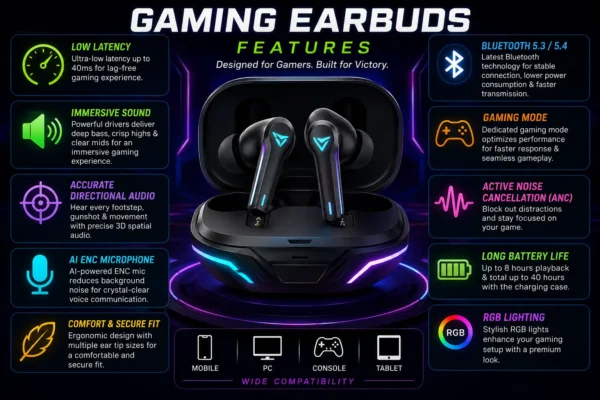
Best Gaming Earbuds in 2026 – Complete Guide for Mobile, PC & Esports Gamers
The Rise of 2G Technology
The 1990s brought major advancements with the introduction of second-generation or 2G mobile networks. Unlike the analog systems used in 1G technology, 2G networks used digital communication technology.
This transition from analog to digital dramatically improved mobile communication quality, security, and efficiency.
The GSM (Global System for Mobile Communications) standard became widely adopted across many countries. This helped mobile phones become more compatible and reliable globally.
During the 2G era, mobile phones became smaller, lighter, more stylish, and more affordable. As prices dropped, millions of ordinary consumers started purchasing mobile phones.
Several companies became dominant players during this period, including:
- Nokia
- Motorola
- Samsung Electronics
- Sony Ericsson
The competition between these companies led to rapid innovation in phone design and features.
Major Improvements Introduced by 2G
Better Voice Quality
Digital signals improved audio clarity and reduced noise during calls.
Improved Security
Digital encryption made phone conversations safer and more private.
Smaller Devices
Phones became compact and portable, making them easier to carry.
Longer Battery Life
Improved batteries allowed users to talk for longer periods.
Introduction of SMS
Text messaging became one of the most popular communication methods worldwide.
The 2G era played a major role in turning mobile phones from luxury devices into mainstream consumer products.
SMS and Text Messaging Revolution
One of the most important developments during the 2G era was SMS (Short Message Service), commonly known as text messaging.
The first SMS message was sent in 1992, and it simply read “Merry Christmas.” Although simple, this innovation completely transformed communication culture worldwide.
Text messaging became extremely popular because it was fast, affordable, and convenient. People could communicate silently without making phone calls, which was especially useful in schools, offices, and public places.
Young people quickly adopted texting culture. New abbreviations and shorthand language became common, including phrases like:
- LOL
- BRB
- OMG
- ASAP
Mobile users also became interested in personalization features such as:
- Custom ringtones
- Wallpapers
- SMS packs
- Mobile chat services
SMS technology helped mobile operators earn huge revenues, and texting soon became one of the most widely used communication methods globally.
The popularity of SMS also laid the foundation for modern messaging applications such as WhatsApp and Telegram.
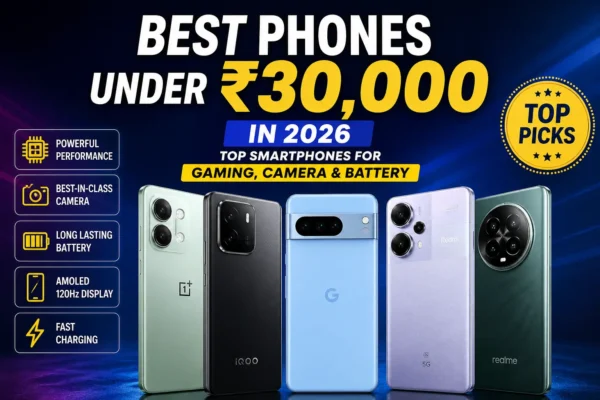
Best Phones Under ₹30,000 in 2026 – Complete Buying Guide
The Era of Flip Phones and Compact Designs
As competition among manufacturers increased, companies focused heavily on phone design and style. During the late 1990s and early 2000s, flip phones, slider phones, and ultra-compact devices became extremely popular.
Consumers wanted phones that were not only functional but also fashionable.
Flip phones became iconic because of their stylish appearance and compact design. Many movies and television shows helped make flip phones a symbol of modern technology and fashion.
Popular Phones of This Era
Nokia 3310
The Nokia 3310 became legendary for its durability, long battery life, and classic Snake game.
Motorola Razr
The Motorola Razr became one of the most successful flip phones ever created because of its slim metallic design.
Sony Ericsson Walkman Series
These phones combined music playback with communication features and became highly popular among music lovers.
BlackBerry Devices
BlackBerry phones became popular among business users because of their email capabilities and physical keyboards.
During this period, mobile phones became part of personal identity and fashion culture.
The Introduction of 3G Networks
The launch of 3G networks in the early 2000s changed mobile communication forever by introducing high-speed mobile internet access.
Before 3G, internet usage on mobile phones was slow and limited. 3G technology allowed users to browse websites, send emails, stream media, and use online applications much more effectively.
Features Introduced by 3G
Video Calling
Users could make face-to-face video calls for the first time.
Faster Internet
Web browsing became smoother and more practical.
Multimedia Messaging
People could send images, videos, and audio files.
Music and Video Streaming
Streaming entertainment services became more accessible.
Mobile Email
Professionals could manage emails while traveling.
The 3G era marked the beginning of smartphones becoming entertainment and productivity devices instead of just communication tools.
Birth of Smartphones
Smartphones represented the next major step in mobile phone evolution. Unlike traditional mobile phones, smartphones combined communication features with advanced computing capabilities.
Early smartphones included:
- Internet browsing
- Email access
- Digital calendars
- Touchscreens
- Multimedia playback
- Productivity applications
Business professionals quickly adopted smartphones because they improved work efficiency and communication.
BlackBerry became one of the most influential smartphone brands during this era. BlackBerry phones were especially popular among corporate users and government organizations.
Meanwhile, companies like Palm and Nokia also introduced advanced smart devices.
These early smartphones laid the foundation for the modern smartphone industry.
The Impact of Apple iPhone
In 2007, Apple introduced the revolutionary iPhone, which completely transformed the mobile industry.
The iPhone introduced a large touchscreen interface without a physical keyboard. Its user-friendly design and smooth software experience set new standards for smartphones.
Revolutionary Features of the iPhone
Multi-Touch Technology
Users could control the device using gestures such as pinch-to-zoom.
App Ecosystem
The App Store allowed developers to create applications for millions of users.
Modern Web Browsing
The iPhone provided a desktop-like internet browsing experience.
Elegant Design
Apple focused heavily on premium design and user experience.
The success of the iPhone forced competitors to redesign their phones and focus more on touchscreens and software quality.
The iPhone era marked the beginning of the modern smartphone revolution.
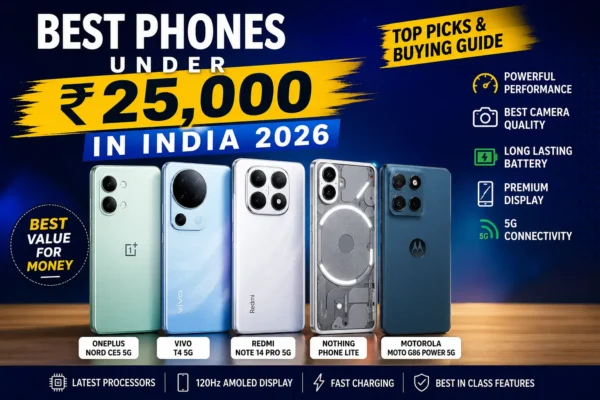
Best Phones Under ₹25,000 in India (2026) – Ultimate Buying Guide
Android and the Smartphone Explosion
After the success of the iPhone, Google launched the Android operating system.
Android became extremely successful because it was open-source and available to many smartphone manufacturers.
Major Android brands included:
- Samsung Electronics
- Xiaomi
- OnePlus
- Vivo
- Oppo
Android phones became available in budget, mid-range, and premium categories, helping billions of people access smartphone technology.
This period saw explosive growth in mobile app development, social media, and digital services.
The Rise of Mobile Internet
The rapid spread of 3G, 4G, and Wi-Fi transformed smartphones into powerful internet devices.
Mobile internet changed how people:
- Learn
- Shop
- Watch entertainment
- Work remotely
- Use banking services
- Access information
Applications such as:
- YouTube
- TikTok
became global platforms largely because of smartphones.
Mobile internet also helped digital businesses grow rapidly worldwide.
Evolution of Mobile Phone Cameras
Camera technology has become one of the most competitive areas in the smartphone industry.
Early mobile phone cameras produced very basic images with low resolution. Today, smartphones include advanced photography systems capable of professional-quality results.
Camera Innovations
Multiple Camera Lenses
Phones now include wide, ultra-wide, telephoto, and macro lenses.
AI Photography
Artificial intelligence improves image quality automatically.
Night Mode
Users can capture detailed images in low-light conditions.
High-Resolution Video
Modern phones support 4K and even 8K recording.
Portrait Photography
Advanced software creates DSLR-like background blur effects.
Companies such as Apple, Samsung Electronics, and Huawei pushed smartphone photography to incredible levels.
Social Media and Mobile Phones
Social media platforms became deeply connected with smartphone growth.
Smartphones allowed users to:
- Share photos instantly
- Upload videos
- Go live online
- Create content
- Build personal brands
- Start digital businesses
Influencer culture and content creation became massive industries because of mobile phones.
Social media platforms changed politics, marketing, entertainment, and communication worldwide.
Mobile Gaming Revolution
Mobile gaming has evolved into a multi-billion-dollar industry.
Early mobile games were simple and limited, but modern smartphones can run advanced high-graphics games.
Popular mobile games include:
- PUBG Mobile
- Call of Duty: Mobile
- Free Fire
Gaming smartphones now feature:
- Powerful processors
- High refresh rate displays
- Cooling systems
- Large batteries
- Fast charging
Mobile gaming continues growing rapidly every year.
Foldable Phones and Modern Innovations
The smartphone industry continues introducing innovative technologies.
Foldable smartphones represent one of the biggest recent innovations.
Companies such as:
- Samsung Electronics
- Huawei
- Motorola
have developed foldable devices that combine smartphone portability with tablet-sized displays.
Modern smartphones also include:
- Wireless charging
- Water resistance
- Face recognition
- Under-display fingerprint sensors
- Satellite communication
- Ultra-fast charging
Technology is evolving faster than ever before.
Artificial Intelligence in Smartphones
Artificial intelligence has become a major part of modern smartphones.
AI technology improves:
- Photography
- Battery management
- Security
- Voice recognition
- Smart assistants
- Translation services
Virtual assistants such as:
- Google Assistant
- Siri
- Bixby
help users perform tasks using voice commands.
AI-powered smartphones are becoming smarter, faster, and more personalized every year.
5G Technology and Future Connectivity
5G is the latest generation of mobile network technology and offers major improvements over previous generations.
Advantages of 5G
Faster Internet Speeds
Downloads and streaming are significantly faster.
Lower Latency
Gaming and real-time communication become smoother.
Better Connectivity
More devices can connect simultaneously.
Support for Future Technologies
5G enables smart cities, IoT devices, cloud gaming, and autonomous vehicles.
Countries worldwide are rapidly expanding 5G infrastructure to support future technological growth.
The Impact of Mobile Phones on Society
Mobile phones have changed society in countless ways.
Positive Effects
Improved Communication
People can connect instantly from anywhere in the world.
Better Access to Information
Users can access educational content and news anytime.
Business Opportunities
Mobile phones support digital businesses and remote work.
Emergency Services
Phones improve disaster communication and safety.
Entertainment
Movies, music, and games are available everywhere.
Negative Effects
Addiction
Excessive smartphone usage can affect mental health.
Privacy Risks
Data collection and online tracking raise concerns.
Reduced Social Interaction
People may spend less time communicating face-to-face.
Cybercrime
Fraud, hacking, and scams are growing threats.
Despite challenges, mobile phones remain essential tools in modern life.
The Future of Mobile Phones
The future of mobile phones looks incredibly advanced and exciting.
Future innovations may include:
- Fully AI-driven smartphones
- Holographic displays
- Rollable screens
- Brain-controlled interfaces
- Advanced augmented reality
- Longer-lasting batteries
- Faster wireless charging
Companies are also focusing on environmentally friendly production methods and recyclable materials.
Future smartphones may become even more intelligent and deeply integrated into daily human life.
Conclusion
The history of mobile phones is one of the most fascinating stories in technological evolution. From bulky analog devices to modern AI-powered smartphones, mobile phones have transformed communication and reshaped society.
They have changed how people work, learn, entertain themselves, and connect with others. Smartphones are now central to modern life and continue evolving rapidly with innovations in artificial intelligence, camera systems, foldable displays, and 5G technology.
As technology advances further, mobile phones will continue influencing the future of humanity in ways we can only begin to imagine.
FAQs
The first handheld mobile phone was invented by Martin Cooper, an engineer working for Motorola. On April 3, 1973, Martin Cooper made the first public mobile phone call using a prototype device called the Motorola DynaTAC. This moment became one of the most important milestones in communication history because it proved that people could communicate wirelessly while moving from one place to another.
Before mobile phones, communication mainly depended on landline telephones, which required wires and fixed locations. People could only make calls from homes, offices, or public telephone booths. Mobile phone technology completely changed this system by introducing portable communication.
The first mobile phones were very different from modern smartphones. They were large, heavy, expensive, and had very limited battery life. Despite these limitations, they represented a revolutionary technological breakthrough. Business professionals were among the first people to use mobile phones because they needed communication while traveling.
Over time, mobile phone technology improved rapidly. Devices became smaller, more affordable, and more powerful. Mobile networks evolved from 1G analog systems to modern 5G technology. Smartphones eventually replaced traditional phones and became multifunctional devices capable of internet browsing, photography, gaming, social media, online banking, and artificial intelligence features.
Today, mobile phones are used by billions of people worldwide and have transformed communication, business, education, healthcare, entertainment, and social interaction. The invention of the mobile phone changed human life forever and continues to influence modern society every day.
Mobile network generations represent different stages of wireless communication technology development. Each generation introduced major improvements in speed, quality, internet connectivity, and overall user experience.
1G was the first generation of mobile networks introduced during the 1980s. It used analog technology for voice communication. Calls on 1G networks often had poor sound quality, weak security, and limited coverage. Mobile phones during this era were large and expensive.
2G technology arrived during the 1990s and introduced digital communication. This improved call quality, battery efficiency, and network security. One of the most important features introduced by 2G was SMS text messaging, which became extremely popular worldwide. Phones also became smaller and more affordable during this period.
3G technology launched in the early 2000s and brought mobile internet into mainstream use. Users could browse websites, send emails, stream music, and make video calls. 3G significantly improved internet speeds compared to older networks.
4G networks introduced much faster internet speeds and transformed smartphones into powerful multimedia devices. People could stream HD videos, play online games, use social media smoothly, and access cloud services efficiently. Applications such as YouTube and Instagram became more popular because of 4G connectivity.
5G is the latest generation of mobile technology. It offers ultra-fast internet speeds, lower latency, better gaming performance, and improved support for smart devices. 5G technology is expected to power future innovations such as smart cities, autonomous vehicles, cloud gaming, and advanced artificial intelligence systems.
Each generation of mobile technology has played an important role in shaping modern communication and digital lifestyles.
Smartphones became more popular than traditional mobile phones because they combined communication, computing, entertainment, and internet functionality into a single portable device. Traditional mobile phones were mainly designed for calling and texting, while smartphones introduced advanced features that transformed user experiences.
One major reason for smartphone popularity was internet access. Smartphones allowed users to browse websites, use search engines, watch videos, access social media platforms, and download applications. This made smartphones much more useful than ordinary feature phones.
The launch of the iPhone by Apple in 2007 changed the smartphone industry dramatically. The iPhone introduced a modern touchscreen interface, smooth software experience, and application ecosystem. Soon after, Google launched Android, which helped many manufacturers create affordable smartphones.
Smartphones also replaced many separate devices. People no longer needed cameras, music players, GPS devices, calculators, or even laptops for basic tasks because smartphones could perform all these functions. Mobile applications made smartphones even more powerful by offering services for banking, shopping, gaming, education, and productivity.
Social media growth also increased smartphone demand. Applications such as Facebook, WhatsApp, and TikTok became part of daily life for millions of people.
Another important factor was improving hardware technology. Smartphone cameras, processors, batteries, and displays became much more advanced over time. Manufacturers introduced better designs, faster charging, and artificial intelligence features.
Today, smartphones are essential tools for communication, business, education, entertainment, and digital services, making them far more popular than traditional mobile phones.
Mobile phones have had a massive impact on human society and daily life. They have transformed communication, business, education, healthcare, entertainment, and social interaction in ways that were unimaginable a few decades ago.
One of the biggest changes introduced by mobile phones is instant communication. People can now contact family, friends, and colleagues from almost anywhere in the world within seconds. Video calling applications allow face-to-face conversations even across different countries.
Mobile phones have also improved access to information. Students can use smartphones for online learning, research, and educational videos. Teachers can conduct virtual classes, and learners can study from home using mobile applications and digital platforms.
Businesses have benefited greatly from smartphones. Entrepreneurs can manage online stores, communicate with customers, process digital payments, and promote products through social media. Remote work has become easier because employees can access work tools and meetings directly from their phones.
Healthcare services have also improved because of mobile technology. People can book doctor appointments, access health information, and use fitness tracking applications. During emergencies, mobile phones help people contact emergency services quickly.
Entertainment has completely changed because of smartphones. Users can stream movies, listen to music, play games, and create digital content anytime. Social media platforms have created new career opportunities for influencers, content creators, and online businesses.
However, mobile phones also created some challenges. Excessive smartphone usage can lead to addiction, reduced physical activity, and mental health issues. Privacy concerns and cybercrime have also increased due to online activities and data collection.
Despite these disadvantages, mobile phones remain one of the most powerful inventions in modern history. They continue improving human connectivity and shaping the future of society.
The future of mobile phones looks extremely advanced and exciting as companies continue developing innovative technologies every year. Smartphones are expected to become smarter, faster, and more deeply integrated into human life.
One of the biggest future trends is artificial intelligence. AI-powered smartphones will become more personalized and capable of understanding user behavior. Virtual assistants such as Google Assistant and Siri will become more intelligent and useful in everyday tasks.
Foldable and rollable display technology is also expected to improve significantly. Future devices may offer larger screens while remaining compact and portable. Companies are investing heavily in flexible display materials and innovative designs.
Battery technology is another important area of development. Future smartphones may support ultra-fast charging and much longer battery life. Wireless charging technology is also expected to become more efficient and convenient.
5G technology will continue expanding globally and support advanced applications such as augmented reality, cloud gaming, smart cities, and autonomous transportation systems. Future 6G networks may provide even faster communication speeds and advanced connectivity.
Smartphone cameras are also expected to become more powerful with better zoom capabilities, AI enhancements, and professional-level video recording features. Mobile photography may continue replacing traditional cameras for most users.
Future smartphones may also include holographic displays, advanced biometric security, and brain-computer interaction systems. Some experts believe smartphones could eventually merge with wearable devices such as smart glasses or augmented reality systems.
Environmental sustainability is becoming increasingly important as well. Smartphone companies are focusing on recyclable materials, energy-efficient components, and eco-friendly manufacturing processes.
The future of mobile phones will likely continue transforming communication, business, entertainment, and everyday life in extraordinary ways.
[…] The History of Mobile Phones: From Brick Phones to AI-Powered Smartphones […]
[…] The History of Mobile Phones: From Brick Phones to AI-Powered Smartphones […]
[…] The History of Mobile Phones: From Brick Phones to AI-Powered Smartphones […]